Munich, 2 October 2026 · Nexuswelt Group
Technology sovereignty spent several years as a phrase in speeches. During 2026 it became something more consequential for anyone seeking European funding: a set of legislative proposals, a defined list of priority technologies, and a logic that increasingly shapes which topics are funded and who may participate in them.
This article covers what changed, which technologies the framework names, how the logic reaches individual call topics, and – because it is a contested policy rather than a settled one – where the argument genuinely runs both ways.
What changed in June 2026
On 3 June 2026 the Commission presented the European Technological Sovereignty Package, described by the Commission itself as a major shift in its approach to technology. The framing matters as much as the content: digital dependence is no longer treated as a market inefficiency to be tolerated, but as a strategic vulnerability to be corrected through legislation.
The figure behind that shift is the one to remember. The EU relies on non-EU countries for over 80% of key digital products, services, infrastructure and intellectual property.
| Component | What it does |
| Chips Act 2.0 | A legislative proposal to build capacity in cutting-edge semiconductor technologies, boost supply and demand, support investment, speed up permits and address the skills shortage. It follows the original Chips Act, which set a target of doubling Europe’s share of global semiconductor production to 20% by 2030 |
| Cloud and AI Development Act (CADA) | A legislative proposal supporting research and innovation in cutting-edge and sustainable technologies, streamlining conditions for deploying data centres across the EU, and introducing a single EU-wide framework to assess cloud and AI sovereignty |
| EU Open Source Strategy | A strategic framework to scale up open source alternatives in priority areas, invest in skills, startups and digital infrastructure, and increase open source use in public administrations |
| Strategic Roadmap for Digitalisation and AI in Energy | A framework to integrate data centres into the energy system and accelerate digitalisation of the energy sector |
Two of the four are legislative proposals and two are strategic frameworks – a distinction worth holding, because the legislative components will change over the course of negotiation while the frameworks shape funding priorities more immediately.
The three technology families that now define priority
The Commission’s communication names three groups as essential to European competitiveness and technological sovereignty. If your work sits inside one of them, the funding environment is moving toward you rather than away.
| Family | What it includes |
| Advanced digital technologies and infrastructure | AI, including AI Gigafactories and AI scale-ups; quantum technologies; semiconductors; cloud; 6G; robotics |
| Biotechnology | Biomanufacturing, drug discovery, and synthetic production of construction materials |
| Clean energy technologies | Batteries, motors and power electronics, and small modular reactors |
This list is not a call topic and it will not appear in a work programme. It is upstream of both – it is the language in which the next generation of topics is being written, which is why reading it now is worth more than reading it when the topics appear.
How the logic reaches actual funding
Sovereignty is not a programme you apply to. It is a criterion that has been threaded through several instruments, and it arrives in different forms.
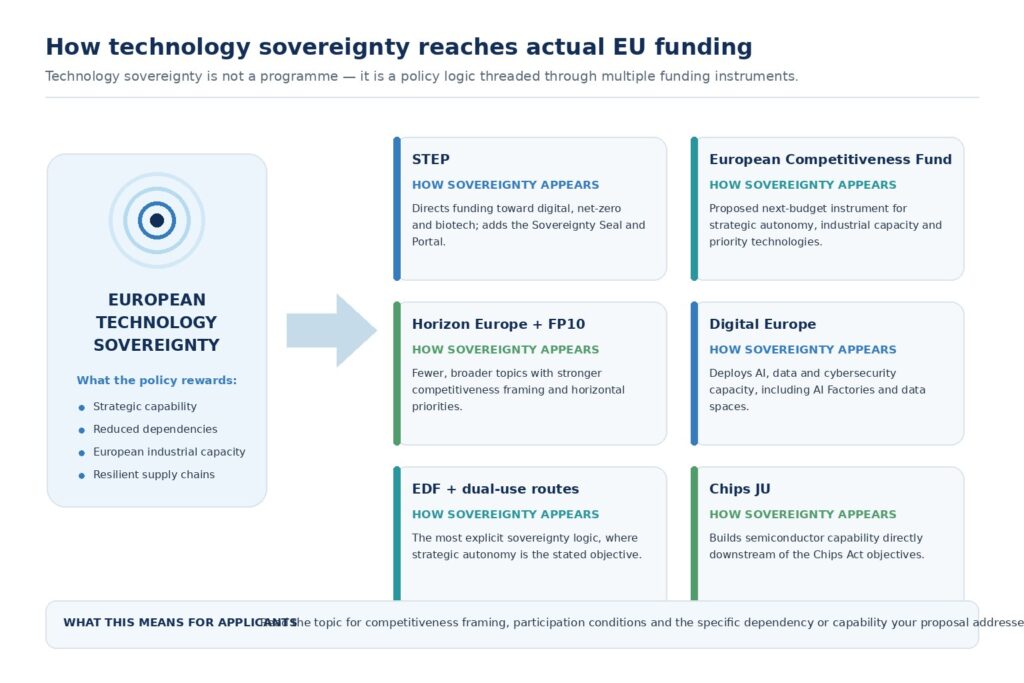
The policy logic is already visible in programme design. In Digital Europe, it appears through AI Factories and data spaces; in Horizon Europe, through broader and more horizontal calls built around shared strategic priorities. For AI startups, see our guide comparing AI funding programmes across Horizon Europe, Digital Europe and Chips JU.
The other edge: participation restrictions
Sovereignty policy has a side that funding guides mention briefly and companies discover late. Individual calls may restrict participation to protect the EU’s strategic assets, interests, autonomy or security.
Three practical points:
- The restriction is stated in the call or topic text, not in a country list. Association status tells you whether you are eligible in general; the topic tells you whether you are eligible for that topic.
- It can apply to entities established in the EU as well, where they are controlled directly or indirectly from an ineligible country. Ownership structure, not address, is what is assessed.
- For associated countries – Canada, South Korea, Ukraine and others – these restrictions are the main practical limit on participation, and they are topic-specific rather than blanket.
If you are a company with non-European ownership, or a consortium including one, resolving this before investing in a proposal is considerably cheaper than resolving it afterwards.
What this means for how you write proposals
The translation from policy to proposal is more concrete than it first appears.
- Name the dependency you reduce. If your technology substitutes for a non-European supply, capability or infrastructure layer, say so specifically – which dependency, at what point in the chain, to what extent.
- Argue capability, not only novelty. Sovereignty framing rewards the ability to build and operate something in Europe, which is a different claim from scientific advance and needs separate evidence.
- Locate yourself in a named family. If your work is in one of the three groups, use their vocabulary rather than your own field’s synonyms.
- Treat supply chain as part of the impact argument. Where the inputs come from, and whether the result can be produced at scale in Europe, is now a relevant question rather than an operational detail.
- Check the topic for participation conditions before writing, especially with international partners.
- Do not overclaim. A proposal asserting sovereignty relevance without a mechanism reads exactly like the generic impact claims evaluators discount – the same failure in newer vocabulary.
If you are outside the EU
The sovereignty agenda and the association agenda are not in contradiction, and it is easy to read them as though they were.
Association to Horizon Europe has continued to expand – Canada and South Korea joined in recent years, and Ukraine is fully associated – while the sovereignty framework has strengthened. The two coexist because the framework distinguishes between partners and dependencies. Collaboration with like-minded countries is treated as a way of reducing dependency rather than creating it.
What this means practically for an organisation in an associated country: general eligibility is not under threat, topic-specific restrictions are, and the areas where restrictions cluster are the most strategically sensitive ones – which are often the same areas where the funding is growing. Read the topic text, and read it early.
Where the argument genuinely runs both ways
This is contested policy, and a guide that presented it as settled would be doing readers a disservice. The main lines of disagreement:
| The case for | The case against |
| Dependence on external suppliers for critical infrastructure is a genuine vulnerability, demonstrated repeatedly in recent years | Restricting participation reduces the pool of expertise available to European projects and can slow the research it is meant to accelerate |
| Public investment at scale is how semiconductor and clean-tech capability was built elsewhere, and Europe has been comparatively slow | Targets set politically rather than commercially can direct investment toward capacity the market does not need |
| Setting standards early is a durable form of influence, and requires domestic capability to set them from | Sovereignty language can be used to justify protection of incumbents under a strategic label |
| Open source and interoperability commitments in the package mitigate the closure risk | The distinction between reducing dependency and excluding competition is easier to state than to administer |
For a company deciding where to invest effort, the disagreement matters less than the direction: whichever way the argument settles, the instruments and the vocabulary are in place now and will shape the next several years of funding.
How Nexuswelt works on this
Nexuswelt works with deep-tech companies, research organisations and coordinators on strategic positioning – reading where programme priorities are moving, selecting instruments accordingly, and building the impact and exploitation logic those priorities are increasingly judged against. The firm also contributes to funded projects as a partner for communication, dissemination, stakeholder engagement and exploitation. Our analysis of the next Framework Programme is in the FP10 guide, and more on the firm is on the Nexuswelt about page.