Munich, 14 August 2026 · Nexuswelt Group
The 2026–27 work programme was widely reported as a simplification exercise. Most coverage listed the changes accurately and stopped there. What has been written far less often is what they mean operationally — how they change the way a consortium is designed, how a proposal is written, and how a project is run once it is funded.
Some of these changes reduce work. Others move work rather than remove it, and one of them shifts real financial risk onto consortia in a way that is easy to miss. This article goes through them from a consortium’s point of view.
What changed, in summary
The European Commission adopted the main Horizon Europe work programme for 2026–2027 on 11 December 2025, with a total budget of around €14 billion. It is the final major work programme of the current cycle. The official work programme documents set out the detail.
| Change | What it is | What it actually means for you |
| Fewer topics | Around 35% fewer call topics than the 2023–2024 edition; the programme document is roughly a third shorter | Higher competition per topic, and less guidance on what the Commission wants |
| Less prescriptive topics | Shorter, broader topic descriptions | More freedom to design your approach — and more responsibility for getting the interpretation right |
| Fewer, larger projects | A substantial reduction in topics designed to fund only a single project; resources concentrated | Bigger consortia, larger budgets, and higher stakes per submission |
| Lump sum at scale | Around half the call budget delivered as lump sum, particularly for grants below €10 million | No actual-cost reporting and no financial audits — but payment tied to completed work packages |
| More two-stage calls | 41 topics use a two-stage process; stage one is a short proposal | Much cheaper to try, and a genuine opening for newcomers |
| Blind evaluation | Many first-stage submissions evaluated anonymously | Reputation carries less weight at stage one; the idea has to stand alone |
| Faster evaluation | Shorter first-stage evaluation and a reduced interval before second-stage submission | Less waiting, but a tighter window to produce the full proposal |
| Shorter templates | Standard page limits reduced; the impact section no longer requires general impact narratives or quantified projections | Less padding, more pressure on precision |
| Horizontal calls | New calls that cut across clusters around shared EU priorities | Consortium design has to think across thematic silos, not within one |
| Newcomer and SME focus | Dedicated newcomer-friendly and SME topics, wider use of cascade funding | The most accessible entry points the programme has offered in this cycle |
Fewer topics, bigger projects: the competition effect
The headline framing is simplification. The consequence is concentration. Cutting roughly a third of the topics while maintaining the budget means more money per remaining topic — and more applicants competing for each one.
For consortia this cuts two ways. A larger topic with a broader description gives a strong consortium room to define its own approach and build a system-level story rather than answering a narrow prescription. But it also removes the guardrails. When a topic tells you precisely what it wants, mediocre proposals can still score adequately by following instructions. When it does not, the difference between a well-designed consortium and an assembled one becomes far more visible.
The practical implication is that consortium design now carries more weight relative to writing quality than it did. A broad topic rewards a team that covers the whole pathway credibly; it exposes a team that has gaps.
Lump sum at 50%: the change with the most operational consequence
This is the change most consortia underestimate, because it is presented as burden reduction — and at proposal and reporting stage, it is.
What genuinely gets easier
- No reporting of actual costs incurred.
- No financial audits of the grant.
- Reporting focuses on technical delivery rather than financial reconciliation.
- Less administrative overhead across the project’s life, which matters disproportionately for small partners.
What gets harder, and is easier to miss
Under a lump sum grant, payment is linked to the completion of work packages. If a work package is not fully completed by the end of a reporting period, the corresponding interim payment can be withheld. That is a materially different risk profile from cost-based funding, where eligible costs incurred are reimbursed regardless of whether a work package finished on schedule.
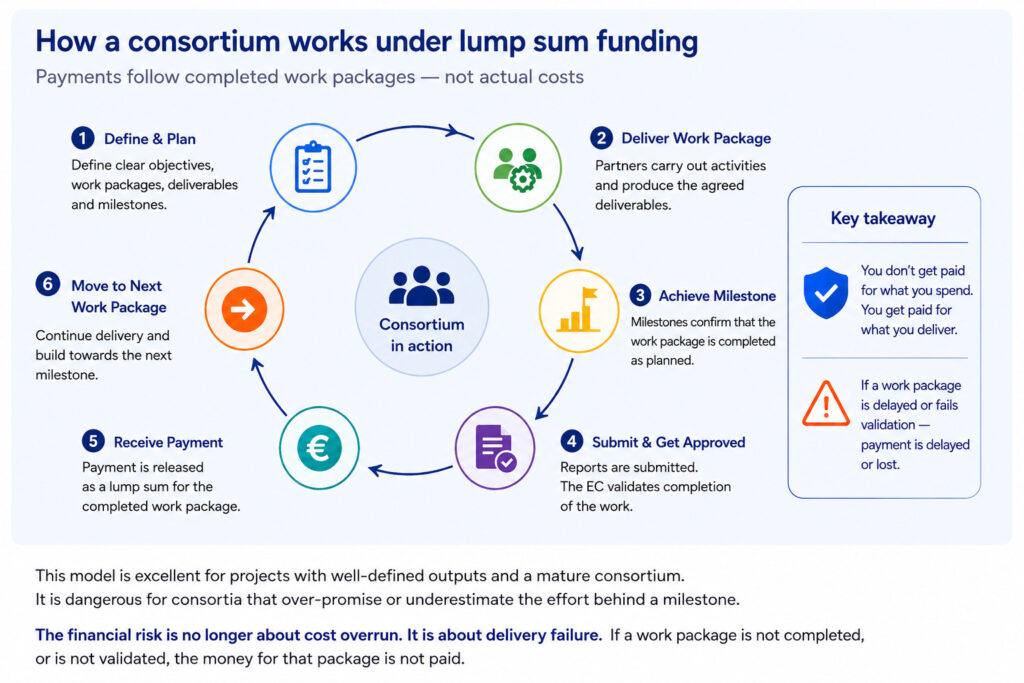
Three consequences follow directly:
- Work package design becomes a financial decision, not just a planning one. Large, long work packages concentrate payment risk; smaller, discrete ones with clean completion criteria spread it.
- The budget must be right at proposal stage. Lump sums are fixed in advance, so an underestimated work package cannot be corrected later by reporting higher actual costs.
- Partner cash flow needs planning. A partner who depends on the interim payment arriving on schedule is exposed if another partner’s work package slips.
None of this makes lump sum a bad model — for most consortia it is a net improvement. But it moves risk from administrative compliance to delivery discipline, and it rewards consortia that plan work packages carefully at the proposal stage.
Two-stage calls and blind evaluation
Forty-one topics now use a two-stage process. Stage one is a short proposal — a concept rather than a full submission — and the full proposal is requested only if the first stage succeeds. Many first-stage submissions are evaluated blindly, with applicant and consortium identities anonymised.
This is the most significant opening for newcomers in the current cycle, and it changes strategy in two ways.
- The cost of attempting drops sharply. A short concept note is a fraction of the effort of a full proposal, which makes it rational to test an idea you would previously not have attempted.
- At stage one, institutional reputation cannot carry a weak concept — and cannot compensate for one either. The idea, the logic and the expected outcomes have to work on their own terms. For an organisation without a long EU track record, this is an advantage rather than a hurdle.
The trade-off is on the other side. The interval between stages has been shortened, so a successful stage-one submission converts into a compressed window for producing the full proposal. Consortia that treat stage one as a lottery ticket and only start assembling seriously after the invitation arrives will find that window uncomfortable.
Shorter templates and the rewritten impact section
Proposal templates have been shortened, with standard page limits reduced. More consequentially, the impact section has been changed: applicants are no longer required to describe general scientific, economic and societal impacts, or to quantify the scale and significance of expected contributions.
The temptation is to read this as impact mattering less. It does not. What has been removed is the boilerplate — the pages of generic societal-benefit narrative and invented quantification that evaluators had learned to discount anyway. What remains is the part that was always doing the work: a specific, credible pathway from your results to their use, with named audiences and a plausible mechanism.
With fewer pages available, a vague impact section is now more visible, not less. There is nowhere for it to hide.
Horizontal calls: the genuinely new structure
The 2026–27 programme introduces horizontal calls that deliberately cut across clusters, pooling resources around shared EU-level objectives rather than staying within thematic boundaries. Substantial examples include a large call in support of the Clean Industrial Deal focused on clean technologies and decarbonisation of energy-intensive industries, and an AI in Science call supporting trustworthy AI applications across fields such as advanced materials, agriculture and environment.
For consortium design this is a real change. A cross-cluster call expects a consortium that spans domains — which usually means partners you would not have approached if you were reading a single cluster’s topics. Organisations that build their partner network within one thematic silo are structurally disadvantaged here, and the fix takes months, not weeks. For the broader strategic context behind these priorities, see our guide to European technology sovereignty.
Newcomers, SMEs and cascade funding
The programme includes dedicated newcomer-friendly and SME-focused topics, wider use of the Fast Track to Research and Innovation scheme in some cases, and more topics permitting cascade funding — financial support to third parties, distributed by funded projects through their own open calls.
Two practical notes. First, cascade funding remains the most accessible legitimate entry point for an organisation with no EU project history, and the expansion in 2026–27 makes it more so. Second, “newcomer-friendly” describes the topic design, not the competition. These topics attract the applicants they are intended to attract, so the field is not thin — it is simply one where a track record is less decisive.
What consortia should actually do differently
- Design work packages as payment units. Under lump sum, completion criteria are financial terms. Make them discrete, verifiable and realistically scoped.
- Get the budget right before submission. There is no later correction mechanism, so the estimation work moves forward in the timeline.
- Build the consortium across clusters, not within one. Horizontal calls reward networks that already span domains.
- Use two-stage calls to test ideas you would not otherwise attempt — but prepare the consortium in parallel, not after the invitation.
- Rewrite the impact section from scratch rather than trimming the old one. The removed requirements changed what the section is for.
- Read the topic more carefully, not less. Broader wording means the interpretation is now your responsibility, and a misread topic is a wasted submission.
- Plan partner cash flow explicitly, including what happens if an interim payment is delayed by another partner’s slippage.
How Nexuswelt works with consortia on this
Nexuswelt supports consortia on the parts of a proposal and a project that these changes make more consequential: consortium design and positioning, impact logic, and the communication, dissemination, stakeholder engagement and exploitation work that a shortened impact section now has to carry with less room. The coordinator-facing companion to this article is our guide to communication, dissemination and exploitation, and more on the firm is on the Nexuswelt about page.