Munich, 5 October 2026 · Nexuswelt Group
Three European programmes fund work described as artificial intelligence, and they fund almost entirely different things. A startup that applies to the wrong one does not get a lower score – it gets rejected for being out of scope, which is the most avoidable outcome in the system.
This is the comparison: what each programme actually funds, which door fits which kind of AI company, and an honest note about how competitive this area has become.
The question that sorts most of it
Before comparing programmes, answer one question: is the hard part of your work still unknown, already known but not deployed, or in the silicon?
- Still unknown – the method does not exist yet, or does not work reliably. That is research, and it belongs in Horizon Europe.
- Known but not deployed – the technology works and the difficulty is getting it into use at scale. That is Digital Europe.
- In the silicon – the constraint is the chip, the edge device or the hardware architecture. That is the Chips Joint Undertaking.
Most misdirected applications come from skipping this question. A deployment project submitted to Horizon Europe loses on novelty; a research project submitted to Digital Europe loses on readiness. Both are complete losses rather than near misses.
The comparison
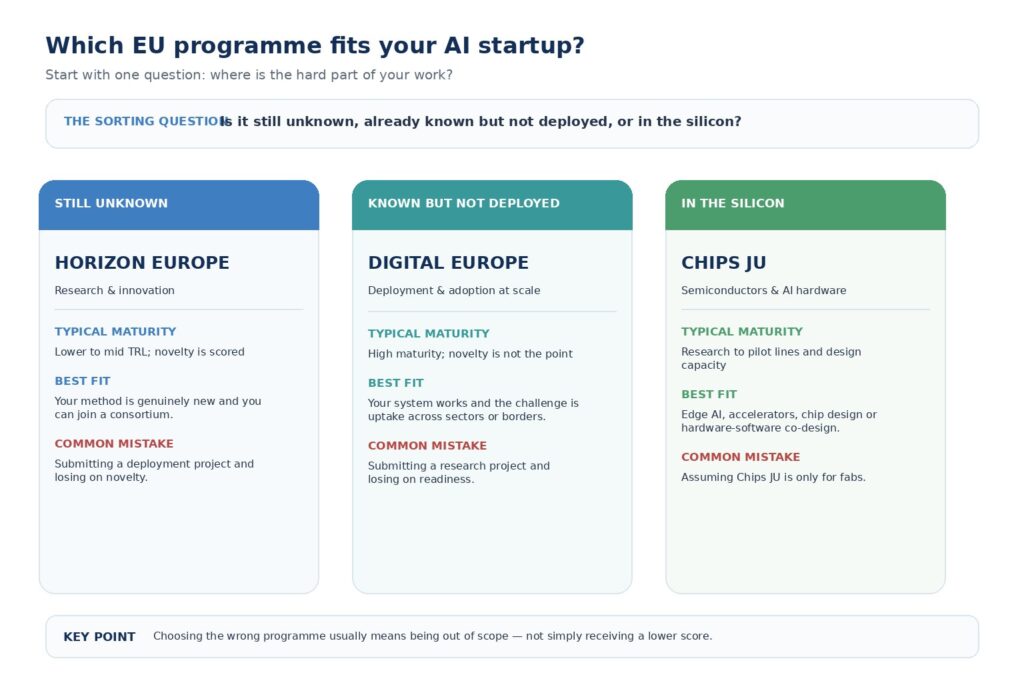
Horizon Europe: where AI research sits
AI work appears in two places. Cluster 4, covering digital, industry and space, carries the main body of AI topics. Alongside it, the current work programme introduced horizontal calls that cut across clusters, including one supporting trustworthy AI applications in fields such as advanced materials, agriculture and environment – which is a route for AI companies whose application domain sits outside the digital cluster.
For a startup, the practical shape is this: you are joining a consortium as a partner, contributing a defined piece of work, and receiving a share of a larger budget. The strategic return – validation, network, standards visibility, a delivery record – is usually worth more than the grant itself.
There is also the European Innovation Council within the programme, which is the single-applicant route and does not require a consortium. For a company at scale-up readiness it is the most direct instrument available; it is also severely competitive and includes a jury interview.
Digital Europe: the deployment programme
Digital Europe funds putting working technology into use – AI adoption, data spaces, cybersecurity, digital skills and digital public services. Novelty is not scored; capacity, adoption and demonstrable deployment are.
Three entry points matter for an AI startup:
- Sector data spaces, where the scarce input is high-quality data from real operational environments rather than compute or modelling capability.
- European Digital Innovation Hubs, which support adoption and are usually the right first door for a company with no EU project history.
- Deployment topics where the requirement is implementation capacity – an area where a startup with a working product can be more credible than a research institute.
Chips JU: the layer people forget
The Chips Joint Undertaking is widely assumed to be about fabrication plants, and therefore irrelevant to a software-led AI company. That assumption costs opportunities.
The joint undertaking covers design capability, pilot lines, edge computing and the hardware-software boundary. An AI startup working on model efficiency, inference at the edge, accelerator architectures or hardware-aware optimisation is closer to this programme than to a Cluster 4 topic, and the competition there is different – fewer applicants, more specialised.
This is also the programme where sector membership pays for itself, since consortium formation runs heavily through industry associations and technology platforms rather than open calls.
Compute access cuts across all three
Independently of which programme you target, the AI Factories network built around EuroHPC supercomputing sites gives startups, SMEs and researchers access to AI-optimised compute, with Antenna nodes extending it to countries without large-scale supercomputing infrastructure of their own. Access is arranged with the facility rather than through a central call, which makes it one of the lowest-effort steps available. The EuroHPC Joint Undertaking operates the network.
The proposal-writing consequence is worth stating plainly: an implementation section that names a compute access route reads as a credible plan, while one stating that computational resources will be secured as required reads as an unpriced risk. Arranging access before you write strengthens the proposal at no cost to the budget.
The honest warning
AI is the most oversubscribed area in European research funding. Independent analysis of eighteen collaborative digital calls under Cluster 4 in 2026 put the success rate at around 5.5% – against a programme average of roughly 14 to 16%, itself falling as applications surge.
Two implications follow, and neither is a reason not to apply:
- Topic selection matters more here than anywhere else. Within the same call, rates vary by a factor of several depending on how crowded the topic is. An afternoon comparing indicative budgets against expected numbers of grants moves your odds more than weeks of writing.
- Adjacent doors are less crowded. The Chips JU hardware layer, Digital Europe deployment topics and application-domain horizontal calls attract fewer applicants than headline AI topics, and an AI company can often reach them by reframing rather than by changing what it does.
Which door fits you
| Your position | The realistic route |
| Novel method, not yet reliable, willing to join a consortium | Horizon Europe collaborative call in Cluster 4 or an application-domain horizontal call |
| Working system, the problem is adoption at scale | Digital Europe deployment topics, or an EDIH if you need adoption support first |
| Model efficiency, edge inference, accelerators, hardware-aware design | Chips JU – less crowded and better matched than a Cluster 4 AI topic |
| Validated innovation, scale-up ready, prefer to apply alone | EIC Accelerator, with realistic expectations about competition and the jury interview |
| No EU track record, want a first credible engagement | Cascade funding open calls from funded AI projects, found through CORDIS rather than the portal |
| You hold industrial or operational data | Data space topics. Data from real environments is the scarce input, and holding it is a stronger position than most holders realise |
| Compute is the constraint | AI Factory or Antenna access, arranged directly with the facility, regardless of which programme you target |
What an AI proposal has to argue now
Beyond the usual requirements, three things have become close to mandatory in this area:
- Trustworthiness, addressed concretely. Robustness, data governance, transparency and regulatory alignment are expected as part of the technical case rather than as an ethics annex.
- Where the data comes from, and on what basis you can use it. Vagueness here is read as a delivery risk, particularly in deployment topics.
- A European capability argument. With the sovereignty framework now shaping priorities, a proposal that can say which dependency its work reduces – specifically, and with a mechanism – is better positioned than one that cannot. Asserting it without a mechanism reads like any other generic impact claim.
How Nexuswelt works with AI companies
Programme selection is the decision that determines everything downstream, and it is usually made too late. For the broader startup funding landscape, see our guide to EU funding for startups. Nexuswelt works with AI and deep-tech companies on instrument choice, consortium positioning and the impact and exploitation logic these programmes are judged on, and contributes to funded projects as a partner for communication, dissemination and exploitation. Our analysis of the European AI infrastructure landscape is in the AI Factories and data spaces guide, and more on the firm is on the Nexuswelt about page.