This guide is written for two audiences at once, because the gap between them is the actual problem. On one side are Ukrainian companies, universities and research organisations that are formally eligible for European funding but still do not appear in enough European consortia. On the other are European coordinators who would consider a Ukrainian partner if they knew how to find, assess and integrate one.
Eligibility was solved years ago. What has not been solved is positioning, visibility and consortium access. This guide explains where Ukraine stands in the European funding landscape in 2026, which routes exist beyond Horizon Europe, what Ukrainian organisations consistently get wrong, and how European coordinators can assess a Ukrainian partner without lowering normal standards of due diligence.
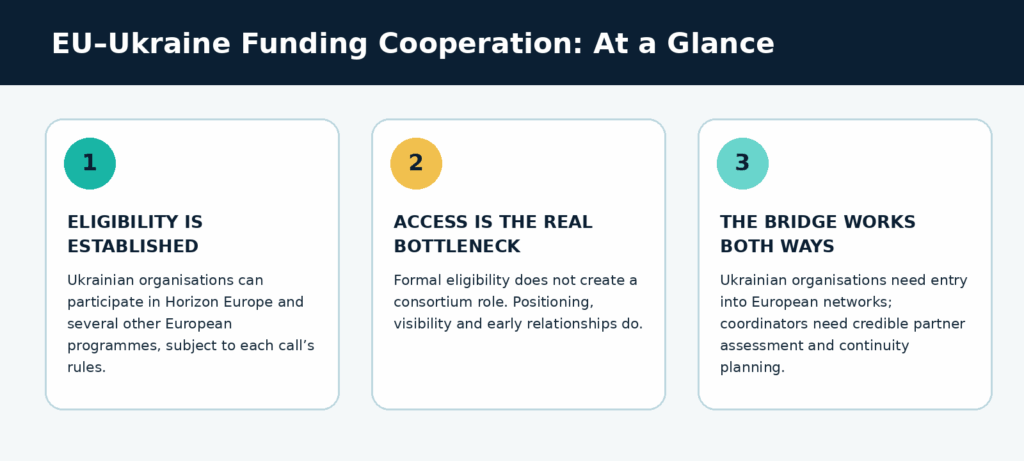
At a glance: eligibility is established, but access depends on positioning and mutual confidence.
Where Ukraine stands in Horizon Europe today
Ukraine is an associated country to Horizon Europe. Ukrainian legal entities can participate under the conditions applicable to associated countries, receive EU funding directly when the call permits it, join consortia and, where the topic rules allow, coordinate projects. The association also covers the Euratom Research and Training Programme. The European Commission’s summary of the association agreement sets out the legal framework.
Two points are still widely misunderstood:
- The EU suspended Ukraine’s obligation to pay its financial contribution under the association arrangements. This removes the programme-level contribution barrier; it does not replace the funding and eligibility rules of individual calls.
- Some calls restrict participation to protect the EU’s strategic assets, interests, autonomy or security. These restrictions are call-specific and must be checked in the topic text. They should not be assumed from the country name alone.
Ukraine remains included among Horizon Europe associated countries, and the Horizon Europe Office in Ukraine provides information, technical support and links between Ukrainian and European research and innovation actors. In practical terms, the main constraint is no longer formal eligibility. It is the sequence between eligibility, a credible role and coordinator confidence.
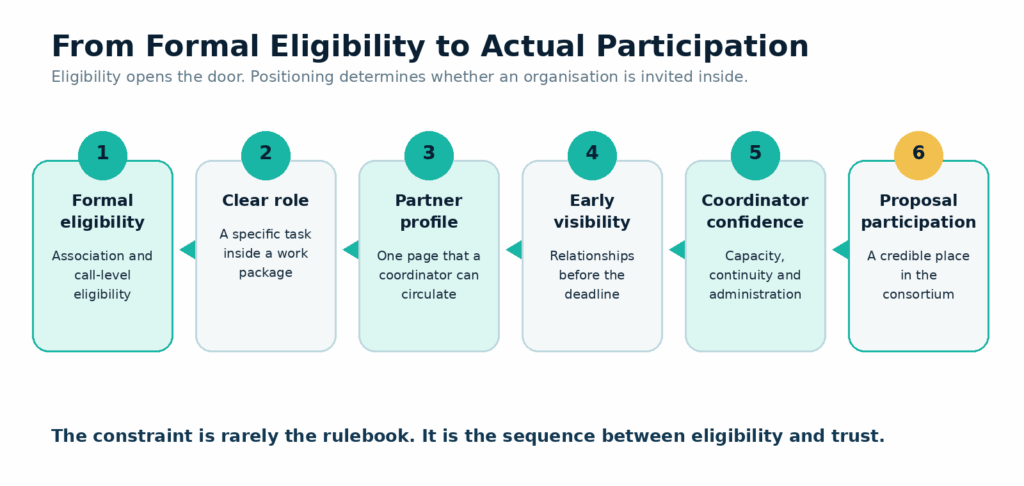
Formal eligibility is only the first step. Participation follows when the organisation is visible, assignable and trusted.
The routes that exist beyond Horizon Europe
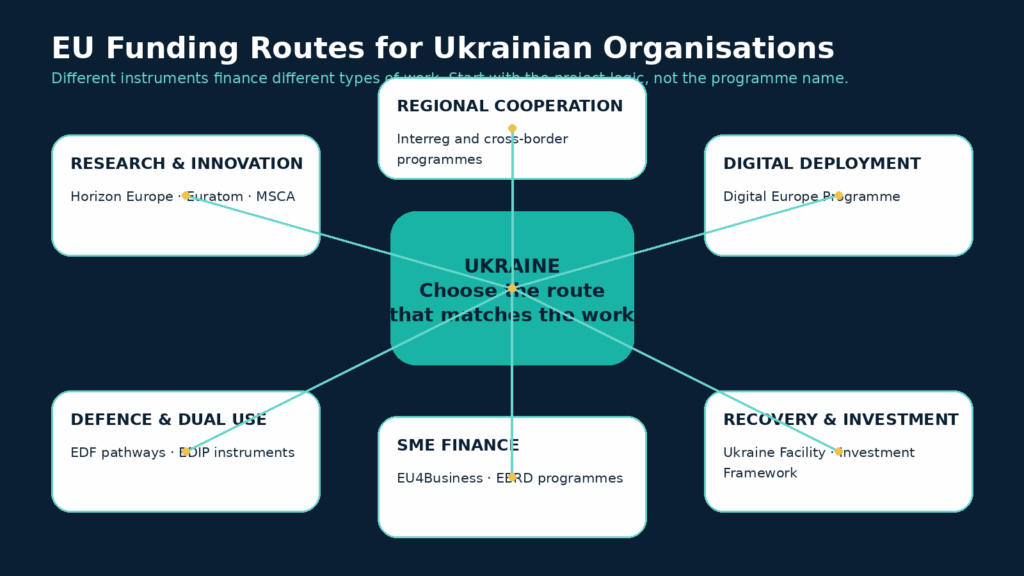
Ukrainian organisations and their European partners often default to Horizon Europe and stop there. The funding landscape is wider, and the instruments serve genuinely different purposes. The right choice depends on whether the proposed work is research, deployment, defence development, reconstruction, investment, mobility or regional cooperation.
What Ukrainian organisations consistently get wrong
These are not capability problems. Ukrainian technical, scientific and engineering expertise is well established and, in several fields, genuinely competitive. The failures are structural and repeatable.
1. Describing capability instead of a role
A coordinator building a consortium is not looking for an organisation with impressive expertise in the abstract. The coordinator is looking for something specific to be done inside a work package. “We have strong competence in materials science” does not identify a task. “We can deliver accelerated corrosion testing on defined substrates, using these facilities, at this stage of the workflow” does.
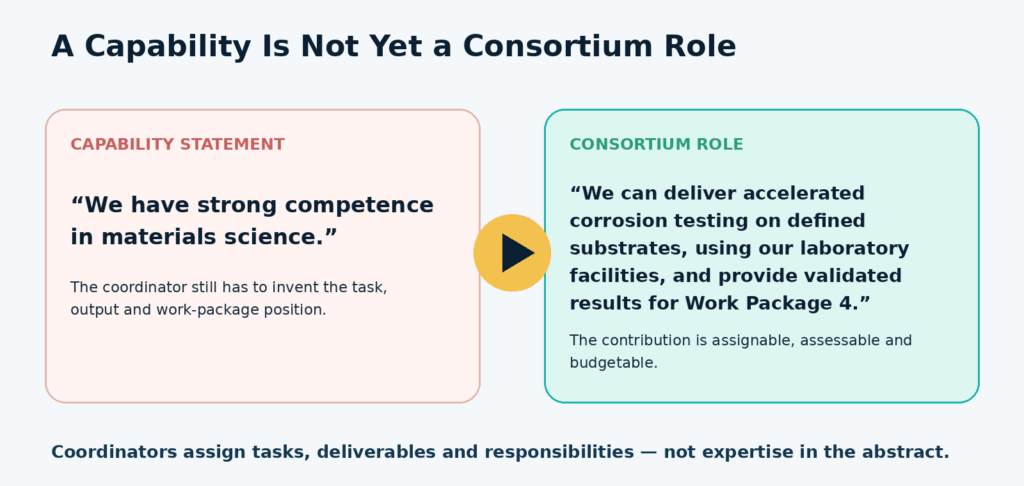
A coordinator needs a contribution that can be assigned, evaluated and budgeted.
2. No partner profile that a coordinator can act on
Many organisations have no one-page document stating what they do, what they have delivered, which instruments they can join, what role they are seeking and who can make a decision. Without that document, the coordinator has to construct the organisation’s relevance. In a competitive consortium-building process, that work is usually not done for an unknown partner.
3. Waiting for calls to open
By the time a call is public, many consortia have already formed around a core group. The strongest window for joining is often before publication or immediately after the work programme becomes visible. Relationship-building therefore happens in advance of the specific opportunity, not only in response to a deadline.
4. Approaching too late and too broadly
A generic message sent to twenty coordinators three weeks before a deadline rarely produces a serious role. A specific, well-timed approach to two or three coordinators whose topic and project logic have actually been studied is more likely to create a conversation.
5. Treating war-related risk as unmentionable
European coordinators have legitimate questions about continuity, work location, data handling, staff safety and delivery capacity. Ukrainian partners are not automatically excluded because those questions exist. Confidence falls when the questions are left unanswered. Addressing continuity planning directly and in writing turns a concern into evidence of professional preparation.
For Ukrainian organisations Do not ask a coordinator whether they are interested in “cooperation with Ukraine.” Show which task you can perform, in which work package, with which people, facilities, methods and outputs. |
For European coordinators: assessing a Ukrainian partner
Including a Ukrainian partner should not be framed as symbolic solidarity. It should be based on project relevance and a credible delivery role. In topics connected to resilience, reconstruction, energy, digital systems, security, health, agriculture or environmental remediation, Ukrainian experience can add technical and contextual value. The same partner should still pass normal consortium due diligence.
What to check in practice:
- Legal status and registration, including a valid Participant Identification Code (PIC).
- Whether the specific call contains strategic-autonomy, security, ownership or control restrictions.
- A named working contact with sufficient English or German and a decision-maker who can commit the organisation.
- Continuity arrangements: where the work will take place, what the fallback is, and how data, equipment and results will be protected.
- Prior EU project experience, or a credible explanation of how reporting and quality requirements will be managed without it.
- Financial and administrative capacity for time recording, cost documentation, reporting, audits and consortium obligations.
- A precise task, deliverable or pilot contribution that is necessary for the project rather than decorative.
None of this is unusual because the organisation is Ukrainian. It is the same due-diligence logic that should apply to any new partner, with additional attention to continuity because the operational environment is exceptional.
A practical entry path
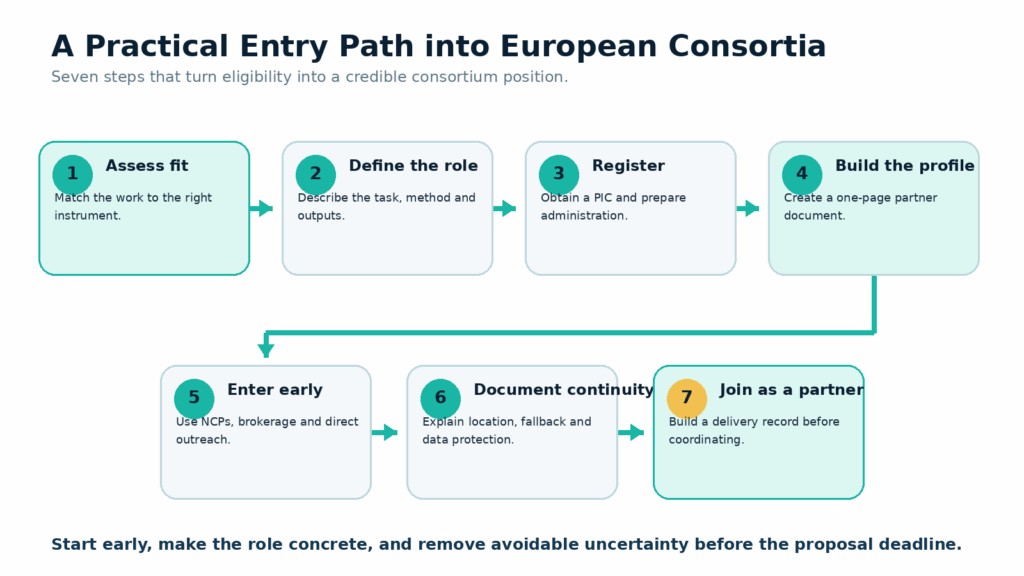
A sequenced process is more effective than reacting to individual calls.
- Assess fit honestly. Identify which instrument matches what the organisation can actually deliver, and rule out the routes that do not fit. This is the step that saves the most time.
- Define a role, not a capability. Write down the specific contribution inside a work package, supported by facilities, methods, people, data access, pilots or outputs.
- Register formally. Obtain a PIC and prepare the basic legal, financial and administrative information before a coordinator asks for it.
- Build a partner profile. Prepare one page in English that states the role sought, relevant delivery evidence, eligibility, continuity arrangements and the decision-making contact.
- Enter the network before the call. Use brokerage events, partner-search platforms, National Contact Point networks, European associations and direct approaches to coordinators of adjacent projects.
- Answer the continuity question in writing. Explain the primary work location, fallback arrangements, data protection and alternative personnel or infrastructure where relevant.
- Start as a partner, not a coordinator. For most first-time participants, a defined partner role is the fastest way to establish the delivery and reporting record that makes later leadership credible.
Where Ukrainian capability meets European demand
The strongest cooperation opportunities are usually found where Ukrainian delivery experience and European programme priorities overlap. The following areas are particularly relevant, but every consortium role must still be tied to a specific topic and expected outcome.
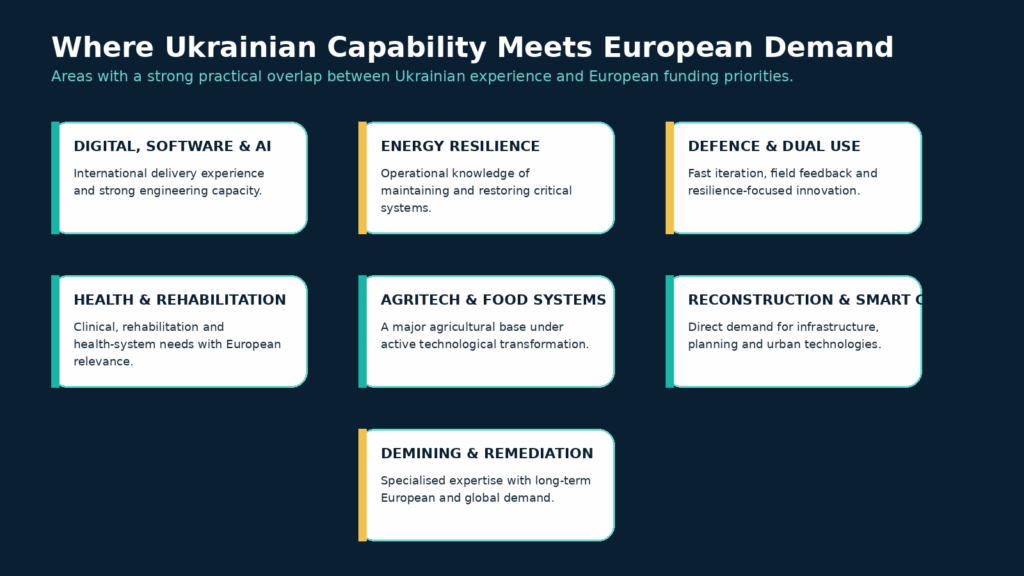
The strongest opportunities combine genuine Ukrainian delivery experience with a clearly funded European need.
Area | Why the overlap exists |
Digital, software and AI | Ukraine’s internationally experienced software and engineering sector can contribute to AI, data, digital public services, industrial digitalisation and deployment-oriented projects. |
Energy resilience and grid technology | Experience maintaining and restoring energy systems under extreme conditions is relevant to resilience, distributed energy, grid management, storage and critical-infrastructure projects. |
Defence-adjacent and dual-use technology | Rapid iteration, field feedback and operational resilience can be relevant to specific EDF, EDIP, EIC and other dual-use or defence innovation routes, subject to call restrictions. |
Health systems and rehabilitation | The scale of rehabilitation and health-system needs has generated experience relevant to medical technologies, care pathways, mental health, prosthetics, rehabilitation and health-system resilience. |
Agritech and food systems | A major agricultural research and production base is undergoing active technological transformation, aligning with food security, climate adaptation, soil, digital agriculture and circular bioeconomy topics. |
Reconstruction, construction technology and smart cities | Ukraine’s reconstruction creates direct demand for resilient infrastructure, energy-efficient construction, urban planning, digital twins, public services and smart-city technologies. |
Demining and environmental remediation | Specialised expertise in explosive detection, demining, contaminated land, water, soil and ecosystem recovery has clear European and global relevance. |
How Nexuswelt works as a bridge
The bridge has two directions Ukrainian organisations need credible access to European programmes and consortia. European coordinators need a reliable way to identify, assess and integrate Ukrainian partners. Effective cooperation requires both. |
Nexuswelt is a European EU funding and innovation agency based in Germany, with representative presence in Cyprus and Ukraine. The structure reflects the work: Ukrainian organisations need support inside the European funding and consortium system, while European coordinators need a partner that can assess positioning, delivery logic and continuity on both sides.
Nexuswelt supports coordinators and consortium partners on exactly this layer: communication, dissemination, exploitation logic, stakeholder engagement and impact-oriented delivery. The firm contributes to EU-funded projects as a partner rather than an external vendor, which is why the work covers stakeholder relevance, acceptance and uptake rather than output volume alone. This includes helping consortia assess and integrate partners from associated countries — see our guide to EU-Ukraine innovation cooperation for more.
The work covers programme-fit assessment, EU funding roadmaps, role definition, partner profiles, consortium positioning, partner search and proposal support. Nexuswelt also contributes inside funded projects through communication, dissemination, stakeholder engagement, exploitation and selected project-management support. More information is available on the Nexuswelt about page and the EU funding and innovation support page. The launch of the Ukraine practice was described following European Research & Innovation Days.
If you are a Ukrainian organisation unsure which instrument fits, or a European coordinator considering a Ukrainian partner and unsure how to evaluate one, a structured assessment is the useful first step. Contact Nexuswelt to discuss the organisation, call and intended consortium role.
Frequently asked questions
Can Ukrainian organisations receive Horizon Europe funding directly?
Yes, where the call and action rules permit funding. Ukraine is an associated country to Horizon Europe, so eligible Ukrainian legal entities can receive EU funding directly and join consortia under the conditions applicable to associated countries.
Does a Ukrainian organisation need an EU-registered entity to participate?
No. The Ukrainian legal entity itself can be eligible. Establishing an EU entity may make sense for commercial, tax or operational reasons, but it is not a general Horizon Europe participation requirement.
Are there calls Ukrainian entities cannot apply to?
Yes. Some topics contain restrictions linked to strategic assets, security, ownership, control or European autonomy. These restrictions are topic-specific. Always check the call and topic text rather than relying only on the general country list.
Does Ukraine pay a contribution to Horizon Europe?
The EU suspended Ukraine’s obligation to pay its financial contribution under the association arrangements. This does not remove project-level eligibility, budgeting, reporting or financial-capacity requirements.
Can Ukrainian organisations join the Digital Europe Programme?
Yes, but the association is not unlimited. Ukraine currently participates in Specific Objectives 1, 2, 4 and 5. The scope and eligible countries must still be checked in each call.
Can Ukrainian companies participate in European defence funding?
There are defined routes, but not a blanket right to join every EDF call. Ukrainian entities can participate in specific disruptive-technology, cascade-funding and Ukraine-focused defence-industrial instruments, subject to security, ownership, control and call-level conditions.
What EU support exists for Ukrainian SMEs outside research funding?
Relevant routes include the Ukraine Facility and Ukraine Investment Framework for recovery and investment, plus EU4Business and EBRD programmes for finance, guarantees, advisory support and technical assistance. These instruments use different application channels from Horizon Europe.
How can a European coordinator find a Ukrainian partner?
National Contact Point networks, the Horizon Europe Office in Ukraine, brokerage events, partner-search platforms, European associations and organisations active in both ecosystems are useful channels. The critical step is not only finding names, but assessing role fit, delivery capacity and continuity.
Is war-related risk a barrier to including a Ukrainian partner?
It is a due-diligence question, not an automatic exclusion. Confidence improves when work location, fallback capacity, staff arrangements, data protection and delivery continuity are documented before proposal submission.
When should a Ukrainian organisation start looking for a consortium?
Before calls open or as early as possible in the work-programme cycle. Many core consortia form well before the submission deadline, so partner positioning should precede the opportunity rather than react to it.
Always verify the call text Programme association and general eligibility do not override the conditions of a specific call. Before committing resources, check the latest Funding & Tenders Portal documents, topic conditions and applicable security or control requirements. |
Sources
1. European Commission — Ukraine and Horizon Europe association
2. EUR-Lex — Association agreement and suspension of Ukraine’s payment obligations
3. EU Funding & Tenders Portal — List of Horizon Europe participating countries
4. European Commission — Horizon Europe programme
5. European Commission — Digital Europe Programme
6. European Commission — Digital support to Ukraine
7. EU Funding & Tenders Portal — Digital Europe participating countries and specific objectives
8. European Commission — Support to Ukraine in the European defence ecosystem
9. European Commission — European Defence Fund Work Programme 2026
10. European Commission — EDIP and Ukraine Support Instrument
11. European Commission — Ukraine Facility
12. European Commission — Ukraine Investment Framework
13. EBRD — Ukraine SME Recovery Programme
14. EU4Business — Support for Ukrainian SMEs