Munich, 28 August 2026 · Nexuswelt Group
Europe’s AI infrastructure programme is usually reported as a sequence of budget announcements: a number, a list of countries, a photograph. Read that way, it looks like something happening to other organisations – national supercomputing centres and large industrial groups.
That reading misses what changed. The AI Factories network is an access infrastructure, and the data-space layer built alongside it is where companies that do not own compute actually participate. Both are now live enough to affect how an AI-related proposal is judged, whichever programme you are applying to. This article sets out what exists, who it is for, and how to position against it.
What actually exists now
Four distinct things are routinely confused with one another. They serve different purposes and have different entry points. The EuroHPC Joint Undertaking operates most of this layer.
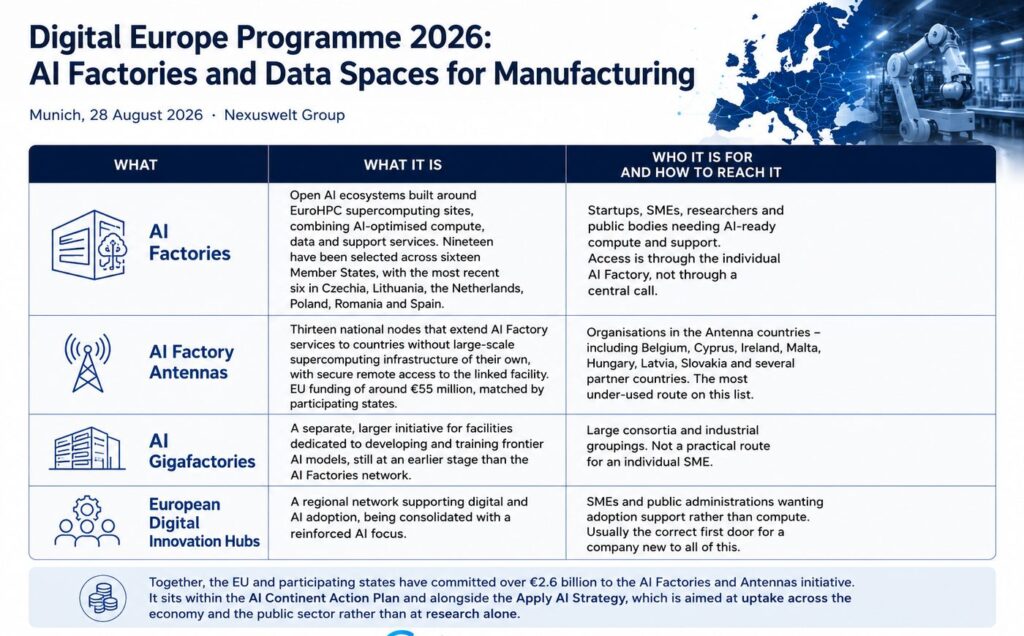
Together, the EU and participating states have committed over €2.6 billion to the AI Factories and Antennas initiative. It sits within the AI Continent Action Plan and alongside the Apply AI Strategy, which is aimed at uptake across the economy and the public sector rather than at research alone.
Why this matters even if you never apply to a Digital Europe call
This is the part most companies miss. Access to AI-optimised compute has become a positioning asset in proposals across programmes, not only a resource question.
Consider how an evaluator reads two otherwise similar proposals. One states that the consortium will train and validate models using capacity arranged through a named AI Factory, with the access route described. The other states that computational resources will be secured as required. The first is a credible implementation plan; the second is a risk the evaluator has to price in.
Three practical consequences:
- Arranging AI Factory or Antenna access before you write strengthens the implementation section of a Horizon Europe proposal at no cost to the budget.
- It also strengthens the impact argument, because uptake claims are more credible when the compute path to a working system is described rather than assumed.
- For organisations in Antenna countries, this is a genuine equalising route. The Antenna exists precisely so that a company in a country without a national supercomputer is not structurally disadvantaged.
The Data Space for Manufacturing: what the 2026 round showed
The Digital Europe call for a Data Space for Manufacturing ran from November 2025 to March 2026 under the AI Continent call cluster, with a budget of around €9 million supporting roughly three data-collection projects at approximately €3 million each. It is closed, and the point of examining it now is not to apply but to read the direction.
What the topic asked for is instructive. It sought solutions to collect large, high-quality data from real industrial environments across different manufacturing systems and sectors, and to make those datasets available for training generative AI models addressing real industrial problems – preferably through trusted third parties hosting data and training compute on behalf of authorised AI developers.
The named use cases were commercial rather than academic: predictive maintenance, process automation, supply-chain management, product design and lifecycle management, digital twins, and sustainability in production. The target sectors were automotive, chemical, aeronautics and energy-intensive industries.
What this tells you about positioning
- The scarce asset in European industrial AI is not compute – that is being built. It is high-quality, labelled data from real production environments, and the organisations that hold it are manufacturers, not AI developers.
- The trusted-intermediary model is being actively encouraged: a third party hosts data and training compute on behalf of authorised developers. That is a role, and it is currently under-occupied.
- Financial sustainability beyond the grant was explicitly part of what the topic asked for. Data spaces that cannot fund themselves after the project are not what the Commission is trying to build, and proposals that treat sustainability as an afterthought are answering a different question.
- The STEP link matters. Topics carrying the Strategic Technologies for Europe Platform framing sit inside a broader competitiveness agenda, and that framing should appear in how a proposal argues its relevance.
Digital Europe or Horizon Europe: which door
Choosing the wrong programme is the most expensive early error in this space, because the positioning work does not transfer between them.
| Horizon Europe | Digital Europe | |
| Funds | Research and innovation – advancing what is technically possible | Deployment and adoption – putting what already works into use at scale |
| Typical maturity | Lower TRL, with novelty as a scoring criterion | Higher maturity; novelty is not the point |
| Scores well when | The state of the art is advanced | Capacity, adoption and real deployment are demonstrated |
| Suits | Research organisations, deep-tech companies, RTOs | Companies with something built, public administrations, intermediaries, EDIHs |
| Common mistake | Submitting a deployment project and losing on novelty | Submitting a research project and losing on readiness |
A useful test: if the honest answer to “what is new here?” is “nothing, but nobody is using it yet”, you are looking at Digital Europe.
Who this is actually for
| Organisation type | The realistic route in |
| Manufacturers with production data | The strongest position in this landscape and the one least often recognised by the organisations holding it. Data from real industrial environments is the scarce input, and it is a basis for consortium participation rather than only a contribution in kind. |
| AI startups and model developers | Compute access through an AI Factory or Antenna, and consortium roles where a manufacturing partner supplies data. Data access is usually the binding constraint, not capability. For a broader starting point, see our guide to EU funding for startups. |
| Research organisations and RTOs | Both doors are open. The trusted-intermediary role between manufacturers and AI developers is a natural fit and is currently under-occupied. |
| SMEs without AI capability of their own | Start with a European Digital Innovation Hub for adoption support, not with a Digital Europe consortium call. |
| Organisations in Antenna countries | The Antenna route specifically. It was created so that the absence of national supercomputing capacity is not a structural disadvantage, and it is under-used. |
How to position now
- Identify the AI Factory or Antenna relevant to your country and make contact. Access is arranged with the facility, not through a central application, and the conversation costs nothing.
- If you hold industrial data, audit what you actually have: coverage, quality, labelling, and what could be shared under what conditions. This is the asset, and most holders have never assessed it as one.
- Decide honestly whether your project is research or deployment, and pick the programme accordingly.
- Name compute and data access explicitly in the implementation section of any AI-related proposal, whichever programme it targets.
- If you are building a data space, design the financial model for life after the grant, because the topic asked for that and the successor programmes will ask harder.
- Watch the AI Continent Action Plan and Apply AI Strategy for the next tranche of topics rather than waiting for a call to appear on the portal.
What to watch
- Memoranda of understanding between Antennas and their linked AI Factories, which set out the terms of collaboration and therefore the practical access conditions.
- Deployment of the six most recently selected AI Factories, which changes the map of where capacity sits.
- Further data space topics across sectors, since manufacturing is one instance of a broader pattern.
- The AI Gigafactory track, which is separate from AI Factories and moving on its own timeline.
- Continued consolidation of the EDIH network with a reinforced AI focus.
How Nexuswelt works with organisations in this space
Nexuswelt works with deep-tech companies, manufacturers and research organisations on programme selection, consortium positioning and the impact and exploitation logic that AI and data projects are judged on – and contributes to funded projects as a partner for communication, dissemination, stakeholder engagement and exploitation. Our companion analysis of what changed in the current programming period is in the Horizon Europe 2026–27 work programme guide, and more on the firm is on the Nexuswelt about page.