Munich, 30 September 2026 · Nexuswelt Group
The communication, dissemination and exploitation work package is usually the last one assigned and the first one questioned at review. That sequence is not an accident: it is assigned last because nobody in a technical consortium wants it, and questioned first because it is where the impact claim has to be evidenced.
Nexuswelt does this work, so treat this article accordingly. What follows is written to be useful whether or not you end up working with us – including the section on when a dedicated partner is the wrong answer.
First question: do you actually need one?
Not every consortium does. Adding a partner has real costs – budget share, coordination overhead, another organisation the implementation section has to justify – and there are cases where it is not the right call.
| You probably do not need a dedicated partner | You probably do |
| A small consortium with a single, well-defined audience the partners already reach | Multiple stakeholder groups across several countries and sectors |
| A partner who already has genuine capacity and a track record in this work | The alternative is a technical partner absorbing it alongside their real job |
| A short project with modest exploitation ambitions | A call with heavy impact weighting, or an industry-facing topic requiring a route to market |
| An existing in-house communication function with EU project experience | Nobody in the consortium has done a periodic report’s dissemination section before |
| A topic where uptake happens through one obvious channel | Results with several distinct exploitation routes and unclear ownership |
If the left column describes you, distribute the work explicitly and name who owns what. What does not work is leaving it unassigned and hoping it resolves itself – that is how consortia arrive at month thirty with a communication plan nobody has read since month six.
What the role actually involves
There is a persistent assumption that a dissemination partner produces a website, a logo and some social media. That is a small part of it, and the part with least bearing on the score.
| What people assume | What the work actually is |
| Website, visual identity, social media | Necessary infrastructure, but it does not produce uptake and does not carry an impact argument |
| Writing the dissemination plan | Designing the impact logic with the technical partners, then maintaining it as a living document across the project |
| Organising events | Identifying which stakeholder groups control decisions relevant to the results, and building engagement that changes something |
| Producing deliverables on time | Producing evidence continuously so that the periodic report is an assembly job rather than an investigation |
| Publicising results at the end | Involving external people before the results exist, which is the only mechanism that produces acceptance |
| Communication expertise | Communication expertise plus fluency in the programme’s rules – Article 17 obligations, deliverable mechanics, dissemination levels, exploitation and KER logic |
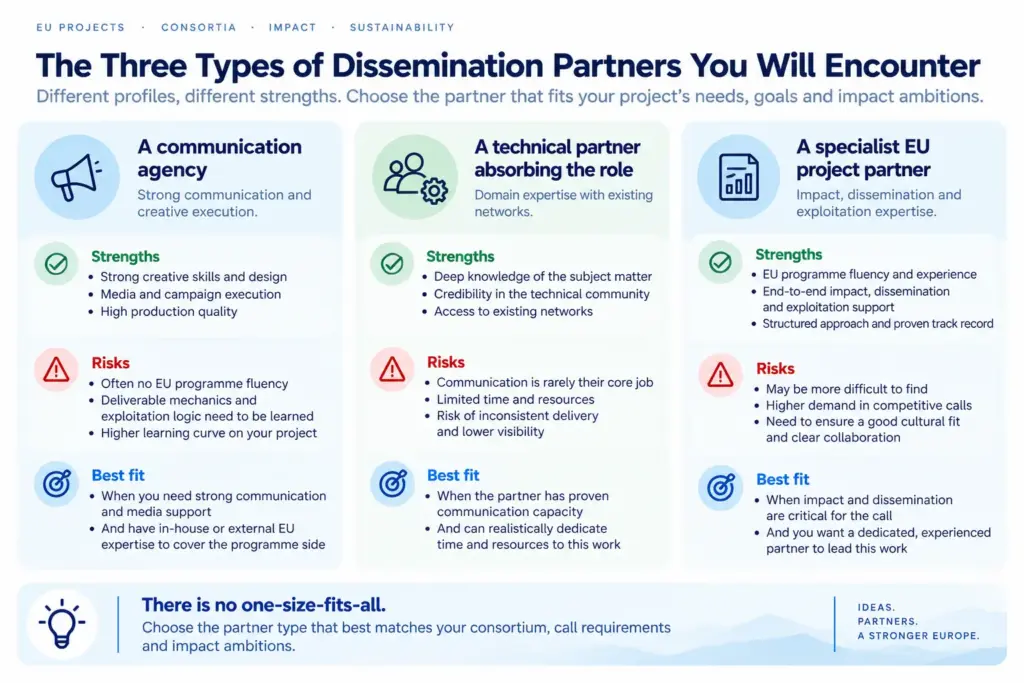
The third category is where Nexuswelt sits, and the honest caveat applies to us as much as anyone: the label does not guarantee the substance. The questions below are how you tell the difference.
What to look for
- Evidence of delivery inside funded projects, not a portfolio of campaigns. Ask which projects, in what role, and what the outcome was.
- Fluency in the programme’s own terms. Someone who cannot distinguish dissemination from exploitation, or who describes publications as an exploitation strategy, will produce a section that loses points.
- Interest in your results rather than your channels. A partner who asks what the results are, who would use them and what would stop them is designing an impact pathway. One who opens with channel plans is designing a campaign.
- Willingness to say what they will not do. A partner who claims to cover everything is either inexperienced or imprecise about the boundary with technical partners.
- Stakeholder access in your domain, or an honest account of how they would build it.
- Capacity for the full duration. Multi-year projects outlast staff, and a one-person dependency is a real risk.
Warning signs
- A proposal contribution that is all channels and no audiences. Named audiences with the decisions they control are the substance; a channel list is not.
- Metrics that are all activity counts – workshops held, posts published, subscribers gained – with no reach or uptake measures.
- No questions about the technical work. Anyone who can write your dissemination section without understanding your results is writing something generic.
- Exploitation treated as a synonym for dissemination, or as something to address in the final year.
- Reluctance to name the projects they have delivered in.
- A boilerplate section that could be dropped into any proposal in your cluster. Reviewers see many of these.
Questions to ask before committing
- Which funded projects have you delivered this work in, and what was your role in each?
- How would you structure the work packages for this project specifically, and why?
- What would you need from the technical partners, and when?
- How do you identify and reach stakeholders in this domain if you do not already have them?
- What indicators would you propose, and how would you collect the data for them?
- What happens to the results after the project ends, and who holds the relationships then?
- Who specifically would work on this, and what happens if that person leaves?
- What will you not be responsible for?
The last question is the most informative. A precise answer indicates someone who has run this work before and knows where the boundary sits.
When to bring them in
At proposal stage, contributing to the impact section – not after the grant is signed. This is also the point at which the dissemination plan should be shaped around real audiences, indicators and responsibilities.
A partner brought in at month six inherits a plan they did not design, audiences they were not consulted on, and indicators nobody knows how to collect. They can execute it, but they cannot fix the logic, because the logic is now in the grant agreement.
A partner involved during proposal writing shapes the impact pathway, aligns the work plan with the indicators, and ensures every claim in the impact section has a resourced task behind it – which is exactly the cross-check reviewers make. That contribution affects the score, not just the delivery.
Structuring the role properly
- A dedicated work package, not tasks scattered across others. Scattered dissemination tasks have no owner and no visibility.
- Split the work package across reporting periods rather than running it as one long stream. Under lump sum funding this converts a single late payment into regular ones, and it gives the work visible checkpoints.
- Name what technical partners owe: their results, their intended users, their domain knowledge. A dissemination partner cannot supply these and should not be expected to.
- Put horizontal contributions on the same reporting cycle as technical work, so they are visible rather than assumed.
- Give the role standing in the governance structure. A partner who cannot raise a problem at board level cannot fix it.
Effort and budget, realistically
Communication, dissemination and exploitation typically account for a modest share of a collaborative project’s total effort – enough to run the work properly, not enough to absorb underestimation. Two practical points:
- Under-resourcing this work package is visible to evaluators. A plan promising extensive multi-country engagement with minimal effort allocated is not credible, and the mismatch is easy to spot.
- Effort should be distributed across the project rather than concentrated at the end. A profile that loads everything into the final year describes publicity, not engagement, and reviewers read the distribution.
How Nexuswelt works with consortia
Nexuswelt joins EU-funded projects as a partner for communication, dissemination, stakeholder engagement and exploitation, contributing from proposal stage rather than after award. The firm is based in Munich, with presence in Cyprus and Ukraine, and works across Horizon Europe, Digital Europe, Chips JU, the European Defence Fund and Interreg. The wider treatment of coordinator obligations is in our guide to communication, dissemination and exploitation, and more on the firm is on the Nexuswelt about page.