There is no shortage of information about Canada’s association to Horizon Europe. Almost all of it is written for researchers at universities, by government departments and university international offices, and it explains eligibility very well.
This guide is written for Canadian companies — SMEs, scale-ups, technology providers and industrial R&D teams — who are eligible, know they are eligible, and still have no realistic route into a consortium. Eligibility is the part that is already solved. What follows is the part that is not.
Where Canada actually stands
Canada is associated to Pillar II of Horizon Europe. The association agreement was signed in Montreal on 3 July 2024 and took effect retroactively from the start of that year, following a transitional arrangement that had already opened participation. Canadian legal entities can join and lead consortia and receive funding directly from the European Commission, on terms equivalent to entities established in EU Member States. The European Commission’s page on cooperation with Canada sets out the terms, and implementation has been reviewed at Joint Committee meetings, most recently in Brussels in March 2026.
Pillar II is the largest collaborative part of the programme, covering climate, energy, digital, health, mobility, food systems and industrial competitiveness. It is also the part that funds companies rather than only researchers.
What association does not cover
Association is to Pillar II specifically, and the distinction matters commercially:
| Pillar | What it funds | Canadian access |
| Pillar I — Excellent Science | Frontier research (ERC), researcher mobility (MSCA), research infrastructures | Unchanged by association. Researchers can move to or host in Europe under MSCA; ERC grants require establishing a group in Europe. |
| Pillar II — Global Challenges and Industrial Competitiveness | Collaborative multi-partner projects across six thematic clusters, plus Missions and partnerships | Full participation on equivalent terms. This is where Canadian companies belong. |
| Pillar III — Innovative Europe | European Innovation Council, EIT | Unchanged. EIC Accelerator requires relocation to Europe, so it is not a route for a Canadian-based company as such. |
One further limitation applies to all associated countries, not to Canada specifically: individual calls may restrict participation to protect the EU’s strategic assets, interests, autonomy or security. This is stated in the call or topic text. Check the topic, not the country list.
Why Canadian companies are under-represented
Canadian participation in the predecessor programme was substantial — third largest outside Europe, behind the United States and China — but concentrated in researcher mobility and in university-led work in health, food, transport and climate. Company participation lagged, and the reasons are structural rather than regulatory.
- The available guidance is written for the research community. A company looking for a commercial rationale finds an eligibility explanation instead.
- Horizon Europe’s architecture is unfamiliar. It does not resemble Canadian funding programmes, and the vocabulary — work packages, TRL, deliverables, consortium agreements — is a barrier before the substance is even reached. For companies new to the system, our guide explains how EU funding works for companies.
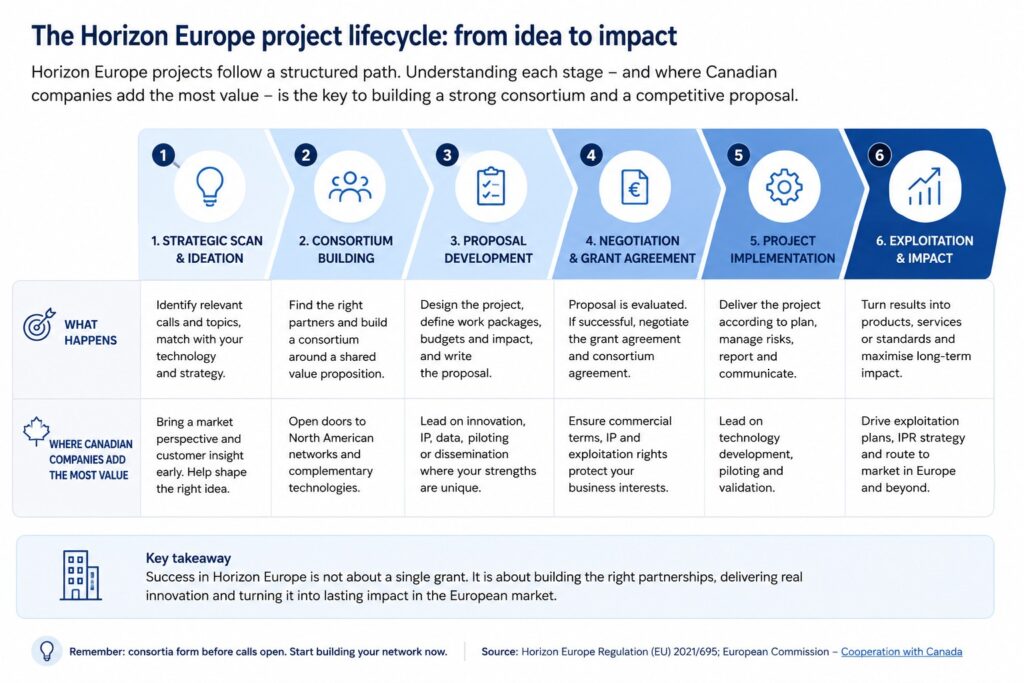
- Consortia form before calls are published, through networks that Canadian companies are usually outside of.
- The time horizon is long. A company assessing this against a domestic programme with a three-month decision cycle will usually conclude it is not worth it — which is the right conclusion if the project is judged only on the grant.
The commercial case, stated honestly
A Canadian company’s share of a collaborative project budget is typically a fraction of a larger total. If the grant is the whole rationale, the effort is hard to justify. The reasons that do justify it are different:
- Access to a European partner network that is otherwise slow and expensive to build — including the industrial partners and end users who will be your customers if you enter the market.
- Technical validation alongside recognised European institutions, which carries weight with European buyers and investors.
- Early sight of where European regulation and standards are heading, in sectors where the EU sets the pace.
- A delivery record inside the EU system, which materially changes access to later opportunities.
- A structured route into European market entry that is not a sales process.
Judged as market entry with an R&D grant attached, the arithmetic works. Judged as a grant application, it usually does not.
How the money and the rules work
| Question | Answer for a Canadian entity |
| Do we get funded directly? | Yes. Canada contributes to the programme budget, so Canadian beneficiaries receive funding directly from the Commission rather than self-funding. |
| Can we coordinate a project? | Yes, Canadian entities can lead consortia. In practice, participating as a partner first is the sensible route. |
| What is the minimum consortium? | For most collaborative actions, at least three independent legal entities from three different eligible countries, with at least one in an EU Member State. Canada counts as an eligible associated country for Pillar II. |
| Who keeps the intellectual property? | Results are owned by the partner that generates them, with access rights and exploitation arrangements set out in the grant agreement and the consortium agreement. Negotiate the consortium agreement carefully — it is where the commercially important terms sit. |
| What about federal entities? | Federal bodies and their employees are unlikely to receive direct funding, but can still join consortia and contribute in kind or from internal sources. |
| Do we need a European entity? | No. Association means the Canadian entity itself is eligible for Pillar II. A European entity may make sense commercially, and is required for EIC Accelerator, but it is not needed to participate. |
Sectors where Canadian companies fit
Fit is not evenly distributed. These are the areas where Canadian industrial capability and current European funding priorities overlap most clearly:
| Area | Why the overlap exists |
| Artificial intelligence and digital | Established Canadian AI research and commercial base, matching Cluster 4 and the AI-focused horizontal calls in the 2026–2027 programme |
| Clean technology and energy transition | Strong Canadian cleantech sector against a European programme where climate action carries a large share of the budget |
| Critical minerals and advanced materials | A live European supply-chain priority with obvious Canadian relevance |
| Health technology and life sciences | A cluster where Canadian institutions already participated heavily under the predecessor programme |
| Agri-food and bioeconomy | Scale and research depth on the Canadian side, matching Cluster 6 topics |
| Quantum and photonics | Recognised Canadian research strength in areas where Europe is investing to build capability |
| Space and earth observation | Long-standing bilateral cooperation and an established Canadian supplier base |
A realistic entry path
- Decide what you want from Europe. Market access, a specific partner, technical validation, standards influence — the answer determines which cluster and which topics are worth reading.
- Read two full call topics end to end, including expected outcomes and specific conditions. This is the fastest way to understand what the programme is actually asking for.
- Register and obtain a Participant Identification Code. Do this independently of any specific application, so it is never on the critical path.
- Define a role rather than a capability. Coordinators assign work, not admiration. State what you would deliver, in which work package, with what facilities and outputs.
- Write a one-page partner profile in English: what you do, what you have delivered, your eligibility status, and the role you are seeking. This is the document that circulates when consortia form. For a fuller view of how these partnerships come together, see our guide to building a consortium.
- Use the Canadian support structure. ISED is the national point of contact and there is a Canadian National Contact Point network — an introduction from an NCP carries weight that cold outreach does not.
- Search CORDIS for completed and ongoing projects in your field, identify the recurring coordinators, and approach them specifically with reference to their actual work.
- Attend brokerage events and info days for the clusters that fit, with a defined role in mind rather than to browse.
- Start as a partner. Coordination is a multi-year administrative commitment and is the wrong first step.
What European coordinators will want to know
Anticipating these questions in your first message removes most of the friction:
- Are you eligible for this specific topic, and have you checked the topic text for restrictions?
- Do you have a Participant Identification Code?
- What exactly would you deliver, and in which work package?
- Have you participated in an EU project before, and if not, do you understand the reporting obligations?
- How will time zones and distance be handled for meetings and delivery?
- Is there anything about your ownership structure that could raise a strategic-autonomy question under this topic?
Answering the last two before being asked is unusual, and it is noticed.
Timeline
A Canadian company entering for the first time should plan on six to twelve months from decision to submission, and a further period before a funded project begins. The partner-search and relationship phase is the long part, and it cannot be compressed by starting late. A call closing in eight weeks with no consortium is a call to skip while building for the next cycle.
How Nexuswelt works with Canadian companies
Nexuswelt is a European company based in Munich and active across Europe. For a Canadian company, the useful thing is not another explanation of eligibility but a partner inside the European system: fit assessment against real topics, role definition, consortium positioning, partner search and the material that makes you credible to a coordinator. Nexuswelt also contributes to funded projects as a partner for communication, dissemination, stakeholder engagement and exploitation. More is on the Nexuswelt about page.