Introduction The European Innovation Council is becoming one of the most important instruments in Europe’s deep-tech innovation landscape. Its role is no longer limited to supporting individual start-ups or research-based companies. It is increasingly connected to Europe’s competitiveness, technology sovereignty, investment capacity and ability to transform scientific excellence into globally…
Introduction The next EU Framework Programme for Research and Innovation is already taking shape. Often referred to as FP10, the programme is expected to continue under the name Horizon Europe and cover the period 2028-2034. For companies, universities, research and technology organisations, public authorities, clusters and innovation ecosystems, this is…
Why this topic matters now Europe’s innovation landscape is changing. Technologies that were once developed mainly for civilian markets are now becoming relevant for resilience, security and defence-related applications. This creates opportunities for startups, SMEs, research organisations and industrial technology providers, but it also creates more strategic complexity. The key…
Executive summary AI is now one of the strongest themes across European research and innovation funding. Horizon Europe, Digital Europe, health, manufacturing, data spaces, public-sector innovation, climate, security and industrial transformation increasingly include AI-based methods, platforms and decision-support tools. But the strongest AI proposals in 2026-2027 will not be the…
Nexuswelt is a European funding and innovation agency based in Germany, with representative presence in Cyprus and Ukraine. Nexuswelt helps startups, SMEs, research organisations, technology providers, project coordinators and EU project consortia enter and succeed in EU-funded projects across Horizon Europe, Chips JU, Digital Europe, the European Defence Fund, Interreg…
Why EU Missions require more than a good research idea EU Missions under Horizon Europe are not ordinary research topics. They are designed around major societal challenges with clear goals, measurable impact and a strong implementation logic. This makes them attractive for universities, research organisations, SMEs, cities, regions, hospitals, clusters,…
Why this topic matters now Many organisations start EU funding preparation with the same question: “Who can join our consortium?” This is understandable. Horizon Europe, Digital Europe, LIFE, the Innovation Fund, the EIC Accelerator and other EU programmes often require cooperation across countries, sectors and types of organisations. But partner…
Helping startups, SMEs and young technology companies find the right EU funding path From startup events to real funding opportunities Europe’s 2026 startup and innovation calendar creates several important meeting points for founders, investors, technology companies, research organisations, public-sector stakeholders and innovation ecosystems. For Nexuswelt, three events are especially relevant:…
Why Shorter Templates Require Stronger Strategy Horizon Europe 2026-2027 is becoming simpler on paper. But for applicants, this does not automatically mean proposals will be easier to prepare. The new Work Programme introduces shorter and more focused topic descriptions, fewer topics, broader calls, more lump-sum funding, more two-stage procedures and…
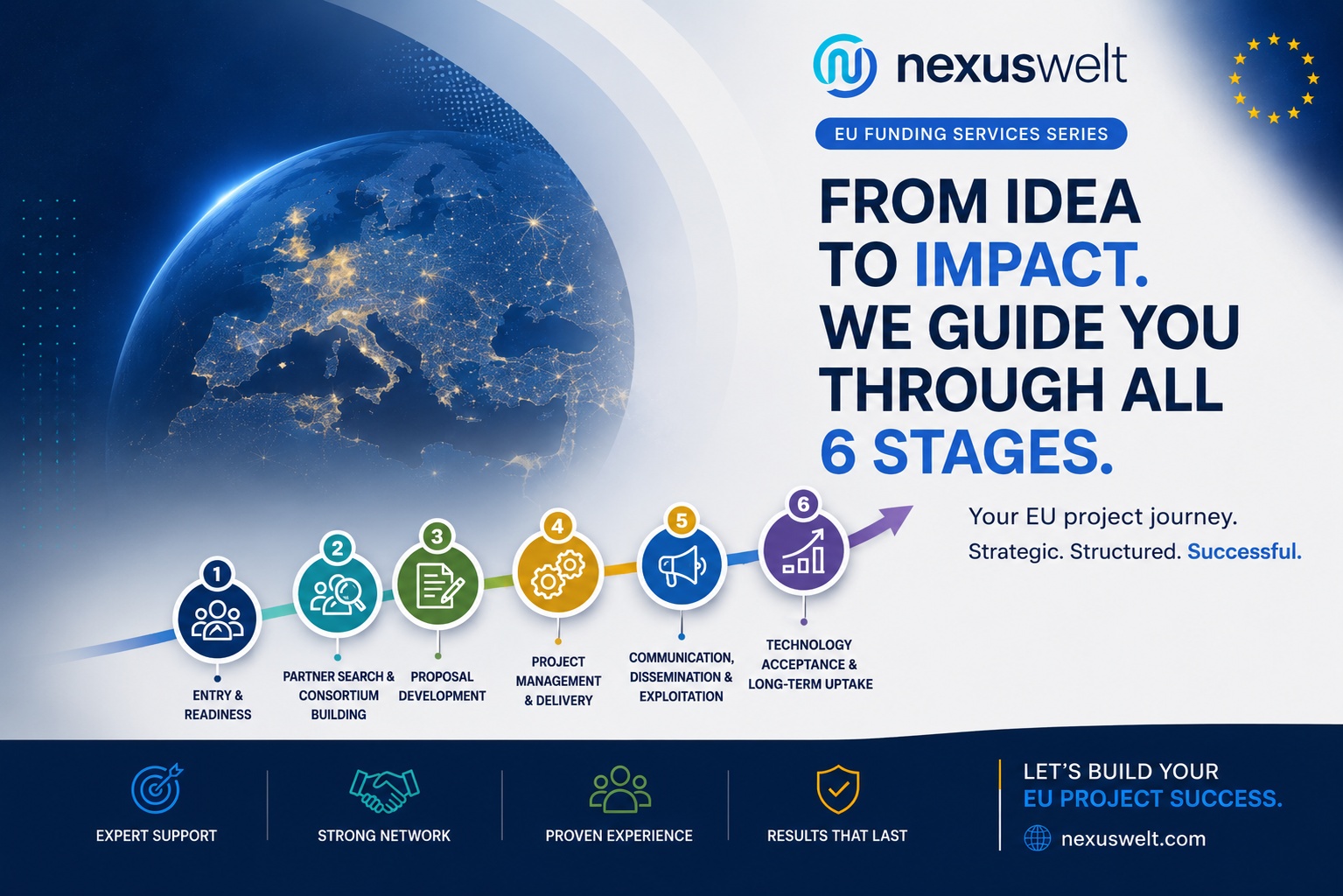
EU-funded projects are becoming more competitive, more strategic and more implementation-oriented. Across Horizon Europe, Digital Europe, Chips JU, Erasmus+, European Defence Fund, LIFE, Interreg, EU4Health and other European programmes, a strong project idea is no longer enough on its own. Successful proposals need the right consortium, a clear policy fit,…