Three to five independent experts will read your proposal. Each spends a few hours on it before the consensus meeting. In that time they are trying to answer one question about this part of the document: will these results leave the lab?
A vague paragraph answers that question badly, and it costs points under the Impact criterion. This article covers what to write, in what structure, with what level of specificity — and what evaluation summary reports consistently say about the sections that score three out of five instead of five.
Where this sits in the evaluation
Communication, dissemination and exploitation are assessed as part of the Impact criterion. Impact is scored alongside Excellence and Implementation, and in two-stage calls only Excellence and Impact are evaluated at the first stage — which raises the weight of this section considerably at the point where the field is widest.
What evaluation summary reports repeatedly identify in proposals scoring three out of five on Impact: outputs listed without an exploitation pathway, missing or unquantified indicators, and a dissemination plan that amounts to publications and conferences. Those three patterns are worth memorising, because they are avoidable in a day of work.
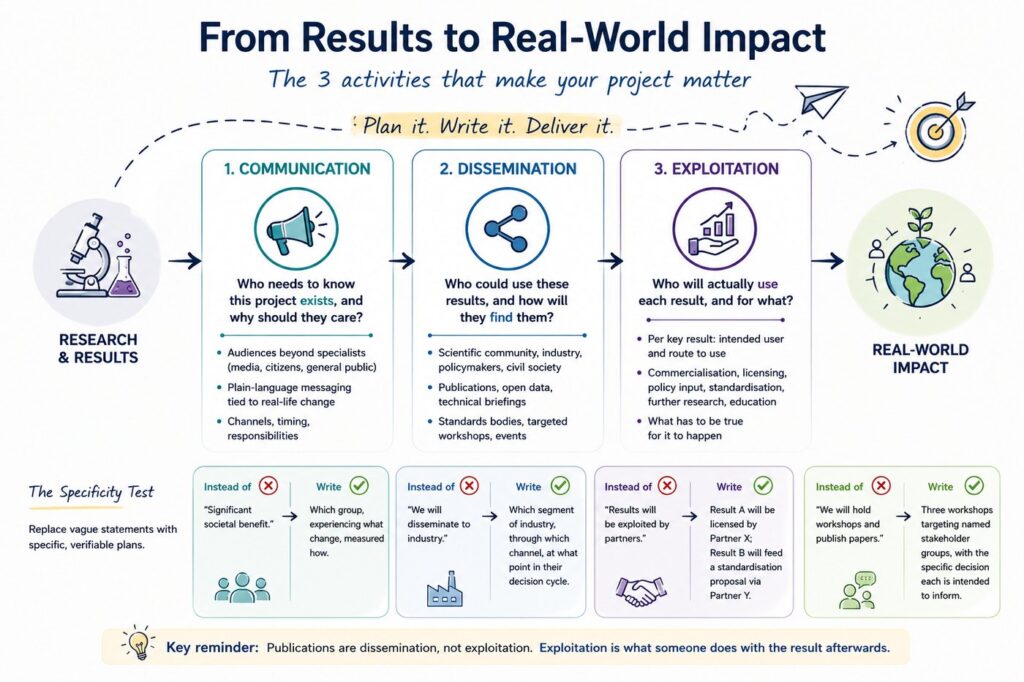
Structure it as three sections, not one
The most common structural failure is a single block of text mixing all three activities. It is flagged repeatedly as a recurring applicant error, and it produces a section that cannot be scored well because the evaluator cannot locate the answers.
Write three clearly separated sections. Even the headings do work here: an evaluator scanning for the exploitation plan should find a heading that says exploitation.
| Activity | The question it answers | What belongs in it |
| Communication | Who needs to know this project exists, and why should they care? | Audiences beyond the specialists, including media and the public. Plain-language messaging tied to what changes in people’s lives. Channels, timing, responsibilities. |
| Dissemination | Who could use these results, and how will they find them? | Scientific community, industry, policymakers, civil society. Publications, open data, technical briefings, standards bodies, targeted workshops. |
| Exploitation | Who will actually use each result, and for what? | Per key result: the intended user, the route to use, and what has to be true for it to happen. Commercialisation, licensing, policy input, standardisation, further research, education. |
The specificity test
Almost every weakness in this section reduces to insufficient specificity. Four substitutions fix most of it.
| Instead of | Write |
| “Significant societal benefit” | Which group, experiencing what change, measured how |
| “We will disseminate to industry” | Which segment of industry, through which channel, at what point in their decision cycle |
| “Results will be exploited by partners” | Result A will be licensed by Partner X; Result B will feed a standardisation proposal via Partner Y |
| “We will hold workshops and publish papers” | Three workshops targeting named stakeholder groups, with the specific decision each is intended to inform |
Evaluators have read the left-hand column several thousand times. It does not score. The right-hand column takes no more space — it is the same sentence with the placeholders filled in.
Exploitation: the section that decides the score
Dissemination plans are usually adequate. Exploitation plans are usually where proposals lose. Two failures dominate.
The first is listing academic publications as the exploitation strategy. Publications are dissemination. Exploitation is what someone does with the result afterwards. A proposal whose exploitation section lists conferences and papers has effectively left the section blank, however well written it is.
The second is treating exploitation as premature. Low-TRL consortia frequently write that exploitation planning is too early to be meaningful at this stage. Evaluators flag this explicitly. Early-stage research still has identifiable downstream users, and a plausible pathway can be described even when the destination is uncertain. Saying it is too early reads as not having thought about it.
The structure that works
Build the exploitation section around results rather than around partners. For each key exploitable result:
- What the result is, concretely — a method, a dataset, a device, a policy recommendation, a piece of software.
- Who owns it, or how ownership will be determined. Unclear ownership is a visible weakness.
- Who the intended user is, named by type and preferably by example.
- The route: commercialisation, licensing, standardisation, policy input, further research, education, internal use.
- What has to be true for that route to work — regulatory approval, further validation, a partner who does not yet exist.
- What happens after the grant ends, since the obligation continues past the final report.
For industry-facing calls, the absence of a route-to-market analysis is close to an automatic score reduction. If the call expects market uptake, the section has to contain a market argument, not a dissemination argument in commercial language.
Indicators evaluators believe
Quantified indicators are expected, and missing them is a named weakness in evaluation reports. But the wrong indicators are almost as damaging as none, because they signal that the consortium is measuring activity rather than effect.
| Level | Example | How it reads to an evaluator |
| Activity | 12 workshops delivered, 8 publications submitted, 40 posts published | Necessary baseline. On its own, it reads as a plan to be busy. |
| Reach | Attendance composition by stakeholder type; downloads by sector; citations in target communities | Better. Shows the right audiences were reached, not just an audience. |
| Uptake | A standards body that took up a result; a public authority citing a recommendation; a licence signed; a curriculum adopting a method | This is what supports an impact claim. One credible uptake indicator outweighs ten activity counts. |
Include all three levels, with baselines where a baseline exists and a stated method of collection. An indicator with no collection method is a number the consortium has no way of producing.
Consistency across the proposal
A specific and frequently penalised failure: an impact claim in Section 2 with no corresponding activity in the work packages in Section 3. Evaluators cross-read the sections, and a claim with no resourced activity behind it undermines the credibility of the whole section.
Before submission, check three alignments:
- Every audience named in the impact section appears in a work package task with effort allocated to reaching them.
- Every key exploitable result named in the exploitation plan appears as an output of a specific work package.
- Every indicator has a task that produces the data it requires.
This check takes an hour and removes the most common cross-sectional criticism in evaluation reports.
Ownership inside the consortium
A plan where the communication partner owns everything will underdeliver, and experienced evaluators recognise the pattern. Technical partners own their results, their intended users and their route to use; nobody else can supply that knowledge.
A workable division: a dedicated partner or work package coordinates, sets the framework, runs the shared channels and drives the monitoring. This division of responsibilities should be part of consortium design from the beginning, rather than added during proposal writing.
Each technical partner owns the exploitation pathway for its own results and contributes the audience knowledge for its domain. Name this division in the plan explicitly — it demonstrates that the consortium has thought about delivery, not just about writing.
Practical constraints worth planning for
- Page limits are enforced by truncation. Excess pages are not read, and the impact or implementation section is often what gets cut. Plan the length early and leave a buffer.
- With the shortened 2026–2027 templates, a padded impact section is more exposed than it used to be. There is less room for narrative that does no work.
- Under lump sum funding, communication and dissemination activity has to be structured so completion can be evidenced, because it sits in work packages that trigger payment.
- EU emblem and funding statement obligations apply to materials produced with grant funding. It is a straightforward compliance point and an avoidable finding.
A checklist before submission
- Three separate sections with headings that name the three activities.
- No sentence containing an unfilled placeholder such as “relevant stakeholders” or “significant benefit”.
- Exploitation organised by result, with an owner and a route for each.
- A route-to-market argument where the call is industry-facing.
- Indicators at activity, reach and uptake level, with collection methods.
- Every audience, result and indicator traceable to a work package task.
- Named responsibilities that do not place everything on one partner.
- Post-project continuation addressed.
- Within the page limit, with room to spare.
How Nexuswelt works with consortia on this section
Nexuswelt contributes to EU-funded projects as a partner for communication, dissemination, stakeholder engagement and exploitation — which means this section is written from the perspective of having to deliver it afterwards, not only of scoring it. The broader treatment of coordinator obligations is in our guide to communication, dissemination and exploitation, and more on the firm is on the Nexuswelt about page. For practical support with communication planning, stakeholder engagement and dissemination activities in Horizon Europe projects, explore our EU Project Communication & Dissemination services.