Building a consortium is the part of Horizon Europe that no rulebook prepares you for. The eligibility conditions take a paragraph to state. Assembling seven organisations across five countries who trust each other enough to co-sign a budget takes months.
This guide is for organisations doing it for the first time, either as a prospective coordinator or as a partner trying to get into a consortium that is already forming. It covers the formal requirements, the sequence that works, where to actually find partners, how to approach them, and the structural mistakes that cost proposals points at evaluation.
The formal requirements, briefly
For most collaborative Horizon Europe actions the minimum is straightforward:
- At least three independent legal entities.
- Each established in a different EU Member State or country associated to Horizon Europe.
- At least one of them established in an EU Member State.
Two clarifications that trip people up. “Independent” means genuinely independent- subsidiaries of the same parent company do not count as separate partners. And individual call topics frequently add conditions on top of the minimum: a required number of SMEs, specific stakeholder types, geographic spread, or end-user involvement. Always read the topic text rather than relying on the general rule.
In practice the minimum is almost never the target. Typical collaborative projects run considerably larger, because the work programme expects a consortium capable of delivering across the whole impact pathway, not one that scrapes past the eligibility threshold.
The sequence that works
The single most common structural error is finding partners first and writing the proposal around whoever agreed. Evaluators can see this. The consortium reads as an assembly of organisations rather than a team designed to deliver a specific outcome.
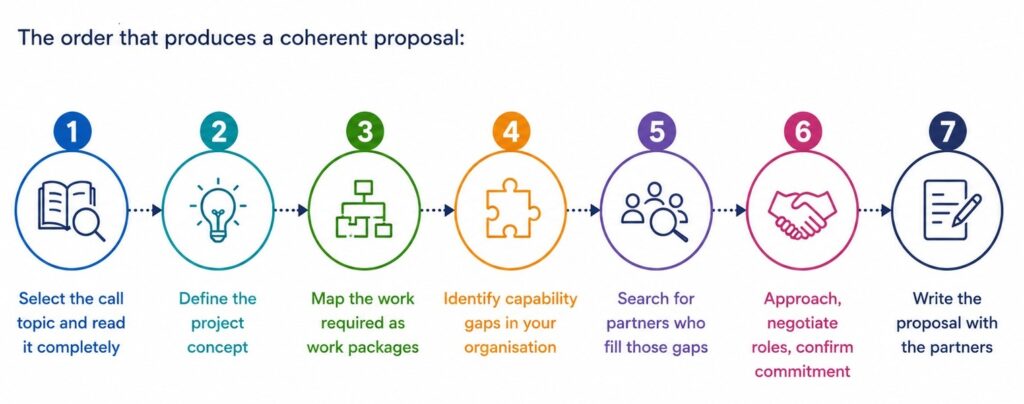
Steps 1 to 4 can be done alone in a fortnight. Skipping them is what makes step 5 take six months and produce the wrong team.
Where to find partners
There are more routes than most first-time applicants realise, and they differ sharply in quality of match.
| Route | What it gives you | How good the match usually is |
| Funding & Tenders Portal partner search | The Commission’s own tool, integrated with the call topics themselves. Organisations publish profiles and collaboration offers. | Variable. Wide reach, but many profiles are generic and unattended. |
| CORDIS project database | Every EU-funded project with its full partner list. Search by topic to see who has already delivered work adjacent to yours. | High. These are organisations with a proven delivery record in your field. |
| Horizon Dashboard | Participation statistics and data on organisations active in EU research and innovation. | Useful for assessment rather than first contact. |
| National Contact Points | Every Member State and associated country has NCPs whose job includes connecting applicants. Free, official, and consistently underused. | High, and they can vouch for you, which cold outreach cannot. |
| Info days and brokerage events | Call-specific events, usually with structured matchmaking platforms attached. | High, if you attend with a defined role in mind rather than to browse. |
| European Technology Platforms, KICs and clusters | Sector-specific membership networks that maintain partner directories. | High within their sector. Membership often pays for itself here. |
| Existing institutional links | Joint labs, bilateral agreements, former project partners, alumni networks. | Highest. Most consortia form around people who have worked together before. |
Start with the last row. Then use CORDIS to find organisations that have delivered in your topic area, and the Funding & Tenders Portal partner search to make yourself findable in return. Contact your National Contact Point early – earlier than feels necessary.
How to approach a potential partner
Most outreach fails for the same reason: it asks the recipient to do the thinking. A coordinator receiving twenty messages before a deadline will answer the ones that require the least work to evaluate.
A message that gets answered contains:
- The specific call topic identifier, so the recipient knows immediately what this is about.
- A two-sentence project concept – not a description of your organisation.
- The specific role you propose for them, or the specific role you are seeking, named against a work package.
- Why them in particular. A reference to their actual prior work signals you have done the research; its absence signals a mass mailing.
- The timeline, including the submission deadline and when you need a decision.
- A one-page profile attached, so they can circulate you internally without rewriting anything.
What to avoid: sending the same message to twenty organisations, approaching three weeks before a deadline, describing capability without proposing a role, and any request for payment in exchange for inclusion – that last one is a recognised warning sign, not a normal practice.
Designing the consortium, not just filling it
Evaluators assess whether the consortium is the right team for this specific project. Several things they look for are structural, and they are decided before a word of the proposal is written. The same pathway logic is central when writing the impact section.
Every partner must be necessary
If two partners have substantially the same profile and capability, one of them is redundant, and a reviewer will say so. Each organisation should map to work that could not be delivered without them.
The chain must be complete
A strong consortium covers the whole path from research through development to the users who will take the results up. A project that is all universities has no route to uptake; a project that is all companies often has no research depth. Where the call expects end-user involvement, an end user must actually be a partner, not a name in a letter of support.
Geographic and organisational balance
Beyond the formal three-country minimum, consortia that concentrate in one region or one organisational type score worse on implementation and impact. Widening-country participation is actively encouraged in many topics and is worth planning for rather than adding late.
This can also include strategically selected Ukrainian partners where the call and project scope make their participation relevant.
Experience distributed sensibly
Newcomers are welcome in Horizon Europe – the consortium as a whole is what must demonstrate capability. Pair a first-time participant with an experienced coordinator and the risk is manageable. A consortium where nobody has delivered an EU project before is a different proposition, and evaluators treat it as one.
Size proportionate to the work
Adding partners to look substantial is counterproductive. Every additional organisation adds coordination cost, dilutes budget, and creates another point where the implementation section has to justify itself. Build to the work, not to an impression.
Coordinator or partner: choose honestly
| Coordinating | Participating as a partner | |
| What it takes | Substantial administrative capacity across the project’s full duration, often several years, and more than one person | Delivery of your work packages and cooperation with reporting |
| What you gain | Control of the concept, the consortium and the direction. Strongest possible track record. | Access, validation, network and experience of how a project actually runs |
| The risk | Underestimating the load. Coordination is a role, not a title. | Limited influence over a concept shaped before you joined |
| Right for | Organisations with prior EU project experience and real institutional support | First-time participants, in almost all cases |
Participating in a first consortium before leading one is not a lesser path. It is the normal path, and it materially improves the odds when you do coordinate.
For organisations entering Horizon Europe for the first time, our guide to EU funding for startups explains where to start and how to approach the funding landscape.
Where consortia go wrong
- Assembling partners before defining the work, then reverse-engineering work packages to fit whoever agreed.
- Starting the search after the call opens. Most consortia form around a core group before publication.
- Duplicate profiles that give evaluators an obvious point of criticism.
- No route to uptake – no end user, no industry partner, no adoption pathway.
- A partner included for a country or a logo rather than for work they will actually do.
- Leaving intellectual property and results ownership to the consortium agreement stage. Discuss it early; it is harder to renegotiate after roles are fixed.
- Unclear commitment. A partner who has not confirmed budget and effort in writing is not a partner yet.
- Ignoring the dissemination and exploitation dimension until the proposal is nearly written, when it should shape who is in the consortium in the first place.
A realistic timeline
| Phase | Realistic duration |
| Topic selection and concept definition | 2–3 weeks |
| Work package mapping and gap analysis | 1–2 weeks |
| Partner search and first approaches | 4–8 weeks for a first consortium |
| Negotiating roles, effort and budget shares | 3–6 weeks, and it overlaps with writing |
| Proposal writing with the consortium | 6–12 weeks |
| Internal review and submission | 2 weeks, and do not compress this one |
Working backwards from that: a first consortium needs roughly four to six months before the deadline. If a call closes in eight weeks and you have no partners, the realistic move is to target the next cycle and use this one to build the network.
How Nexuswelt supports consortium building
Nexuswelt works with organisations on exactly this stage: assessing fit against a topic, defining a defensible role, building and positioning consortia, and preparing the partner-facing material that makes an organisation findable and credible. The firm also contributes to funded projects as a partner for communication, dissemination, stakeholder engagement and exploitation – which is why consortium design and impact delivery are treated here as one problem rather than two. More is on the Nexuswelt about page.
Frequently asked questions
What is the minimum consortium for a Horizon Europe project?
Most collaborative actions require at least three independent legal entities, each established in a different EU Member State or associated country, with at least one established in an EU Member State. Individual call topics often add further conditions, so the topic text takes precedence over the general rule.
Can two companies from the same group count as separate partners?
No. Partners must be independent of each other, and subsidiaries of the same parent are not considered independent for eligibility purposes.
How many partners does a typical Horizon Europe project have?
Considerably more than the minimum. Collaborative projects commonly involve a substantially larger consortium, because the work programme expects coverage of the full pathway from research to uptake. The right number is determined by the work, not by the eligibility threshold.
Where can I find Horizon Europe consortium partners?
The main routes are the Funding & Tenders Portal partner search, the CORDIS database of funded projects, National Contact Point networks, call-specific info days and brokerage events, sector platforms and clusters, and existing institutional relationships. Prior collaborations and NCP introductions typically produce better matches than open databases.
When should I start looking for partners?
Before the call opens, wherever possible. Most consortia form around a core group before the topic is public. A first consortium realistically needs four to six months before the submission deadline.
Should a first-time participant coordinate or join as a partner?
Join as a partner in almost all cases. Coordination requires sustained administrative capacity across several years and more than one person. Participating first builds the track record and the practical understanding that make later coordination viable.
Can newcomers join a Horizon Europe consortium?
Yes. New organisations are welcome, and what matters is that the consortium as a whole demonstrates capability. Pairing an inexperienced partner with an experienced coordinator is a normal and accepted structure.
Is it normal to pay to join a consortium?
No. A request for up-front payment in exchange for inclusion in a proposal is a recognised warning sign rather than standard practice. Legitimate consortium partners contribute work and receive a share of the project budget.
Sources
- EU Funding & Tenders Portal – partner search and call topics
- CORDIS – EU research results and funded project database
- Horizon Europe NCP Portal – National Contact Point networks and partner search guidance
- Horizon Europe NCP Portal – partner search guide
- Horizon Europe – official research and innovation portal
- EU Grants – List of participating countries in Horizon Europe