Impact is where technically excellent proposals lose. A consortium that scores well on Excellence and Implementation and only three out of five on Impact will usually not be funded, because in a field this competitive the threshold is not the problem – the ranking is.
The difference between a three and a five is rarely ambition. It is causal logic: whether an evaluator can follow a plausible chain from what you will do, through what will exist because of it, to who will change their behaviour as a result. This article covers how to build that chain, how the 2026 template changed what belongs in the section, and what separates a scoring impact section from a plausible-sounding one.
How Impact is scored
Every collaborative proposal is assessed against three criteria – Excellence, Impact and Implementation – each scored from zero to five, each with a threshold below which the proposal is rejected regardless of the other scores. For innovation actions, Impact carries additional weight in the ranking formula, which is worth knowing before deciding how to allocate writing effort.
Evaluators assess two things under Impact: the credibility of the pathways from your activities to the expected outcomes and wider impacts, and the magnitude and importance of those impacts. Credibility comes first. An enormous claimed impact with no plausible route to it scores worse than a modest one with a convincing chain.
| Score | What it looks like | Why it happens |
| 5 | A specific, evidenced causal chain; named users; realistic magnitude; measures that clearly serve the pathway | The consortium designed the impact logic before writing, and the work plan reflects it |
| 4 | Credible pathway with one or two soft links or unevidenced assumptions | Usually a single weak step – often the transition from result to user |
| 3 | Plausible but generic. Societal benefits described in broad terms without a credible route to them | The section was written after the technical work was designed, as narrative rather than logic |
| Below 3 | Claims without mechanism, or impacts unrelated to the topic’s expected outcomes | The topic text was not used as the anchor |
The three is the dangerous score. It passes the threshold, feels acceptable when you read it back, and quietly removes you from the funded range.
Start from the topic, not from your project
The single most common structural error is writing the impact you would like your project to have, then attempting to connect it to the call. The order has to be reversed.
Each topic states expected outcomes, and sits within a destination with wider expected impacts. Those are the targets your section must hit. But repeating them verbatim is not the answer either – evaluators read the same restated sentences in every proposal on their pile.
What scores is restating them implicitly through your own specific results. If a topic expects improved decision-making by public authorities, the section should identify which of your outputs – a validated decision-support tool, a dataset, a guideline – produces that improvement, which authorities could realistically adopt it, and under what conditions they would.
Outputs, outcomes, impacts: keep them distinct
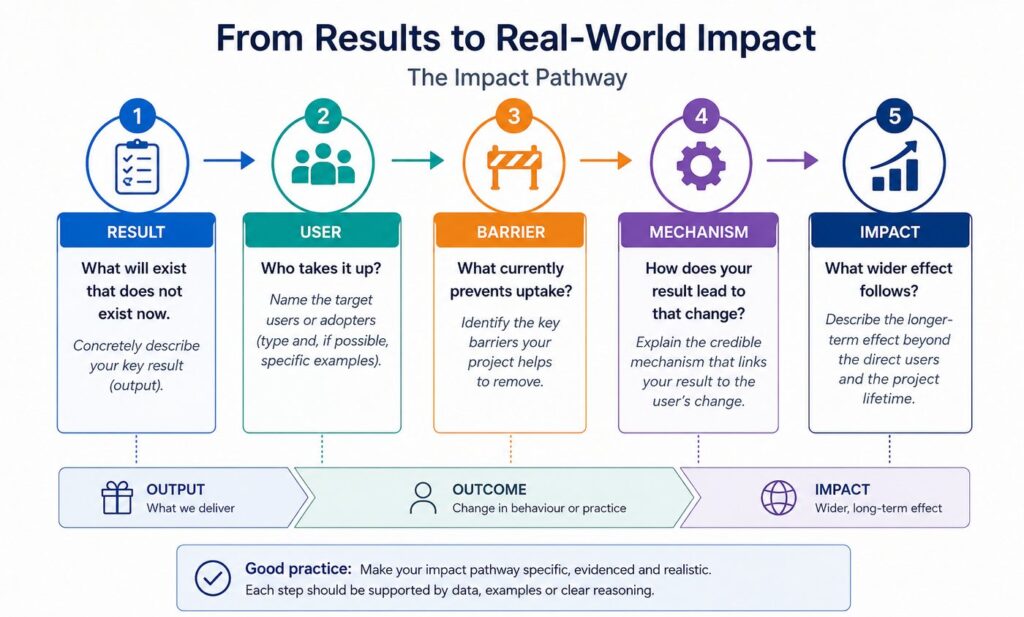
Most weak sections list outputs and then assert impacts, skipping the outcome entirely. The outcome is the load-bearing step: it is where a real person outside the consortium does something differently. If you cannot name that person and that change, the chain is broken and an evaluator will see the gap.
Building the pathway
For each significant result, write the chain explicitly:
- The result – what will exist that does not exist now, described concretely.
- The user – who takes it up, named by type and where possible by example.
- The barrier – what currently prevents that uptake, and what in your project removes it.
- The mechanism – through what route the result reaches that user: licensing, standardisation, policy channel, open publication, further research, training.
- The condition – what has to be true for the mechanism to work, including things outside your control.
- The evidence – why this is plausible: preliminary data, letters of intent, comparable adoption rates, prior funded work.
Naming a condition outside your control strengthens the section rather than weakening it. It signals that the consortium understands the environment it is operating in. A pathway with no stated assumptions reads as one nobody stress-tested.
What changed in the 2026 template
The 2026–2027 impact section was streamlined. Applicants are no longer required to describe general scientific, economic and societal impacts in the abstract, or to quantify the scale and significance of expected contributions. For the wider context, see our overview of what changed in the 2026–27 work programme.
Two consequences follow, and they pull in opposite directions from how the change is usually read.
- What was removed was the boilerplate – the generic societal-benefit narrative and invented quantification that evaluators had long since learned to discount. Its absence does not reduce the weight of Impact in the score.
- Page limits are tighter. With less room, a padded section is more exposed, not less. Every paragraph that does not advance the causal chain is now visibly occupying space that a stronger proposal used for evidence.
The practical instruction: do not trim an old impact section to fit. Rebuild it around the pathway logic, and let the length fall out of that.
Indicators that support the claim
Missing or unquantified indicators is a named weakness in evaluation reports. But indicators that measure activity rather than effect signal that the consortium has not understood what is being asked.
| Level | Example indicator | What it evidences |
| Output | Deliverables produced; publications submitted; events held | That the work was done. Necessary, and not an impact claim. |
| Outcome | Number and type of organisations adopting the method; composition of workshop attendance by stakeholder type; downloads by sector | That the intended change began. This is the level most sections omit. |
| Impact | Measured effect in the target domain; a standard amended; a policy citing the result; a licence signed | That the pathway completed. One credible indicator here outweighs many activity counts. |
Every indicator needs a baseline where one exists and a stated method of collection. A target with no baseline cannot demonstrate change, and an indicator with no collection method is a number the consortium has no way of producing.
Consistency: the cross-check evaluators make
Evaluators read the sections against each other. A specific and frequently penalised failure is an impact claim in Section 2 with no corresponding resourced activity in the work packages in Section 3.
Before submission, verify three alignments:
- Every named user in the impact section appears in a work package task with effort allocated to reaching them.
- Every result in a pathway is an output of a specific work package.
- Every indicator has a task that generates the data it requires.
The reverse check matters too: an objective stated in the Excellence section that never appears in the work plan, or a work package that produces something no pathway uses. Both read as a proposal assembled in parts. This is ultimately a consortium and work plan design issue, not only a writing issue.
Writing for how the section is actually read
Three to five experts read your proposal, each spending a few hours on it before the consensus meeting. They scan before they read, and they use the evaluation sub-criteria as a checklist.
- Mirror the template structure and the criterion headings. An evaluator looking for the pathways discussion should not have to hunt for it.
- Use a summary table where the template provides one, and conform to it rather than improvising a better format.
- Bold the load-bearing claims. Scanning is the first pass, and what is bold is what gets read first.
- Where a sub-criterion does not apply to your project, say so explicitly. Silence reads as an omission; a stated reason reads as judgement.
- Support claims with references, preliminary results, letters of intent from end users, or adoption data from comparable funded work available through CORDIS.
Where sections lose points
- Impact claims that could appear in any proposal in the field.
- Skipping the outcome level – outputs asserted directly into impacts.
- Confusing dissemination and exploitation – for example, describing exploitation as publications and conferences.
- “Too early to consider” as an answer on exploitation at low TRL. Evaluators flag this explicitly.
- No route-to-market argument in an industry-facing call.
- Impacts unconnected to the topic’s stated expected outcomes.
- Quantification invented to look rigorous. An unevidenced number is worse than an honest range.
- Exceeding the page limit, which is enforced by truncation – and the impact or implementation section is often what gets cut.
How Nexuswelt works on impact sections
Nexuswelt works with consortia on impact logic, pathway design and the communication, dissemination and exploitation measures that carry it – from the perspective of having to deliver them afterwards as a project partner, not only of scoring them. The companion article on the section that sits inside Impact is our guide to writing a communication and dissemination plan that passes evaluation, and more on the firm is on the Nexuswelt about page.