Lump sum funding is usually introduced with a single sentence: you report on what you delivered instead of what you spent. That is accurate, and it is also the reason so many consortia are caught out by it.
The sentence describes what happens after the grant is signed. It says nothing about what happens before — where lump sum demands more preparation, not less — or about the way payment actually works, which changes how a work plan should be structured. With around half of the 2026–2027 call budget delivered this way, this is no longer a niche mechanism to learn about when it comes up. This guide explains it end to end. This shift is one of the most consequential of the 2026–27 work programme changes.
What lump sum funding actually is
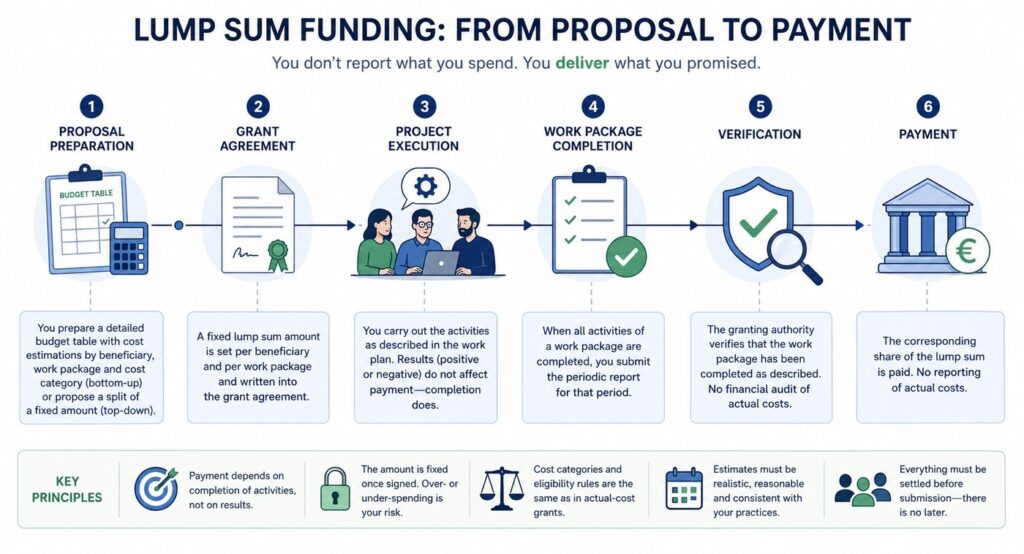
Under a lump sum grant, a fixed amount is set per beneficiary and per work package in the grant agreement. When a work package is completed, the corresponding share is paid. There is no reporting of actual costs incurred, and the granting authority does not carry out financial checks or audits of the resources used.
Two points deserve emphasis because they are consistently misread.
- Payment depends on completion of the activities, not on the success of the results. A work package that was carried out as described but produced a negative scientific result is still completed. This is not a performance-based instrument.
- The amount is fixed once signed. If the work costs more than estimated, the difference is absorbed by the beneficiary. If it costs less, the amount does not shrink. The estimate you submit is the number you live with.
The two types, and which one you will actually meet
| Type | How the amount is set | What you have to do |
| Type 1 (top-down) | The total lump sum is fixed by the granting authority in the call itself. Your requested budget must add up to that figure. | Propose a split of the lump sum across work packages, and describe the effort and resources each beneficiary commits for that amount |
| Type 2 (bottom-up) | You define the amount yourself in the proposal, based on cost estimations. | Complete a detailed budget table with cost estimations broken down by beneficiary, work package and cost category |
In practice, most Horizon Europe topics using lump sum use the bottom-up variant. That means the detailed budget table is the part of the process you should plan for.
The part nobody warns you about: the detailed budget table
For bottom-up lump sums, a detailed budget table must be submitted as a mandatory annex to Part B of the proposal. It is an Excel file downloaded from the submission system, and it requires cost estimations for every beneficiary and affiliated entity, broken down by work package and by cost category. The Commission’s own guidance note, “Lump sum funding: what do I need to know?”, walks through how it is filled in.
Three things follow from this, and together they overturn the idea that lump sum means less work:
- All cost categories still exist, and the same eligibility rules apply. A cost estimation can be included only if that same cost would have been eligible in an actual-cost grant. You are not escaping the cost rules; you are applying them in advance instead of afterwards.
- The estimations must be a genuine approximation of real costs, consistent with your organisation’s normal practices, reasonable and not excessive. Evaluators assess whether the budget is realistic, and an implausible estimate can lower your score or lead to an adjustment at grant preparation.
- Everything has to be settled before submission. In an actual-cost grant, a budget can absorb a degree of imprecision because reality is reported later. Here there is no later.
The practical consequence for planning: budget work moves forward in the proposal timeline, and it takes longer than teams expect, particularly with many partners and a long work package list. The file is functional but heavily protected, and iterating it while keeping Part B consistent is slow.
One useful compensation: lump sum proposals are generally allowed additional pages relative to the standard template limit, in recognition of the extra budget justification. Check the specific template for your topic rather than assuming a number, since page limits changed with the 2026–2027 templates.
How payment actually works
| Actual cost grant | Lump sum grant | |
| Basis of payment | Eligible costs incurred and reported | Completion of work packages |
| Pre-financing | Yes, after the grant agreement is signed | Yes, the same |
| Interim payments | Reimbursement of reported costs for the period | The lump sum shares of work packages declared completed in that period |
| Partial delivery | Costs incurred are still reimbursed if eligible | A work package not fully completed generally does not release its share in that period |
| Financial reporting | Detailed cost reporting per category | None |
| Audits of actual costs | Yes | No |
| Changing the plan | Some flexibility within the budget | Moving amounts between work packages or partners requires an amendment |
There is one important relief valve. At the final reporting period, partial completion of a work package can be accepted, releasing a proportionate share rather than nothing. It is an exception applied case by case, not a routine mechanism, and it should not be built into a plan.
Work package design becomes a financial decision
This is the single most useful thing to understand about lump sum, and it is where good consortia separate themselves from careless ones.
Because payment is released per completed work package, the shape of your work plan determines your cash flow. A small number of large, long work packages concentrates money at a few distant points and creates a real risk that one delayed task holds up a substantial payment. Many smaller work packages with clean, verifiable completion criteria spread the risk and keep money moving. This makes consortium and work plan design part of the financial logic of the proposal.
Splitting long horizontal work packages
Project management, communication, dissemination and exploitation typically run across the whole project. As a single work package, such a stream cannot be declared complete until the final period — which parks a meaningful share of the budget at the very end.
These horizontal work packages can be split across reporting periods into several sequential work packages: management for period one, management for period two, and so on. It is a legitimate, widely used structure, and it converts a late lump payment into a series of regular ones. For partners whose main role is horizontal — which includes dissemination and exploitation partners — this materially changes the cash flow of the project.
Writing completion criteria you can actually evidence
Completion is assessed against the activities described in the project description annexed to the grant agreement. Vague descriptions produce arguments at reporting time. Describe activities in terms that can be demonstrated as done, and align deliverables and milestones so that the evidence of completion falls naturally out of the work rather than having to be constructed afterwards.
What genuinely gets easier
- No timesheets tied to grant financial reporting, and no cost reconciliation at each period.
- No financial audit of the grant’s actual costs.
- Periodic reporting focuses on technical delivery, which is the conversation partners can actually have.
- Disproportionate benefit for small partners, SMEs and first-time participants, whose administrative capacity is the real constraint on participation.
- Fewer disputes about cost eligibility during the project, because eligibility was settled at proposal stage.
Where consortia get caught
- Underestimating the budget to look competitive. There is no correction mechanism afterwards, and the shortfall is absorbed by the partner who underbid.
- Building three enormous work packages because it looked tidy in the work plan, then discovering the payment profile.
- Leaving management and dissemination as single project-long work packages, stranding budget at the end.
- Treating the budget table as an administrative formality to be completed the week before the deadline.
- Writing activity descriptions too loosely to evidence completion, then negotiating at the review.
- Assuming flexibility that is not there. Shifting amounts between work packages or partners requires a formal amendment, not an internal agreement.
- Forgetting that partners still need internal cost records for their own accounting and national obligations, even though the Commission will not ask for them.
Is lump sum better for you?
| Organisation type | How lump sum tends to work out |
| SMEs and startups | Generally favourable. The administrative saving is large relative to capacity, and the fixed amount is easier to plan against. The exposure is underestimating effort. For the broader funding landscape, see our guide to EU funding for startups. |
| Universities and research organisations | Mixed. Established cost-accounting systems already handle actual-cost reporting, so the saving is smaller, while fixed amounts sit awkwardly with variable staff costs and long recruitment timelines. |
| First-time participants | Favourable. Removing financial reporting removes the part of EU participation newcomers most often struggle with. |
| Horizontal and support partners | Favourable if work packages are split sensibly; poor if their contribution sits in one project-long work package. |
| Coordinators | More work at proposal stage, less during implementation — but more responsibility for a plan that cannot easily be corrected later. |
A practical checklist
- Confirm early whether the topic uses lump sum and which type, because it changes your proposal timeline.
- Download the budget table at the start of preparation, not at the end.
- Estimate costs as if you were going to report them — same categories, same eligibility rules, same internal rates.
- Design work packages around payment as well as around logic. Discrete, verifiable, sensibly sized.
- Split long horizontal work packages across reporting periods.
- Write activity descriptions that can be evidenced as completed.
- Check that Part B and the budget table say the same thing after every iteration. They drift.
- Discuss cash flow with partners explicitly, including what happens if a payment is delayed by another partner’s slippage.
How Nexuswelt supports consortia on this
Nexuswelt works with consortia on the parts of a lump sum proposal that carry the most risk downstream: work package structure, positioning, and the design of communication, dissemination and exploitation activity so that it is deliverable and evidenceable rather than aspirational — which under lump sum is a financial question, not only a quality one. More on the firm is on the Nexuswelt about page. For consortia preparing Horizon Europe lump sum proposals, Nexuswelt offers Proposal Development & Support, including work-package structuring, implementation planning and alignment between proposal activities and budgets.