Munich, 9 October 2026 · Nexuswelt Group
Most writing on Ukraine and EU funding addresses Ukrainian organisations. This one addresses the other side of the table: the coordinator in Munich, Barcelona or Helsinki assembling a consortium, who would consider a Ukrainian partner and does not know how to find one or how to evaluate what they find. For the Ukrainian applicant perspective, see how Ukrainian organisations approach EU funding.
The difficulty is rarely finding candidates. It is assessing delivery capacity and continuity in a way that satisfies your own accountability for a multi-year project. This guide covers the case on the merits, where to look, and a due diligence framework that treats the question seriously rather than sentimentally.
The case on the merits
Including a Ukrainian partner is not a gesture, and framing it as one leads to weak consortium design. There are four arguments that stand on their own.
- Technical capability. Ukrainian expertise is well established in software and AI, energy systems, agritech, materials, and increasingly in dual-use and resilience technologies – several of which are areas where European programmes are expanding funding.
- Widening participation. Ukraine is a Widening country, and Ukrainian involvement contributes to the geographic and participation breadth that evaluators assess and that many topics actively encourage.
- Relevance to current priorities. Reconstruction, resilience, energy security and dual-use themes carry weight in the present work programme, and a Ukrainian partner brings operational credibility to claims in those areas that no other partner can supply.
- Cost of entry. Ukraine’s financial contribution to Horizon Europe was waived, so association carries no cost barrier, and Ukrainian entities receive funding directly from the Commission on terms equivalent to those in Member States.
What does not work is including a partner for the country rather than for the work. Evaluators identify that quickly, and it is the same criticism they make of any partner added for a logo.
Where to look
| Channel | What it gives you |
| Horizon Europe Office in Ukraine | The national support office. The most direct route, and the one most likely to produce a matched introduction rather than a list |
| Ukrainian National Contact Point network | Sector-specific contacts who know which organisations are active and ready |
| CORDIS | Ukrainian organisations already in funded projects. Prior EU participation is the strongest single signal of delivery readiness |
| Funding & Tenders Portal partner search | Published Ukrainian profiles against specific topics |
| Brokerage events and info days | Increasingly hybrid, which removes the travel barrier that previously limited Ukrainian attendance |
| Ukrainian innovation hubs, clusters and university networks | Depth in a specific domain, and organisations that have not yet published a portal profile |
| Partners with presence in both systems | Assessment as well as introduction, which is the part that takes coordinator time |
Due diligence: what to actually check
This is ordinary partner assessment applied carefully, not a special regime. The questions below are the ones you would ask about any organisation you had not worked with, plus two that are specific to the context. For the broader non-EU perspective, see our guide to partner search from outside Europe.
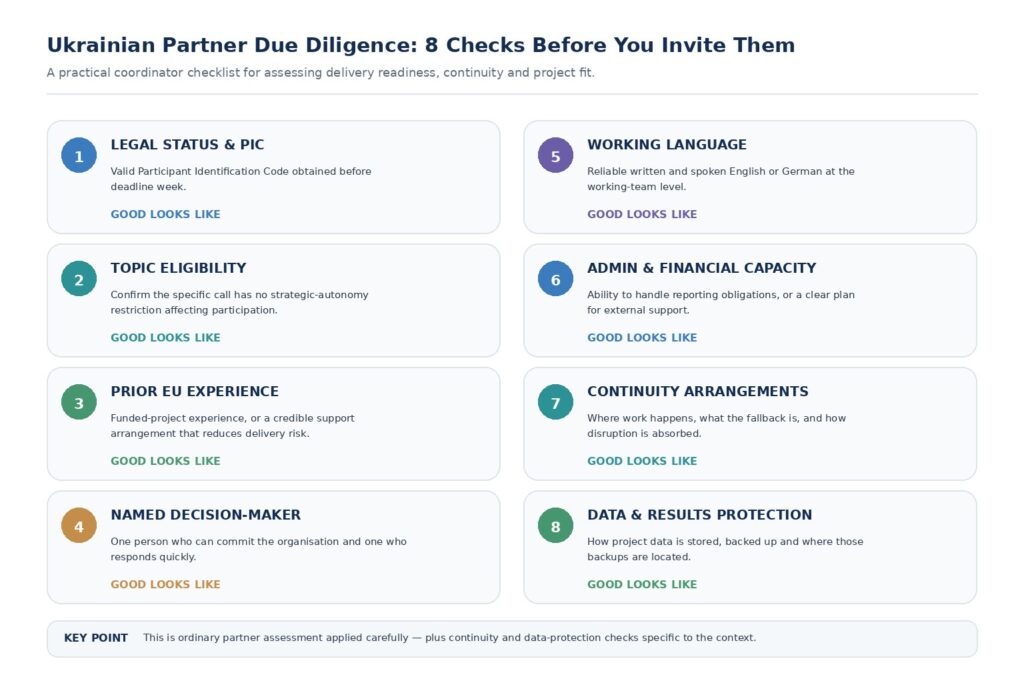
The continuity question, handled properly
This is the question coordinators hesitate to ask and Ukrainian organisations expect. Asking it directly is professional; leaving it unasked and unresolved is what actually causes problems later.
What a satisfactory answer contains:
- Where the work is performed, and whether that location can change without the work stopping.
- Whether key personnel can work from more than one location, and whether some are already outside Ukraine.
- How data and results are backed up, and in which jurisdiction the backups sit.
- What the fallback is if a deliverable is delayed by circumstances outside anyone’s control, and which tasks have schedule flexibility.
- Who the second contact is if the first becomes unreachable.
Ukrainian organisations delivering in EU projects have generally thought about all of this in more detail than their European partners have. A partner who answers these points crisply and in writing is demonstrating operational maturity, and that is how the answer should be read. The same continuity and backup-contact logic is part of sound year one coordination.
A note on proportion: disruption risk is real and it is also not unique. European projects absorb partner insolvency, key-person departure, laboratory closure and institutional reorganisation routinely. The appropriate response is documented planning, not exclusion.
Practical questions coordinators ask
| Question | Short answer |
| Do Ukrainian partners receive EU funding directly? | Yes. Ukraine is fully associated, and Ukrainian entities receive funding directly from the Commission on equivalent terms |
| Is an EU-registered entity required? | No. The Ukrainian entity itself is eligible. Some organisations have established EU entities for commercial reasons, which is a separate decision |
| Can a Ukrainian partner coordinate? | Yes, though as with any first-time participant, joining as a partner first is the sensible route |
| Are there calls they cannot join? | Some topics restrict participation to protect the EU’s strategic assets, interests, autonomy or security. This applies to associated countries generally and is stated in the topic text |
| Does it complicate the consortium agreement? | Not structurally. Give the usual attention to results ownership, access rights and confidentiality, and consider adding explicit force majeure and communication-failure provisions |
| Are there additional reporting obligations? | No. The same grant agreement rules apply to all beneficiaries |
| What about travel to consortium meetings? | Plan for hybrid participation as standard and treat physical attendance as variable. Most consortia now operate this way regardless |
| Is Ukraine a Widening country? | Yes, which is relevant to topics that encourage or reward Widening participation |
Structuring the role well
- Assign work that plays to demonstrated strength rather than distributing tasks evenly. A partner delivering something they are genuinely good at absorbs disruption better than one stretched across unfamiliar work.
- Avoid placing a Ukrainian partner on the critical path for a single, unsubstitutable deliverable in the first reporting period, unless the continuity arrangements specifically support it.
- Build schedule flexibility into their tasks where the work plan allows, in the same way you would for any partner with a known risk factor.
- Under lump sum funding, avoid concentrating their contribution in one long work package. Splitting across reporting periods protects both their cash flow and the consortium’s payment schedule.
- Give them a substantive role rather than a peripheral one. Peripheral partners disengage, and a partner brought in for breadth without real work is a criticism waiting to be made at review.
- Include them in dissemination and exploitation planning from the start, since Ukrainian stakeholder access is a genuine asset in reconstruction, resilience and energy topics.
What not to do
- Including a partner for the country rather than the work. It is visible and it is criticised.
- Avoiding the continuity conversation out of discomfort. The unasked question is the one that causes problems in year two.
- Assuming a Ukrainian partner needs less budget or a smaller role. Equivalent terms mean equivalent treatment.
- Leaving eligibility unchecked because the country is associated. Association is general; topic restrictions are specific.
- Approaching three weeks before a deadline. As with any partner, relationship-building precedes the call.
- Treating the partnership as temporary. Consortia re-form, and a partner who delivered once is the easiest partner to include next time.
How Nexuswelt works with coordinators on this
Nexuswelt is a European company headquartered in Munich, with presence in Cyprus and Ukraine. For a coordinator, that structure means partner identification and assessment can happen on the European side of the table, with the practical questions resolved before they become consortium-level uncertainties. Nexuswelt also contributes to funded projects as a partner for communication, dissemination, stakeholder engagement and exploitation. The full landscape is in our complete guide to EU funding and innovation cooperation with Ukraine, and more on the firm is on the Nexuswelt about page.