Munich, 25 September 2026 · Nexuswelt Group
If your country is associated to Horizon Europe, the eligibility question is settled and the access question is not. European consortia form through networks, months before a call is published, and those networks are geographically concentrated in ways that have nothing to do with the rules.
This guide is the process – country-agnostic, written for organisations in Canada, South Korea, Ukraine, Japan, Australia, New Zealand and elsewhere. What to use, in what order, and how to handle the specific frictions that distance creates.
Why this is different from the inside
A German institute looking for partners has advantages that are invisible until you lack them: it meets people at national events, its colleagues have worked on EU projects for years, and it hears about forming consortia informally. None of that is available from Toronto or Seoul.
Four specific frictions follow, and each has a workable response:
| The friction | The response |
| You are not in the informal loop where consortia form | Substitute formal channels deliberately – National Contact Points, CORDIS, brokerage events – and use them earlier than a European organisation would need to |
| A coordinator sees you as an unknown risk rather than a known quantity | Resolve their specific uncertainties in the first message rather than waiting to be asked |
| Time zones make informal relationship-building slow | Make the coordination arrangement an explicit proposal, not something to work out later |
| Your eligibility status is not obvious to them | State it plainly with the topic identifier. Do not make a busy coordinator check your country’s association scope |
The search channels, ranked for a non-EU organisation
| Channel | What it gives you | Priority from outside Europe |
| National Contact Points – yours and theirs | Official introductions carrying an implicit endorsement. Your own country’s NCP knows the European network; the NCP in a target country can point you to active organisations | Highest. This is the closest available substitute for being in the informal loop, and it is free |
| CORDIS | Every EU-funded project with its full partner list. Search your field and the recurring coordinators become obvious | Very high. This is how you identify who to approach rather than guessing |
| Brokerage events and info days | Call-specific matchmaking, usually with a structured platform attached. Many now run hybrid | High, if you arrive with a defined role rather than to browse |
| Funding & Tenders Portal partner search | The Commission’s own tool, tied to specific topics. Publishing a profile makes you findable | Medium as a search tool, high as a visibility tool. Do both |
| Sector platforms, clusters and associations | Membership networks with partner directories in your domain | Medium to high within your sector. Membership frequently pays for itself here |
| Enterprise Europe Network | Partner matchmaking and SME advisory, with a presence in many non-EU countries | Medium, and easy to arrange |
| Existing institutional links | Joint labs, bilateral agreements, alumni networks, former research collaborations | Highest where they exist. Most consortia form around people who have worked together before |
Start with the last row and the first. An existing relationship plus an NCP introduction outperforms months of cold outreach, and both are available before you have spent anything.
The process, step by step
- This process is written for organisations joining from outside Europe; if you are building a consortium from inside the system, see our guide to building a consortium. Confirm your association scope. Which pillars is your country associated to, and does the topic you are targeting carry a participation restriction? Check the topic text, not a country list. Getting this wrong wastes everything downstream.
- Register and obtain a Participant Identification Code. Do it now, independently of any call, so it is never on the critical path.
- Choose two topics and read them completely – expected outcomes, scope, specific conditions. Two read properly beats twenty skimmed. Before choosing between them, check how competitive a topic is.
- Define a role, not a capability. What you would deliver, in which work package, with which facilities and what output. A coordinator fills gaps in a work plan; they do not evaluate organisations in the abstract.
- Write the one-page partner profile in English. This is the document that circulates when consortia form, and most non-EU organisations do not have one.
- Search CORDIS for funded projects in your topic area. List the organisations that appear repeatedly as coordinators – that recurrence is the signal.
- Contact your National Contact Point and ask for introductions to two of them. This request is ordinary and NCPs handle it routinely.
- Approach directly where no introduction is available, referencing their actual prior work, with the topic identifier in the subject line.
- Register for the next relevant brokerage event with your profile uploaded in advance.
- Follow up once, politely, after ten days. Then move on. Coordinators are managing many conversations and silence is usually capacity rather than rejection.
Evaluating a coordinator before you approach
Partner search runs both ways, and approaching the wrong consortium costs a cycle. Before investing in a relationship, check:
- Have they coordinated before, or only participated? A first-time coordinator carries more delivery risk for everyone in the consortium.
- Is their prior work genuinely adjacent to yours, or only superficially similar? CORDIS project descriptions answer this in a few minutes.
- Do they already have a partner doing what you propose? If so, you are competing rather than complementing, and it is better to know before writing.
- Have they worked with non-EU partners before? Those that have will handle your practical questions without friction.
- Is the consortium already largely formed? Joining late as an addition is different from joining early as a contributor, and it affects both your role and your budget share.
Working across time zones
This is the practical concern coordinators raise most often about distant partners, and the organisations that address it before being asked stand out.
- Propose the overlap explicitly. State the hours you can meet in Central European Time and commit to them rather than negotiating each time.
- Name one responsive contact. Fast, clear replies do more to settle doubts about distance than any statement of capability.
- Accept some asymmetry. Consortium meetings will usually run on European hours, and treating that as given rather than as a grievance smooths the first year.
- Offer asynchronous contributions where they work – written input on drafts, recorded updates, documented decisions – so that your absence from a call is not a gap in the work.
Using brokerage events properly
Most attendees browse. The ones who leave with something arrive prepared.
- Upload your profile before the event, not during it. Other attendees search the platform in advance.
- Book meetings ahead. Walk-in conversations at these events rarely convert.
- Target coordinators and consortium builders, not organisations like yours. Two similar organisations meeting have nothing to offer each other.
- Have the topic identifier and your proposed role ready in one sentence.
- Follow up within forty-eight hours, referencing what was actually discussed. Most attendees do not, which is why the ones who do are remembered.
What non-EU organisations get wrong
- Starting after the call opens. By publication, most consortia have formed around a core group.
- Sending the same message to twenty coordinators. It is visible immediately and it ends the conversation before it starts.
- Describing the organisation rather than proposing a role.
- Waiting to be asked about eligibility, reporting capacity or time zones instead of answering unprompted.
- Aiming to coordinate a first project. Coordination is a multi-year administrative commitment and the wrong first step from any distance, let alone across eight time zones.
- Treating silence as rejection. Coordinators are managing many parallel conversations under deadline pressure.
- Paying to be included. A request for payment in exchange for a place in a proposal is a recognised warning sign, not standard practice.
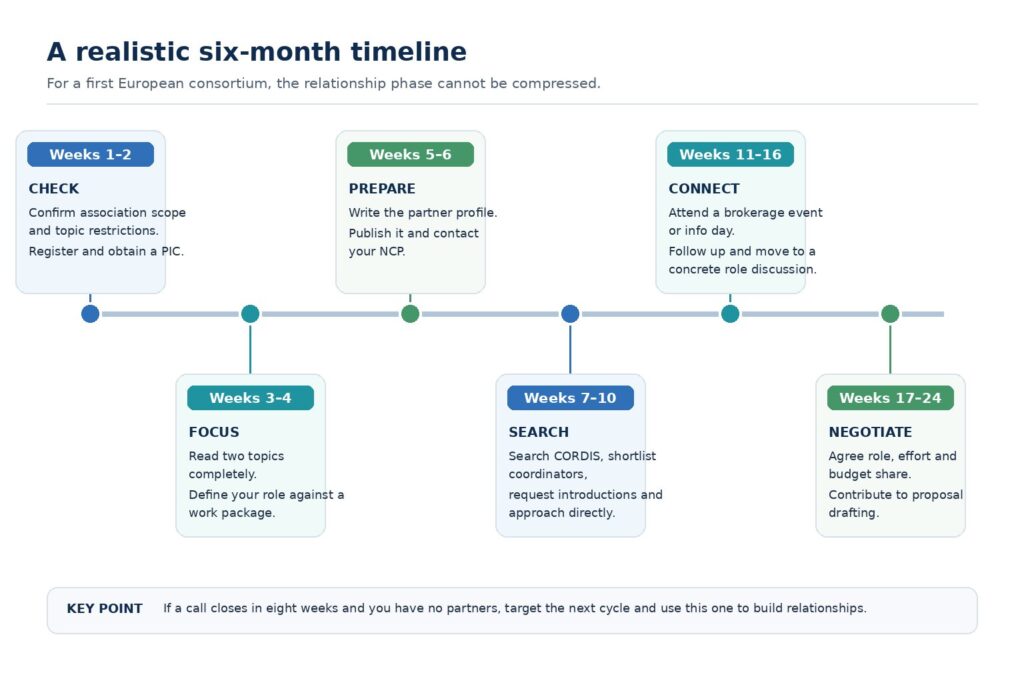
Six months is the realistic minimum for a first consortium, and the relationship phase is the part that cannot be compressed. If a call closes in eight weeks and you have no partners, the correct decision is to target the next cycle and use this one to build.
How Nexuswelt works with non-EU organisations
Nexuswelt is a European company based in Munich and active across Europe. For an organisation outside the EU, the useful thing is a counterpart inside the system: fit assessment against real topics, role definition, partner search, and the material that makes an unfamiliar organisation credible to a coordinator. Country-specific guidance is in our guides for Canadian companies and South Korean companies, and more on the firm is on the Nexuswelt about page.