Nexuswelt Insights · Oct 8, 2026 · @Nexuswelt
On 6 October 2026, the European Commission adopted its proposal for a new Regulation on European standardisation, COM(2026) 780, which would repeal Regulation (EU) No 1025/2012. Most coverage focuses on compliance costs for businesses. For coordinators and partners in Horizon Europe, Chips JU and Digital Europe consortia, the more relevant part is how the proposal positions research results inside the European standards system.
Key takeaways
- Standardisation is framed as a route to valorise research results, and European standards are expected to build on EU-funded projects.
- National and European standardisation bodies would have to ensure effective representation of research and innovation stakeholders.
- Harmonised standards would become freely accessible through a central repository.
- The Commission’s impact assessment targets an average development time of about 4.2 years instead of six.
- It is a proposal. The European Parliament and the Council still have to negotiate and adopt it.
New to standardisation? The basics in two minutes
A standard is a shared technical recipe: a test method, a data format, an interface or a quality requirement that many organisations agree to use. Using one is voluntary.
- Who writes them. In Europe, three organisations: CEN (most sectors), CENELEC (electrotechnical) and ETSI (telecoms and ICT). Experts draft them in technical committees. National bodies such as DIN in Germany, Austrian Standards or CYS in Cyprus run mirror committees where national experts take part.
- Harmonised standards are a special type. The Commission requests them to support EU law, and products made to them are presumed to comply with that law. This is the part the new regulation mostly governs.
- How research gets in. Usually through a project expert joining a technical committee, or through a CEN Workshop Agreement (CWA): a lighter document drafted in an open workshop, far faster than a full standard.
- What it costs. Mainly expert time, travel to meetings and sometimes national membership fees. These can be planned and budgeted in the proposal.
- Why it pays off. A standard turns one project’s result into something a whole market uses, and evaluators count it as impact.
|
Body |
Level |
Covers |
How experts take part |
|
CEN |
European |
Most sectors |
Through national members, e.g. DIN, Austrian Standards, CYS |
|
CENELEC |
European |
Electrotechnical |
Through national committees, e.g. DKE, OVE, CYS |
|
ETSI |
European |
Telecoms and ICT |
Direct membership of organisations |
|
ISO / IEC |
International |
Global counterparts of CEN / CENELEC |
Through national bodies |
What the Commission proposed
The package consists of the legislative proposal COM(2026) 780, its annexes, an impact assessment (SWD(2026) 786), its executive summary (SWD(2026) 787) and a subsidiarity grid (SWD(2026) 785). It is the standardisation strand of the wider European Product Act agenda, alongside the revision of the New Legislative Framework and the Market Surveillance Regulation.
The Commission assessed three options and chose the middle one. In short:
- European Standardisation Organisations (CEN, CENELEC, ETSI) stay at the centre of the system.
- New flexibility: where they lack expertise or fail to deliver, the Commission could address standardisation requests to other standards development organisations. Common specifications adopted by the Commission remain the last resort.
- Free access to harmonised standards through a central online repository, in line with recent Court of Justice case law.
- A Centre of Excellence on European Standardisation inside the Commission, to coordinate EU positions in international standardisation, plus a public EU Standards Platform showing the status of every requested standard.
- Inclusiveness and transparency: measures for SMEs, civil society and the research and innovation community, plus transparency registers showing whose interests are represented in standards work.
Today vs. the proposal at a glance
|
Regulation 1025/2012 (today) |
Proposal COM(2026) 780 |
|
|
Who receives Commission requests |
CEN, CENELEC, ETSI only |
ESOs first; designated standards bodies if ESOs lack expertise or fail to deliver |
|
Access to harmonised standards |
Mostly sold by national bodies |
Free, without registration, via online repositories |
|
Interim solution |
None with presumption of conformity |
Harmonised standardisation deliverable until the standard is ready |
|
Fallback if no standard |
Common specifications only in some sectoral laws |
One horizontal framework for common specifications |
|
Timing |
About 6 years on average, no deadline per step |
Deadlines per step, target about 4.2 years |
|
Transparency |
Limited |
Public list of stakeholders in each technical body, including consultants’ clients |
|
Oversight |
Annual reporting |
KPIs, public EU Standards Platform, Centre of Excellence |
The six-year problem
A harmonised standard currently takes around six years to develop. A typical Horizon Europe or Chips JU project runs for three to four years. Many projects therefore end before the standard their results could inform is even drafted, and the expertise disperses with the consortium.
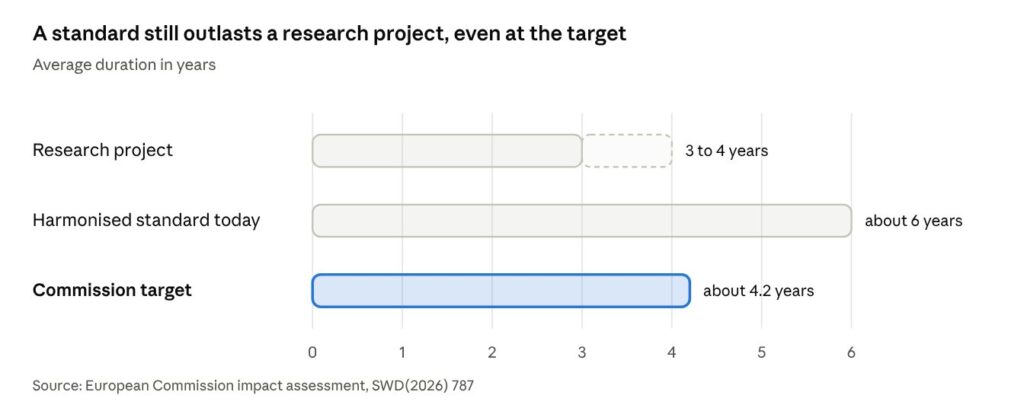
research project vs harmonised standard · average years
The impact assessment estimates the faster process would save businesses around EUR 295 million per year in compliance costs, and free access another EUR 30 million. SMEs would capture most of the benefit.
What changes for research projects
The recitals of COM(2026) 780 go further than most summaries. The points most relevant to research consortia:
- EU-funded projects as a source of standards. Standardisation is framed as a valorisation route for research, linked to the Guiding Principles for Knowledge Valorisation and the ERA Code of Practice on standardisation. European standardisation should build on results of Union-funded research projects and on research and technology infrastructures funded by the EU. Researchers, academics, research centres, startups, scaleups and open-source communities are named explicitly.
- Lower entry barriers at national level. National standardisation bodies should allow participation without mandatory membership, offer free access or reduced rates to R&I stakeholders, SMEs and civil society, and give free access to draft standards.
- Pre-normative research in the work programme. The annual Union work programme on European standardisation should identify priority areas for pre-normative work, complementing EU research and innovation policy. Expect this to feed into future call topics.
- Funding from the next MFF. The text names Horizon Europe 2028–2034, the European Competitiveness Fund and the Single Market and Customs Programme as possible sources for standardisation activities. Standardisation bodies may become designated beneficiaries. The indicative standardisation budget is EUR 183 million for 2028–2034.
- Interim deliverables with legal effect. Where a full harmonised standard would take too long, for example in fast-moving digital products, ESOs can deliver a harmonised standardisation deliverable that gives presumption of conformity until the standard is ready.
- Clear clocks. The Commission should adopt a standardisation request within 12 months of consulting the ESOs and assess delivered standards within six months. Draft requests are published for comment.
- New standards bodies, including open source. Where CEN, CENELEC and ETSI lack expertise or fail to deliver, the Commission can turn to other designated standards bodies. Open-source organisations may be designated as standards development organisations if they meet the criteria.
- Transparency on who is in the room. ESOs and designated bodies must publish the stakeholders in each technical body and the interests they represent, including clients behind consultants.
- Free access, also backwards. Access must work without registration or subscription and also covers standards already referenced under Regulation 1025/2012.
Not everyone agrees. In the consultation, European standardisation organisations and national bodies opposed publishing standards in the Official Journal because of their revenue model. The Commission estimates free access could cost national bodies up to EUR 30 million a year, around 15 % of their standards sales in the EU.
What to do in your 2027 proposals
The new regulation is unlikely to be in force before most 2027 deadlines, but the policy direction is set, and evaluators read impact sections against it. Proposals that plan standardisation, rather than mention it, will stand out. Five steps help:
- Map the standards landscape at proposal stage. Identify the relevant technical committees (CEN/CENELEC, ETSI, ISO/IEC) and existing work items before you write the impact section.
- Write standardisation into the impact pathway. Link specific results (test methods, data formats, interfaces, measurement procedures) to specific committees or deliverables, such as a CEN Workshop Agreement.
- Budget for participation. Person-months, travel to committee meetings and, where needed, national body membership. Standards work is rarely free of cost.
- Set measurable KPIs. Contributions submitted, liaisons established, workshop agreements launched. Put them in the same register as your dissemination and exploitation KPIs.
- Plan for life after the project. Name the partner who will carry contributions forward once funding ends. This is exactly the gap the six-year timeline creates.
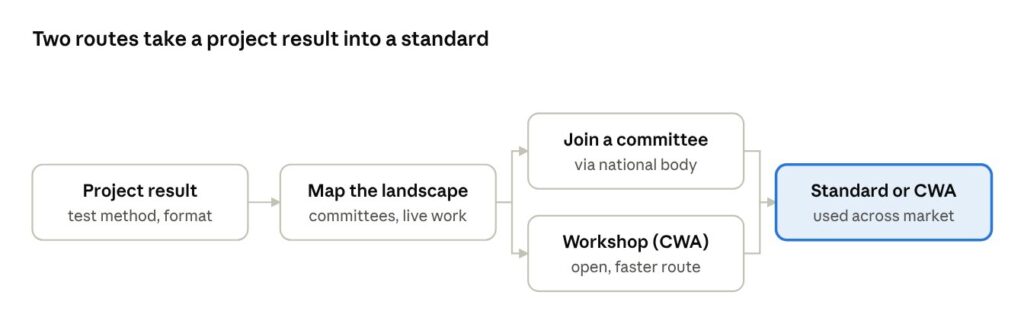
from project result to standard · two routes
The committee route builds long-term influence; the workshop route produces a citable result within the project’s lifetime.
For semiconductor and electronics consortia under the Chips JU, typical candidates are test and characterisation methods, data and interface formats, and reliability procedures developed in pilot lines and design platforms.
Free support exists. The Horizon Standardisation Booster (HSbooster.eu) offers proposal support, mentoring and a standards accelerator service to EU and nationally funded projects.
What happens next
The proposal (procedure 2026/0307(COD), legal basis Article 114 TFEU) now goes through the ordinary legislative procedure in the European Parliament and the Council. Nothing changes for running projects yet, and the final text may differ. The Commission plans to evaluate the new regulation five years after entry into force, explicitly measuring the participation of experts from SMEs, civil society and the research and innovation community.
For consortia preparing proposals for the 2027 calls, the direction is clear enough to act on now.
How Nexuswelt can help
Nexuswelt builds communication, dissemination and exploitation strategies for EU consortia, including standardisation pathways, KPI registers and post-project continuity plans. If you are preparing a Horizon Europe, Chips JU or Digital Europe proposal and want to check where your results could feed into standards, book a 15-minute call.
FAQ
What is the new EU Standardisation Regulation? A Commission proposal of 6 October 2026, COM(2026) 780, that would replace Regulation (EU) No 1025/2012, the legal basis for European standardisation since 2013.
Is it already in force? No. The European Parliament and the Council must first agree on a final text.
Will standards become free? The proposal provides free access to harmonised standards, the standards referenced in EU legislation, via a central repository. Other European standards are not covered in the same way.
Why does it matter for Horizon Europe projects? It recognises standardisation as a route to valorise research and requires standardisation bodies to involve research and innovation stakeholders, which makes standards a stronger impact pathway for proposals.
How can a project get started with standardisation? Map relevant technical committees early, budget for participation and use free services such as HSbooster.eu.
Sources
- European Commission, Proposal for a Regulation on European standardisation, COM(2026) 780 and impact assessment documents
- European Commission, legal text COM(2026) 780 (explanatory memorandum and recitals) and executive summary of the impact assessment, SWD(2026) 787
- HSbooster.eu, A new rulebook for European standards: what it could mean for your research project (7 October 2026)
- Regulation (EU) No 1025/2012
- Council Recommendation on the Guiding Principles for Knowledge Valorisation
- Code of Practice on Standardisation in the European Research Area (European Commission)
- EPRS briefing on the European product act (June 2026)