Munich, 23 September 2026 · Nexuswelt Group
The honest headline is that roughly one proposal in seven is funded. The more useful answer is that the average is close to meaningless, because the range behind it runs from around 3% to around 25% depending on which topic you choose – and topic selection is a decision you make before writing a word.
This article sets out the current numbers, explains the two different figures that get quoted interchangeably, and ranks what actually shifts the odds by how much leverage it gives you.
The current numbers
Horizon Europe has run at roughly 14 to 16% overall, against about 12% under Horizon 2020. Calls are typically oversubscribed by a factor of four to five: if every submitted proposal were funded, the call budgets would need to be around five times larger.
The direction of travel is downward. Applications have surged – some calls have seen proposal numbers rise by as much as 80% in a year – and the overall rate for the most recent complete reporting has been running lower than the programme average, with the Commission publishing figures only for fully evaluated calls.
Two different numbers, quoted interchangeably
This trips up almost everyone reading programme statistics, and it explains why two credible sources can give different figures for the same period.
| Metric | What it counts |
| Success rate of proposals | The share of submitted proposals that are funded. This is the number that matters if you are deciding whether to write one |
| Success rate of applications | The share of individual participations that are funded. A single funded collaborative project contains many participants, so this figure is higher |
Under Horizon Europe the proposal rate has run around 16% while the application rate has run around 22%. Neither is wrong; they answer different questions. When a consultancy quotes an encouraging figure, check which one it is.
Why the average hides everything
The programme-level number conceals a spread wide enough to make it useless for planning.
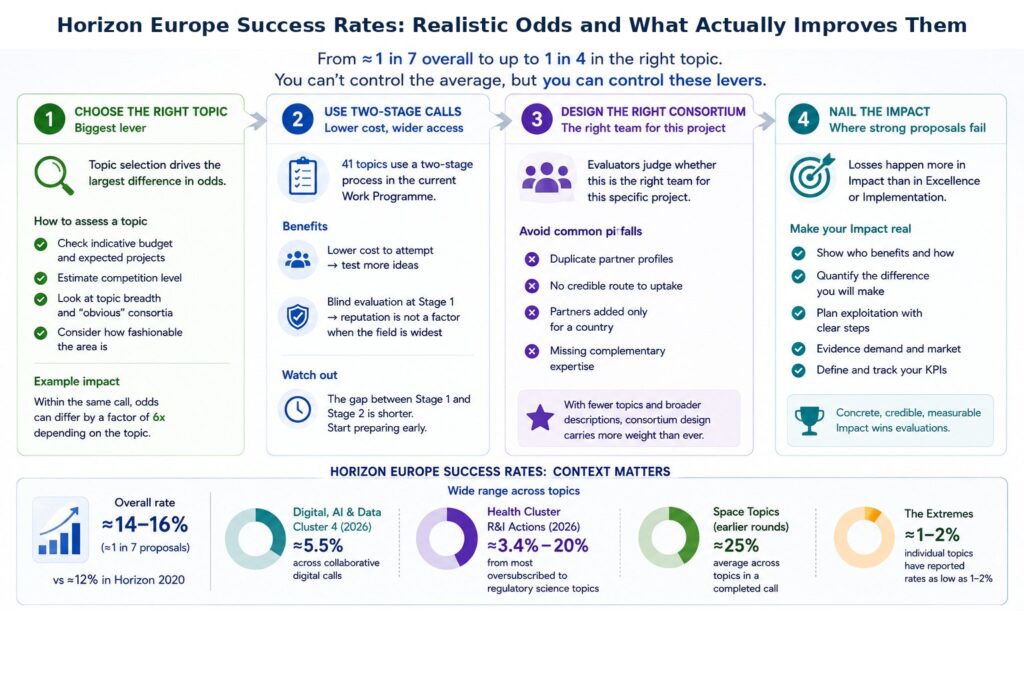
Read the Health example again: within one call, closing on one date, under one set of rules, the odds differed by a factor of six depending on which topic a consortium chose. No amount of writing quality closes that gap.
What actually improves your odds, ranked by leverage
1. Topic selection – by far the largest lever
The Commission publishes the indicative budget and the expected number of projects for each topic. Divide one by the other and you know roughly how many grants are available. Compare that against how crowded the topic looks – how broadly it is written, how many obvious candidate consortia exist in your field, whether it sits in a fashionable area.
A narrowly written topic in an unglamorous area with several expected grants is a materially better bet than a broad topic in a popular area funding two projects. This assessment takes an afternoon and moves your odds more than six weeks of writing.
2. Two-stage calls
Forty-one topics in the current work programme use two-stage calls, with a short first-stage proposal and many first-stage submissions subject to blind evaluation. The cost of attempting drops sharply, which makes it rational to test ideas you would not otherwise attempt, and blind evaluation removes reputation as a factor at the point where the field is widest.
The catch: the interval before the full proposal has been shortened, so a consortium that treats stage one as a lottery ticket and only assembles seriously after the invitation will find the second stage uncomfortable.
3. Consortium design
Evaluators assess whether this is the right team for this specific project. Duplicate partner profiles, no route to uptake, a partner included for a country rather than for work – each is an obvious criticism and each is decided before writing begins. Fewer topics and broader topic descriptions in the current work programme have raised the weight of consortium design relative to writing quality, because there is less prescriptive guidance to follow.
4. The impact section
Technically strong proposals lose here more than anywhere else. A three out of five on Impact passes the threshold and still removes you from the funded range in a call at these ratios. The difference between a three and a five is causal logic – a specific chain from result to named user to change in practice – not ambition.
5. Resubmission, done properly
An evaluation summary report is detailed and specific, and a revised resubmission that addresses it directly is a normal path to funding. A resubmission that ignores it scores worse than the first attempt, because the same weaknesses now appear in a proposal that has had another cycle to fix them.
What matters less than people think
- Institutional prestige. In blind first-stage evaluation it is invisible by design, and elsewhere it is one input among many.
- Proposal length. Page limits are enforced by truncation, and with the shortened 2026–2027 templates a padded section is more exposed, not less.
- Consortium size. Adding partners to look substantial dilutes budget, adds coordination cost and gives the implementation section more to justify.
- Polish, past a point. A well-written proposal in an oversubscribed topic still loses to an adequately written one in a topic with four grants available.
Checking the odds before you commit
- Read the topic’s indicative budget and expected number of grants. This gives you the denominator.
- Check whether the topic is single-stage or two-stage, since that changes the cost of attempting.
- Search CORDIS for funded projects in the area to see how crowded the field is and who keeps appearing.
- Ask your National Contact Point what they are hearing about interest in the topic. They often know, and it is free.
- Look at published statistics for the equivalent call in the previous cycle where they exist.
- Compare two or three topics on this basis before choosing, rather than choosing first and analysing afterwards.
Deciding whether it is worth it
At a one-in-seven average and considerably worse in popular areas, the arithmetic deserves stating plainly. A serious proposal costs six to twelve weeks of senior time. Expected value depends on your realistic rate, not the programme average, and on what you gain from the attempt regardless of outcome.
For startups, our readiness checklist can help determine whether the organisation is actually prepared to commit the time, resources and runway required.
What the attempt produces even when unsuccessful: a defined role and partner profile that circulate, relationships with coordinators who will form consortia again, an evaluation summary report that is genuinely useful feedback, and a clearer articulation of your own impact logic. Organisations that treat a first unsuccessful submission as a sunk cost usually withdraw at exactly the point where the investment starts to pay.
What makes it not worth it: applying to whichever call closes soonest, without a defined role, three weeks before the deadline, in a topic nobody assessed for crowding. That is the profile of most unsuccessful first attempts, and it is avoidable.
How Nexuswelt works on this
The decisions that move the odds most are made before writing starts: which topic, which role, which consortium, what impact logic. Nexuswelt works with organisations on exactly that stage, and contributes to funded projects as a partner for communication, dissemination, stakeholder engagement and exploitation. The companion article on where technically strong proposals lose points is our guide to the Horizon Europe impact section, and more on the firm is on the Nexuswelt about page.