The EU Project Lifecycle: From First Call to Lasting Impact
Munich, 26 October 2026 · Nexuswelt Group
Most guidance on EU funding covers one stage in isolation: how to write a proposal, how to find partners, how to report. What newcomers actually lack is the map – how long the whole thing takes, what happens in what order, and which decisions at each stage constrain everything downstream.
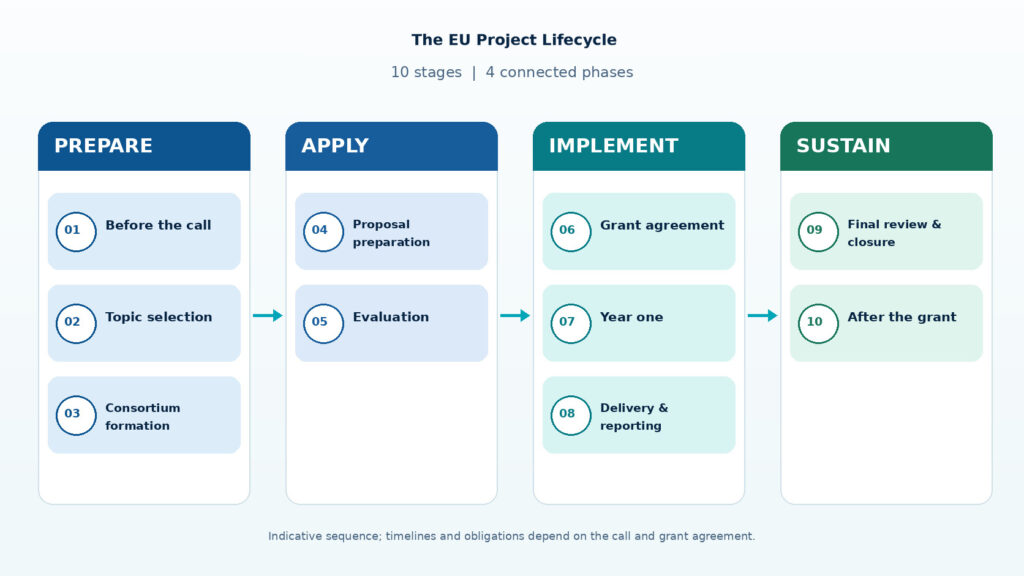
This is that map, from before a call is published to after the grant closes. Each stage links to a detailed treatment elsewhere on this site.
The whole lifecycle at a glance
| Stage | Realistic duration | What determines success |
| Before the call | Ongoing, months to years | Network position. Consortia form through relationships that predate the call |
| Topic selection | 2–4 weeks | The single largest lever on your odds. Success rates vary by a factor of several between topics |
| Consortium formation | 1–4 months, longer for a first project | Whether you can define a role rather than a capability |
| Proposal preparation | 6–12 weeks | Impact logic and consortium design, more than writing quality |
| Evaluation | Several months | Nothing you can influence. Use the time to prepare |
| Grant agreement preparation | Weeks to a few months | Getting the budget, dissemination levels and work package structure right while they can still change |
| Year one | 12 months | Cadence, governance and evidence collection. Most later problems are created here |
| Delivery and reporting | Project duration | Continuous evidence collection rather than retrospective assembly |
| Final review and closure | Months after the end date | Whether the impact pathway’s early steps were evidenced as they happened |
| After the grant | Defined period afterwards | Named owners for results and relationships |
From decision to first payment is realistically around twelve months. That single fact reframes what European funding is for: it is a strategic instrument on a long horizon, not a solution to a cash problem this quarter.
1. Before the call
The stage that determines the most and appears in no guidance, because it has no deadline attached.
European consortia form through networks, months before a call is published. By the time a topic is public, most consortia have assembled around a core group. An organisation that starts when the call opens is competing for the remaining seats, not for the good ones.
What belongs here: establishing your technology readiness level honestly, defining what you would deliver rather than what you are good at, writing a one-page partner profile, registering for a Participant Identification Code, and building relationships with coordinators identified through funded-project records. For a practical starting point, use our EU funding readiness checklist before approaching potential coordinators.
2. Topic selection
An afternoon of analysis that moves your odds more than six weeks of writing.
The Commission publishes an indicative budget and an expected number of projects for each topic. Divide one by the other and you know roughly how many grants exist. Compare that against how crowded the topic looks – how broadly it is written, how fashionable the area is, how many obvious candidate consortia exist in your field.
Within a single call, closing on one date under one set of rules, success rates have differed by a factor of six depending on the topic chosen. No amount of writing quality closes a gap that size. Our guide to Horizon Europe success rates and topic selection explains why choosing the right topic matters.
3. Consortium formation
The order that produces a coherent proposal: read the topic completely, define the project concept, map the work as work packages, identify the capability gaps, then look for partners who fill those specific gaps. Finding partners first and building the proposal around whoever agreed is visible to evaluators.
For most collaborative actions the eligibility minimum is three independent legal entities from three different eligible countries, with at least one in a Member State. In practice the minimum is almost never the target, because the work programme expects coverage of the whole pathway from research to uptake. For a practical approach to building a Horizon Europe consortium, start with the project’s work packages and identify the capabilities needed to deliver them.
4. Proposal preparation
Six to twelve weeks for a serious submission, with senior involvement throughout. Three criteria are scored from zero to five – Excellence, Impact and Implementation – each with a threshold below which the proposal is rejected regardless of the others.
Technically strong proposals lose on Impact more than anywhere else, and the difference between a three and a five is causal logic rather than ambition: a specific chain from result to named user to change in practice. A three passes the threshold and still removes you from the funded range.
Two-stage calls change this economics substantially. Where a topic uses them, a short concept note tests the idea for a fraction of the effort, and many first-stage submissions are evaluated blind. Our guide to writing the Horizon Europe impact section explains how to build a credible pathway from project results to measurable outcomes.
5. Evaluation
Several months during which you can do nothing. The consortia that use this period well are the ones that continue building – particularly in two-stage calls, where the interval between the stage one result and the stage two deadline is compressed.
At programme level, roughly one proposal in seven is funded, and the rate is falling as applications rise. Rejection is the normal outcome, and the evaluation summary report that follows is the most detailed external assessment of your project you will receive.
6. Grant agreement preparation
The stage most consortia treat as administrative and later wish they had used. Several things are still changeable here that become difficult afterwards.
- Dissemination levels per deliverable. Marking something public that will contain commercially sensitive detail creates a problem two years later.
- Work package structure. Under lump sum funding, work packages are payment units – long horizontal streams should be split across reporting periods.
- Budget distribution and the number of deliverables, which become contractual obligations with dates and owners.
- The consortium agreement, which governs decision-making, results ownership and dispute resolution between partners. It is signed under deadline pressure and rarely read again until there is a conflict.
7. Year one
Almost every problem that surfaces at a mid-term review was created in the first twelve months – not dramatically, but through a cadence that never got established, a partner who went quiet in month four, and a reporting system built the week before it was due.
What has to happen: governance that actually meets and records decisions, a meeting rhythm partners can plan around, evidence collection running from month one, baselines established while they still can be, stakeholder engagement started, and the dissemination and exploitation plan delivered as a working document rather than a formality.
The transition that catches coordinators out: winning a grant and delivering a project are different jobs, and the informal habits that produced a funded proposal are unhelpful once it is signed.
8. Delivery and reporting
Two reporting systems run at different speeds. Continuous reporting stays open throughout, taking deliverables, milestone achievements, publications and dissemination activities. Periodic reporting happens at the end of each reporting period, within sixty days, and its first part is generated automatically from the continuous data.
That relationship is the thing to understand. A consortium that neglects the continuous module all period faces a report with nothing in it and evidence that has to be reconstructed – which is difficult and visibly retrospective.
Deliverables and milestones are different: a deliverable is an output carrying a dissemination level and is uploaded; a milestone is a control point carrying a means of verification and is reported as achieved.
9. Final review and closure
The structural problem of every EU project is that it ends before its impact happens. Outputs exist during the project, outcomes emerge shortly after, and impact arrives years later.
What you can prove at the final review is therefore the credibility of the pathway, with its early steps evidenced: named organisations that took something up, documented commitments, completed preconditions such as certification or a standards step, and early adopters however few. Invented quantification of future impact is the classic weakness reviewers discount.
10. After the grant
Exploitation and dissemination obligations continue for a defined period after the end date, and the impact case is not closed at the final review.
Before the consortium disperses, name who holds each result and each stakeholder relationship afterwards. A consortium that dissolves without doing so has ended its impact pathway at precisely the point where the impact was supposed to begin.
The decisions that constrain everything downstream
| Decision | What it constrains |
| Your honest TRL | Which instruments exist for you at all |
| Topic selection | Your odds, more than any other single factor |
| Consortium composition | The Impact and Implementation scores, and the delivery risk for years |
| Work package structure | Cash flow under lump sum, and the visibility of horizontal work |
| Dissemination levels | What you can commercialise later |
| Number of deliverables | Years of contractual obligation, decided in an afternoon at proposal stage |
| Evidence collection design | What you can prove at the final review |
| Post-project ownership | Whether the impact pathway completes at all |
How Nexuswelt works across the lifecycle
Nexuswelt works with organisations at both ends of this map: positioning, instrument selection and consortium entry before a proposal exists, and communication, dissemination, stakeholder engagement and exploitation as a partner inside funded projects. The firm is based in Munich, with presence in Cyprus and Ukraine, and works across Horizon Europe, Digital Europe, Chips JU, the European Defence Fund and Interreg. More is on the Nexuswelt about page.