Munich, 14 October 2026 · Nexuswelt Group
Every EU project has a structural measurement problem: it ends before its impact happens. Outputs exist during the project, outcomes emerge shortly after it, and impact arrives years later – usually after the consortium has dissolved and the final report has been approved.
This creates the question every coordinator faces at the final review. If the impact has not happened yet, what exactly are you proving? The answer is more specific than most consortia realise, and it depends almost entirely on decisions made in the first six months.
What you can and cannot prove by the final review
| Level | When evidence exists | What you can show at final review |
| Outputs | During the project | Complete evidence. Deliverables, publications, datasets, prototypes — all produced and documented |
| Outcomes | Late in the project and shortly after | Partial evidence. Early adopters, documented commitments, changes in stakeholder practice that began during the project |
| Impacts | Typically three to five years after | Almost never direct evidence. What you can show is a credible pathway with the early steps completed and the later ones underway |
The mistake is treating this as a reason to measure less. It is the opposite: because the impact itself cannot be demonstrated within the project’s lifetime, the credibility of the pathway is what carries the claim – and a pathway is only credible if its early steps are evidenced.That pathway should already have been defined in the impact section at proposal stage; the challenge during delivery is to produce the evidence that supports it.
The nine Key Impact Pathways
Horizon Europe monitors impact through nine Key Impact Pathways, grouped in three families. They are the framework the Commission uses to describe what the programme achieves, and they are set out in the Commission’s monitoring and evaluation framework.
| Family | Pathways |
| Scientific impact | Creating high-quality new knowledge; strengthening human capital in research and innovation; fostering diffusion of knowledge and open science |
| Societal impact | Addressing EU policy priorities and global challenges; delivering benefits and impact via missions; strengthening the uptake of research and innovation in society |
| Economic and technological impact | Generating innovation-based growth; creating more and better jobs; leveraging investments in research and innovation |
Each pathway is monitored with time-sensitive indicators: short-term from around one year, when the first projects complete; medium-term from around three years, for the interim evaluation; and long-term from around five years, for the ex-post evaluation.
The misunderstanding worth clearing up
Many coordinators believe they must report against the Key Impact Pathways. They do not. The Commission monitors them at programme level, drawing on data already held – including after projects conclude, and without requiring input from beneficiaries.
Why they still matter to you: the KIPs are the vocabulary in which the programme thinks about what it funds. A project whose own indicator framework maps cleanly onto them produces evidence that fits the frame reviewers use, which is a considerable advantage over one that invents its own categories. Use them as a design reference, not as a reporting obligation.
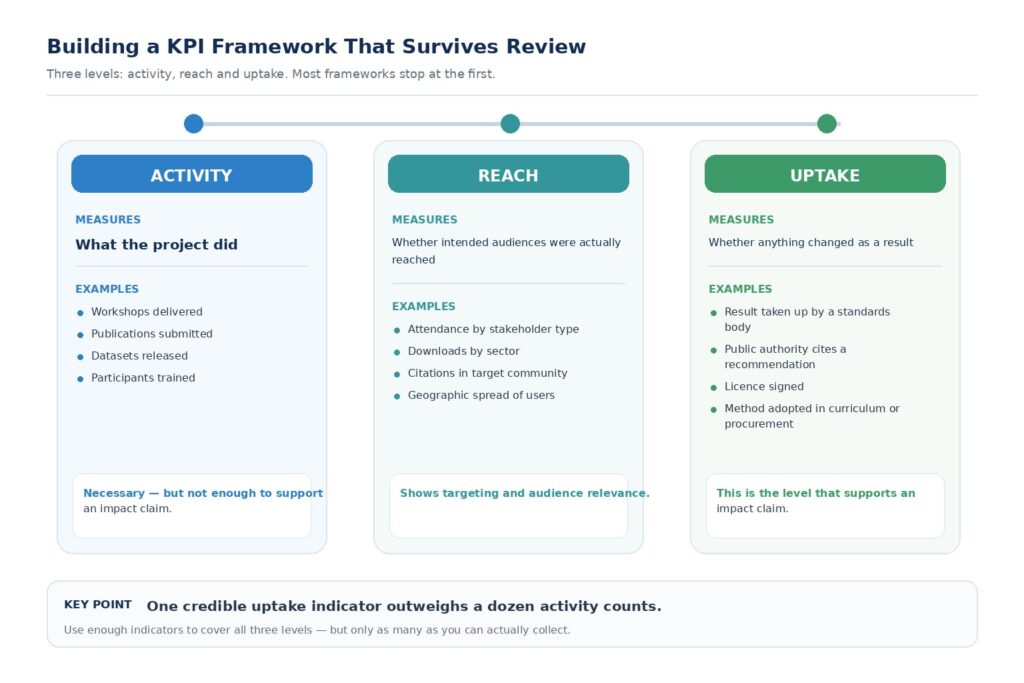
The same three-level logic should already be visible in the indicators in the dissemination plan: activity shows execution, reach shows targeting, and uptake begins to support the impact claim.
Activity indicators are necessary and insufficient. Reach indicators demonstrate targeting. Uptake indicators are the only ones that support an impact claim, and one credible uptake indicator outweighs a dozen activity counts.
A practical rule for the number: enough to cover all three levels across your main results, few enough that every one has a named owner and a working collection method. A framework with forty indicators and no data collection produces nothing; one with eight indicators that are actually collected produces a defensible case.
Baselines: the thing nobody sets
An indicator without a baseline cannot demonstrate change. This is the most common structural weakness in impact reporting, and it is unfixable retrospectively – you cannot measure the starting point after you have moved.
What to establish in the first six months:
- Current practice among your target user group. What do they do now, and how do you know?
- Existing performance of whatever your result improves on, measured the same way you intend to measure yours.
- Current awareness or adoption levels where those are part of the claim.
- The state of the relevant standard, regulation or policy at project start, if influencing it is part of the pathway.
Where a numerical baseline genuinely does not exist, document that explicitly with the reason. A stated absence is defensible; a silent one reads as an omission.
Designing the collection system
Evidence has to be gathered as the work happens. Reconstructing it in the final reporting period is difficult, time-consuming and visibly reconstructed – reviewers recognise a dataset assembled in retrospect.
- Set up collection in month one, before there is anything to collect.This should be built into the year one setup of the consortium, alongside reporting routines, ownership and review cadence.
- Give each indicator a named owner and a stated method. An indicator with no method is a number nobody can produce.
- Capture engagement in a form that survives: who attended, from which organisation type, what they asked for afterwards. Attendance numbers alone are the weakest possible evidence.
- Record uptake signals when they occur – an enquiry, a request for the dataset, an invitation to a standards working group. These are the moments that become the impact case, and they are easy to miss in passing.
- Log deviations and their reasons as they happen, not at reporting time.
- Review the framework at each reporting period and prune indicators that are not being collected rather than carrying them dead to the final report.The evidence collected here should also feed continuous reporting throughout the project rather than be reconstructed at the end of a reporting period.
What reviewers accept as evidence
| Weak | Strong |
| Our results were well received | Named organisations that requested follow-up, and what they asked for |
| The workshops were well attended | Attendance composition by stakeholder type, with the decision each group influences |
| The technology has significant market potential | A licence agreement, a letter of intent, or an identified partner with a stated next step |
| Our recommendations will inform policy | A public authority document citing the result, or membership of a working group where it was tabled |
| The method could be widely adopted | A named organisation that has adopted it, or a standards body that has taken it forward |
| Dissemination reached a wide audience | Downloads by sector, citations within the target community, or a documented change in practice |
The pattern is consistent: reviewers accept specific, attributable and verifiable evidence, and discount everything that could be asserted by any project in the field.
Proving what has not happened yet
For the impacts that will only materialise after the project, the evidence available is different in kind – and it is legitimate, provided it is presented honestly.
- Documented commitments. An organisation that has agreed in writing to take a result forward is stronger evidence than a projection of how many might.
- Completed preconditions. If uptake requires certification, a standard or regulatory approval, showing that step completed is evidence the pathway is live.
- Named owners for after the end. A result with an identified holder is on a pathway; one without is not, whatever the projections say.
- Early adopters, however few. Three organisations using something is evidence; three hundred forecast to use it is an assumption.
Avoid inventing quantification. A projected market size with no basis is the classic weakness reviewers discount immediately, and it damages the credibility of the claims around it. An honest range with a stated method beats a confident number with none.
After the grant ends
Exploitation and dissemination obligations continue for a defined period after the project’s end date, and the impact case is not closed at the final review.
Two things are worth doing before the consortium disperses: name who holds each result and each stakeholder relationship afterwards, and agree how any later uptake will be recorded and shared. A consortium that dissolves without either has ended its impact pathway at exactly the point where the impact was supposed to begin.
Common failures
- Only activity indicators, producing a report that shows a busy project rather than a consequential one.
- No baselines, making change impossible to demonstrate.
- Indicators with no collection method, discovered in the final period.
- Attendance numbers presented as engagement evidence.
- Invented quantification of future impact.
- A framework designed at proposal stage and never revisited, so it measures a project that changed.
- Uptake signals occurring during the project and going unrecorded because nobody was watching for them.
- No named owner for results after the end, which leaves the pathway unfinished by design.
How Nexuswelt works on this
Impact measurement fails at the design stage far more often than at the reporting stage, and by the final review the options are limited to what was collected. Nexuswelt contributes to EU-funded projects as a partner on communication, dissemination, stakeholder engagement and exploitation, which includes building the indicator framework and running the collection that the final case depends on. The companion article on engagement practice is our guide to stakeholder engagement in EU projects, and more on the firm is on the Nexuswelt about page.