Munich, 23 October 2026 · Nexuswelt Group
Until recently the boundary was clear: civil research went to Horizon Europe, defence work went to the European Defence Fund, and companies chose one side. During 2026 that boundary moved substantially, and a civil technology company now has routes into defence-adjacent funding that did not exist eighteen months ago.
This article covers what changed, how the instruments map, the funding rules that differ sharply from Horizon Europe, and – because this is a decision with consequences beyond the grant – what a civil innovator should think through before entering.
What changed in 2026
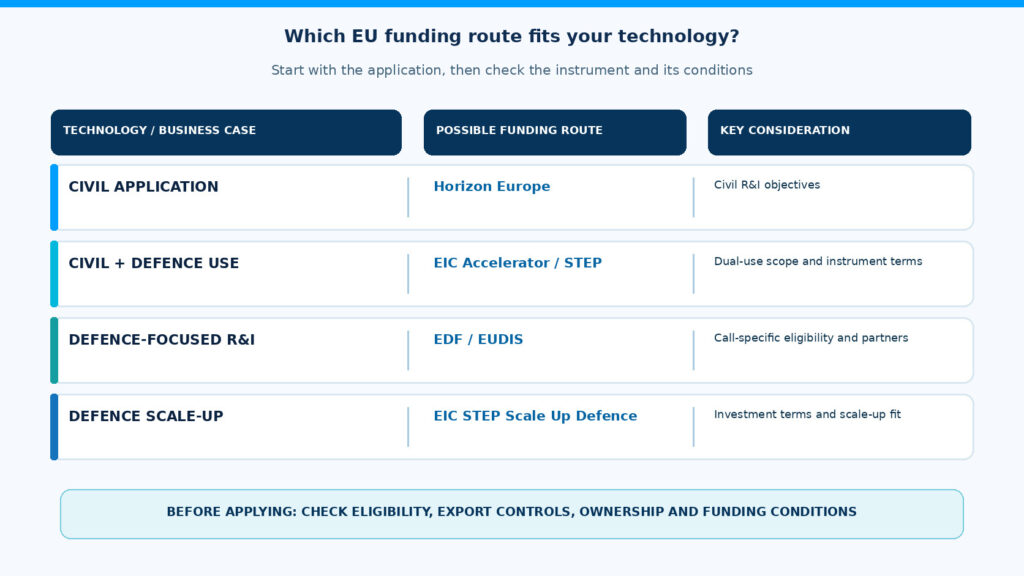
The most consequential change came in June 2026, when an amendment to the European Innovation Council work programme took effect and expanded EIC funding toward dual-use technologies and the defence sector. The EIC Accelerator and EIC STEP Scale Up now accept projects based on dual-use technologies – those with both civil and military applications – and a new EIC STEP Scale Up Defence call was created specifically for technologies with defence applications.
The defence-specific call carries an indicative budget of €100 million for 2026 with a further €100 million indicated for 2027, subject to adoption of the corresponding work programme. It is aimed at startups, SMEs and small mid-caps from around TRL 6 upward, with evaluation on a quarterly cycle, and targets areas including artificial intelligence, quantum computing, robotics, space, cybersecurity and advanced materials. Understanding Technology Readiness Levels (TRL 1–9) is essential when assessing whether an innovation is mature enough for a particular EU funding instrument.
The practical significance is that a company with civil market potential and possible defence applications no longer has to choose a lane at the outset. That is a genuine change in the European funding landscape, and it is recent enough that most companies have not yet registered it.
The instruments, mapped
| Instrument | What it funds | Best fit for a civil innovator |
| European Defence Fund | Collaborative defence research and capability development. The 2026 programme ran around €1 billion across ten calls and thirty-one topics | Companies willing to work in a defence consortium on defence-specific outcomes |
| EU Defence Innovation Scheme (EUDIS) | The entry layer within the EDF, accounting for around €231 million in 2026 and designed to lower barriers for SMEs, startups and non-traditional defence actors | First contact with the defence ecosystem, especially through cascade funding and accelerator support |
| EIC Accelerator and EIC STEP Scale Up | Single-company grant and investment support, now open to dual-use technology projects | A civil company whose technology has defence relevance but whose market is civil |
| EIC STEP Scale Up Defence | A dedicated call for technologies with defence applications, from around TRL 6, with quarterly evaluation | Companies ready to scale a technology with clear defence application |
| Defence Equity Facility | Equity investment into defence SMEs and mid-caps, under InvestEU and implemented by the European Investment Fund | Companies seeking capital rather than grant funding |
| Horizon Europe | Civil research and innovation. Remains civil in orientation, though several topics touch resilience and security | Where genuinely civil work still belongs |
Companies considering investment-based instruments should also understand the differences between EU grants and venture capital, particularly regarding equity, financial obligations and long-term commercial flexibility.
The spin-in logic
The EDF actively promotes what it calls spin-in: adapting civilian technologies for defence use. This is the concept a civil innovator needs to understand, because it is the mechanism by which the programme is trying to reach companies like yours.
The 2026 programme included research and development calls explicitly fostering the spin-in of EU-funded civil research, in areas such as energy resilience and environmental transition, and underwater domain technologies. In other words, the Commission is looking for civil research outputs that can be redirected – and a company that already holds Horizon Europe results is precisely the profile these calls were designed for.
The corollary matters too. A civil project that produced a promising result and no follow-on funding may have a second route available that its coordinators have not considered.
Funding rules that differ from Horizon Europe
This is where assumptions carried over from Horizon Europe cause problems.
| Feature | How it works in the EDF |
| Consortium requirement | Generally at least three independent entities established in three different Member States or EDF-associated countries such as Norway. Similar in shape to Horizon Europe, but the eligible country set differs |
| Research actions | Funded at 100% of eligible costs |
| Development actions | Funded between 20% and 100% depending on the activity – design, prototyping, testing, qualification and certification attract different rates. This is unlike Horizon Europe and requires real co-financing planning |
| Bonuses | Additional funding bonuses apply for projects involving SMEs, mid-caps, or links to Permanent Structured Cooperation projects |
| Security requirements | Substantially stricter than Horizon Europe, including on ownership, control and information handling. Ownership structure matters more here than anywhere else in European funding |
| Results and IP | Arrangements are more restrictive, with implications for how results can be exploited commercially and internationally |
For comparison, our guide to building a Horizon Europe budget explains the cost categories, funding rates and co-financing requirements used in civilian research and innovation projects. The development action funding rate is the item most often misread. A company assuming Horizon Europe-style reimbursement can find that a qualification or certification activity is funded at a fraction of that, with the remainder to be found elsewhere.
EUDIS: the low-barrier entry points
For a civil company that wants to test the water rather than commit, EUDIS is where to look. It was established under the EDF specifically to lower entry barriers for smaller and non-traditional players.
- Cascade funding calls for startups and SMEs, distributed through funded projects, with lighter application processes than main calls.
- Open, non-thematic SME calls, run twice yearly. Research-action calls dedicated to SMEs and research organisations are funded at 100%, and applicants still need a consortium of at least three companies across three Member States.
- The EUDIS Business Accelerator, supporting startups and scale-ups across spring and autumn cohorts, with matchmaking events connecting innovators to defence end users and investors.
- Defence hackathons, run in multiple editions across several countries each year – a low-commitment way to meet the ecosystem without a proposal.
For startups exploring alternatives to large collaborative proposals, our guide explains when Horizon Europe applications without a consortium are possible and how single-applicant and cascade funding routes differ. Ukrainian entities are eligible to apply for EDF cascade funding grants, which is a specific and under-publicised route worth knowing if your consortium includes or could include a Ukrainian partner. For the broader context, our guide to EU funding and innovation cooperation with Ukraine explains how Ukrainian organisations can position themselves for European programmes and consortium participation.
What to think through before entering
This is a strategic decision with consequences beyond the funding, and it deserves deliberation rather than opportunism. The considerations below are the ones companies most often address too late.
Export control and classification
Dual-use technologies are subject to export control regimes. Work that shifts a product’s classification can restrict where it can be sold, to whom, and under what licensing – including in civil markets. Establish the classification position before the work begins, not after the result exists.
Intellectual property and commercial freedom
Results arrangements in defence funding are more restrictive than in Horizon Europe, with implications for licensing, international sales and future investment. Read these terms with the same attention you would give a term sheet.
Investor and customer implications
Some investors have mandates that exclude defence exposure; others actively seek it, and that balance has shifted in recent years. Some civil customers will be indifferent; others will not. Both conversations are better held before an application than after an award.
Organisational position
Staff views on defence work vary, and a company entering this space without internal alignment can create a retention problem it did not anticipate. This is a legitimate consideration rather than a soft one, and it is best surfaced early.
Whether the technology genuinely fits
Defence requirements are specific, and adjacency is not the same as applicability. A technology that works in a commercial setting may need substantial adaptation for operational conditions, and the funding will not cover a mismatch that was apparent at the outset.
Practical steps
- Establish your export control classification position first. This is the item with the longest tail and the greatest capacity to constrain later decisions.
- Decide whether you are seeking a civil route with defence adjacency, or entering defence properly. The EIC dual-use route and the EDF are different commitments.
- Use EUDIS to make first contact – hackathons, matchmaking events and the accelerator involve no proposal and give a realistic view of the ecosystem.
- Check the funding rate for the specific activity type before budgeting. Development actions are not funded like Horizon Europe.
- Review your ownership and control position against the security requirements, which are stricter here than elsewhere.
- Have the investor and internal conversations before you apply.
- If you hold results from a completed civil project, examine whether the spin-in calls offer a second route for them.
How Nexuswelt works in this area
Nexuswelt works across Horizon Europe, Digital Europe, Chips JU, the European Defence Fund and Interreg, supporting organisations on programme selection, consortium positioning and the communication, dissemination, stakeholder engagement and exploitation layer – which in defence-adjacent projects carries additional constraints that have to be designed in rather than added later. The wider policy context is in our guide to European technology sovereignty, and more on the firm is on the Nexuswelt about page. Nexuswelt is not a legal adviser; export control and IP positions should be confirmed with a qualified professional.