Munich, 4 September 2026 · Nexuswelt Group
Horizon Europe for South Korean companies is now a practical participation opportunity, not simply an eligibility question.
Korea’s access to Horizon Europe has been settled for more than a year. The support structures exist, the national agencies are running information sessions, and the eligibility rules are clear. And yet, across Korean universities, startups and research institutes, the same pattern keeps repeating: teams that are formally eligible never reach the starting point.
Korean commentary has identified this accurately – the barrier is no longer the policy, it is knowing how to begin. What has not been written is the other half: what beginning actually looks like from the European side, and what a coordinator in Munich or Barcelona is deciding when they consider a Korean partner. This guide covers both.
Where Korea stands
Korea is associated to Pillar II of Horizon Europe – the first Asian country to associate to the programme. Participation began under a transitional arrangement on 1 January 2025, and the Association Agreement was signed on 17 July 2025. Korean legal entities apply on the same terms as entities from EU Member States and receive funding directly from the Horizon Europe budget, without a separate domestic selection process. The European Commission’s page on cooperation with Korea sets out the framework.
Pillar II is the largest part of the programme – around €53.5 billion – covering health, culture and security, digital, industry and space, climate, energy and mobility, and food and bioeconomy, together with most European partnerships. Unlike some associated countries, Korea makes a financial contribution to the programme in return for this access. For comparison, see our guide to Horizon Europe for Canadian companies.
What association does not cover
| Pillar | What it funds | Korean access |
| Pillar I – Excellent Science | European Research Council, Marie Skłodowska-Curie Actions, research infrastructures | Not associated. Korea is treated as a non-associated third country here; equal ERC access was explicitly not part of the deal. |
| Pillar II – Global Challenges and European Industrial Competitiveness | Collaborative multi-partner projects across six clusters, Missions and most partnerships | Full participation on equal terms. This is where Korean organisations belong. |
| Pillar III – Innovative Europe | European Innovation Council, EIT | Not associated. The EIC Accelerator is not a route for a Korea-based company as such. |
One further condition applies to all associated countries: individual calls may restrict participation to protect the EU’s strategic assets, interests, autonomy or security. This is stated in the call or topic text, so the topic governs rather than the country list.
The real gap: most teams never start
Korean participation so far is concentrated in digital, industry and space – which reflects where existing bilateral relationships already ran, not where Korean capability ends. The teams that did start were mostly teams that already knew someone.
That is the whole problem in one sentence. European consortia do not form through open calls; they form through networks, months before a call is published. Eligibility gives you the right to be in the room. It does not get you into the room.
Four structural reasons the first step does not happen:
- The programme’s architecture is unfamiliar. Work packages, TRL, deliverables, consortium agreements, impact pathways – the vocabulary is a barrier before the substance is reached, and the available guidance explains eligibility rather than practice.
- There is no domestic gatekeeper to satisfy. Korean researchers are accustomed to a national selection process; in Horizon Europe there is no such stage, and the absence of a familiar entry ritual removes the obvious first action.
- The timeline is long and the payoff is indirect, which makes it easy to defer indefinitely against domestic programmes with faster cycles.
- Distance and time zones make informal relationship-building – the mechanism by which consortia actually form – considerably harder than it is between two European organisations.
The trust question, stated honestly
Behind all of this sits something rarely written down: a European coordinator bildung a consortium is making a risk judgement, and an unfamiliar partner ten thousand kilometres away is a larger risk than a familiar one two countries over.
This is not prejudice, and treating it as such leads to the wrong response. The coordinator is accountable for delivery across several years. What they need is not reassurance but resolution of specific uncertainties – and every one of those uncertainties can be answered in advance.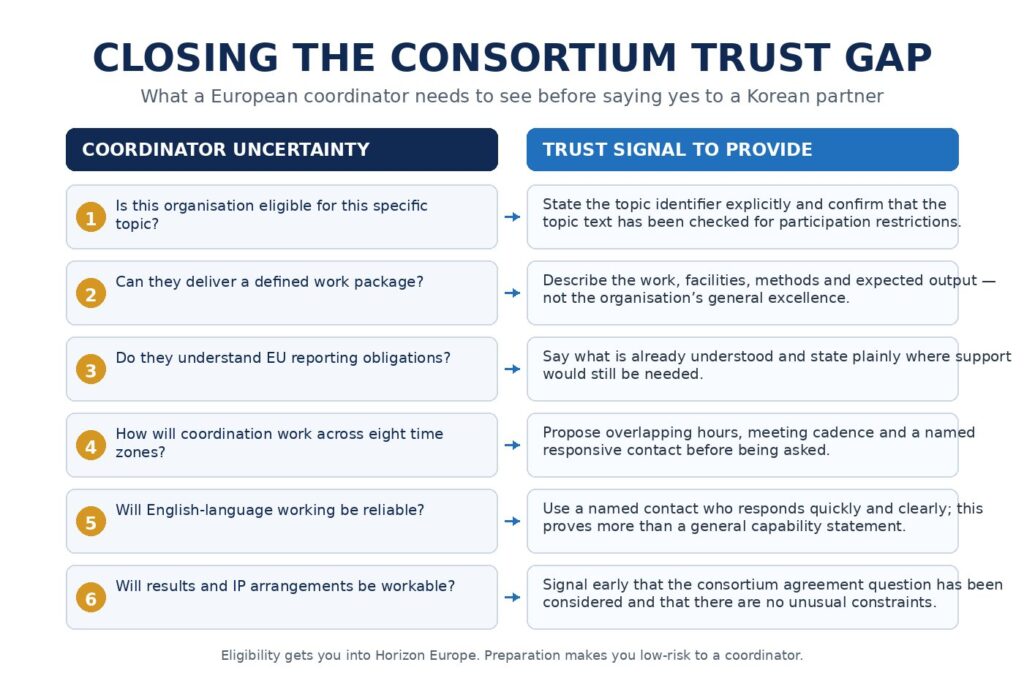
A Korean organisation that answers these six points unprompted in its first contact is, in the coordinator’s experience, unusual. That is the advantage available here, and it costs nothing but preparation.
For European coordinators: assessing a Korean partner
If you coordinate an EU project, a Korean partner is not a diversity gesture. Korea is a scientifically and industrially advanced economy whose association was pursued precisely to bring that capability into European consortia, and in several clusters a Korean partner strengthens the proposal on the merits.
What to check is ordinary due diligence: legal status and a Participant Identification Code; whether the specific topic restricts participation; a named decision-maker with working English; prior EU project experience or a credible account of why its absence is not a delivery risk; administrative capacity for reporting; and a practical answer on meeting cadence across time zones. These are the same questions you would ask about any partner you had not worked with before.
Where Korean capability meets European demand
| Area | Why the overlap exists |
| Semiconductors and advanced electronics | A globally leading Korean industrial base against a European agenda actively building capability and supply-chain resilience |
| Batteries, energy storage and mobility | Deep Korean manufacturing capability meeting one of the largest concentrations of European funding |
| Digital, AI and robotics | The cluster where Korean participation is already strongest, and where the current work programme has expanded horizontal AI calls |
| Hydrogen and clean energy technologies | Korean industrial commitment aligning with European decarbonisation priorities |
| Health technology and biotech | Strong Korean clinical and device capability in a cluster where consortium slots for industrial partners are genuinely available |
| Space and earth observation | Established bilateral cooperation and a growing Korean supplier base |
| Advanced materials | A recognised research base in an area European programmes treat as strategically critical |
A practical entry path
If you are new to building a consortium, our practical guide explains how Horizon Europe consortia are formed from the first partner search to role definition.
- Decide what you want from Europe beyond the grant – market access, a specific partner, technical validation, standards influence. Your share of a collaborative budget will be modest; the strategic return is the reason to do it.
- Read two full call topics end to end, including expected outcomes and specific conditions. This teaches the programme’s logic faster than any briefing.
- Register and obtain a Participant Identification Code now, independently of any application.
- Define a role, not a capability. What you would deliver, in which work package, with what facilities and what output.
- Write a one-page partner profile in English. This is the document that circulates when consortia form, and most Korean organisations do not have one.
- Use the Korean support structure early – the National Research Foundation’s information sessions and National Contact Point network, and the Korea–EU Research Centre for onboarding and collaboration support. An introduction from a national contact point carries weight that cold outreach does not.
- Search CORDIS for funded projects in your field, identify the coordinators who appear repeatedly, and approach two of them with reference to their actual work.
- Answer the six uncertainty points above in that first message, unprompted.
- Start as a partner, not a coordinator. First participation is what makes later coordination viable.
Timeline
A Korean organisation entering for the first time should plan on six to twelve months from decision to submission. The relationship-building phase is the long part and cannot be compressed by starting late. A call closing in eight weeks with no consortium is a call to skip while building for the next cycle – and given that most consortia form before publication, the next cycle is the realistic target in any case.
How Nexuswelt works with Korean organisations
Nexuswelt is a European company based in Munich and active across Europe. For a Korean organisation, the useful thing is not another explanation of eligibility but a counterpart inside the European system: fit assessment against real topics, role definition, consortium positioning, partner search, and the material that makes an unfamiliar organisation credible to a coordinator. Nexuswelt also contributes to funded projects as a partner for communication, dissemination, stakeholder engagement and exploitation. More is on the Nexuswelt about page.