Munich, 2 September 2026 · Nexuswelt Group
A project can finish every deliverable, publish well, hold every planned workshop, and produce nothing that anybody outside the consortium uses. This is the most common form of failure in EU-funded work, and it does not appear in any report as a failure.
Uptake requires that people outside the project were involved before the results existed. That is what stakeholder engagement is for. It is not awareness-raising with a different name, and treating it as such is why so many technically successful projects end with a dissemination record and no adopters.
Awareness is not acceptance, and acceptance is not uptake
These three words are used interchangeably in most project documents. They describe different states, they require different work, and only the last one supports an impact claim.
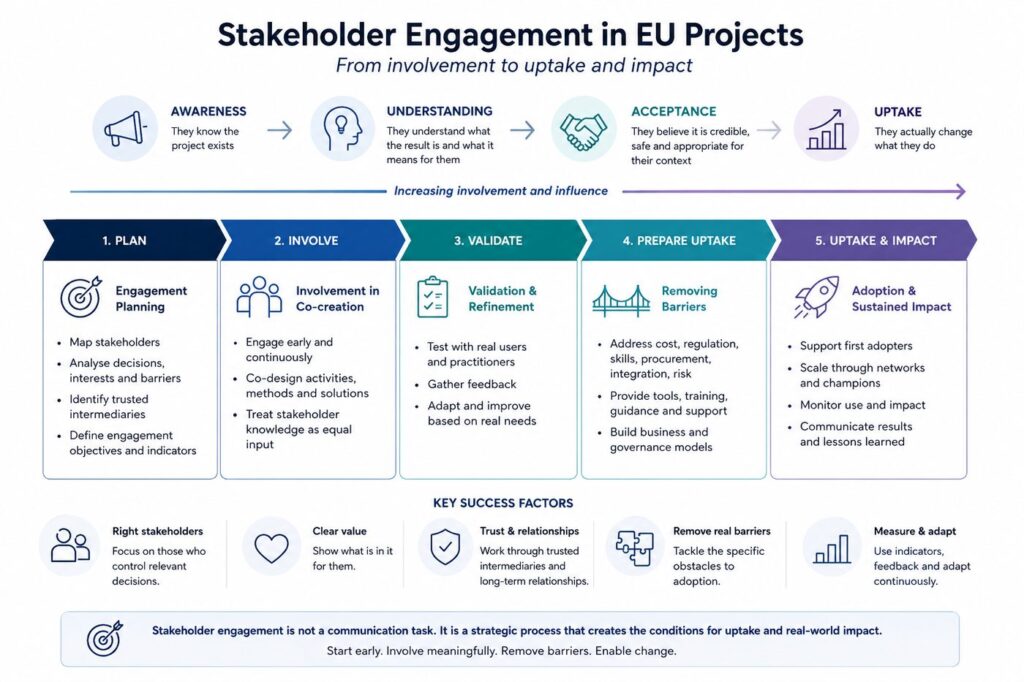
Most engagement plans stop after the second row. The gap between understanding and acceptance is where projects lose their impact, and it cannot be closed by producing more material.
Consultation is not engagement
There is a hierarchy of involvement, and where a project sits on it determines what it can credibly claim.
| Level | What happens | What it can produce |
| Informing | You tell them what you are doing | Awareness |
| Consulting | You ask their opinion, then decide | Better-informed decisions, and often resentment if the input visibly changed nothing |
| Involving | They participate in shaping the work at defined points | Understanding and some acceptance |
| Co-creating | They help produce the result, and their knowledge is treated as equivalent input to technical expertise | Acceptance, co-ownership, and a realistic route to uptake |
In some parts of Horizon Europe this is not optional. The multi-actor approach requires genuine and sufficient involvement of relevant actors in co-creation, from proposal drafting through to the end of implementation, and it is applied across a substantial share of topics in the clusters where it applies. Communicating results or running consultation activities does not satisfy it.
The Commission’s own definition distinguishes actors – who are partners inside the consortium – from stakeholders and end users, who are external and targeted by the project. Both matter, but only actors are integrated as beneficiaries. The official description of the multi-actor approach sets out the requirements in detail.
Mapping stakeholders properly
Most stakeholder maps are a list of categories drawn up in an afternoon: industry, policymakers, academia, civil society. That is not a map, it is a table of contents.
A usable map answers five questions for each group:
- Who exactly – named organisations or precisely defined roles, not sectors.
- What decision do they control that matters to your result? If they control no relevant decision, they are an audience, not a stakeholder.
- What is in it for them? A stakeholder with no interest in the outcome will not engage regardless of how well you communicate.
- What would stop them adopting, specifically – cost, regulatory approval, integration with existing systems, skills, procurement rules, internal authority.
- Who do they trust? Uptake usually travels through an intermediary rather than directly from a research consortium.
That last question is the one most maps omit and the one that most often determines whether anything happens. A regional authority is more likely to adopt a method recommended by its national association than one presented by a project it has never heard of.
Timing: the engagement curve
Engagement effort is usually distributed backwards. Projects run a kick-off workshop, go quiet through the technical work, and then attempt intensive outreach in the final six months – at the point when nothing about the result can still be changed in response to what they hear.
| Phase | What engagement is for | What it looks like |
| Proposal stage | Establishing that the need is real and the intended users are interested | Letters of intent that mean something; named organisations; evidence in the impact section |
| Early project | Validating the problem definition and the specification | Requirements workshops where the specification can still change as a result |
| Mid project | Testing and adjusting; building trust through visible responsiveness | Pilots, living labs, iterative feedback with documented changes |
| Late project | Preparing adoption, removing barriers, transferring ownership | Training, procurement conversations, standards submissions, intermediary handover |
| Post project | Continuation without the consortium | A named owner outside the project; a maintained resource; an intermediary carrying it forward |
The test for whether early engagement is real: has anything about the project changed because of what a stakeholder said? If nothing ever changes, the engagement is theatre, and stakeholders learn that quickly.
Why stakeholders disengage
- They were consulted and nothing visibly followed from their input.
- The time commitment was never stated honestly at the start.
- Every interaction is a request for their input and none returns anything they can use.
- The material is written in the project’s vocabulary rather than theirs.
- The contact is a different person each time, and the relationship never accumulates.
- The project asked for engagement at the phase of their year when they had least capacity – harvest, budget cycle, semester start, audit season.
Each of these is preventable, and each is more damaging than it looks: a disengaged stakeholder is harder to re-engage than a new one is to recruit.
Designing engagement so it survives the project
Engagement work has a structural weakness in EU projects: it is funded for the project’s duration, and the relationships it builds usually end with it. Three design choices change that.
Route through intermediaries
Associations, chambers, professional bodies, standards organisations and regional agencies already hold the relationships you are trying to build, and they persist after the grant. Engaging fifty companies directly builds fifty relationships that end at month thirty-six. Engaging the association that represents them builds one that continues.
Give before you ask
Every engagement interaction should return something usable to the stakeholder: a benchmark, an early finding, an introduction, a briefing they can use internally. Projects that only extract input exhaust their stakeholder base by mid-project.
Name the owner for after the end
Before the final year, identify who continues to hold each relationship and each result once the consortium dissolves. If the answer is nobody, the uptake claim in the proposal was not credible, and the final review is a poor time to discover it.
Evidencing engagement
Reviewers ask for evidence of engagement and receive attendance numbers. Attendance is an activity measure. What demonstrates engagement is different:
| Weak evidence | Strong evidence |
| 120 people attended our workshops | Attendance composition by stakeholder type, with the decision each group influences |
| We consulted stakeholders throughout | Three documented instances where the specification changed because of stakeholder input |
| Our newsletter has 800 subscribers | Named organisations that requested follow-up, and what they asked for |
| Stakeholders responded positively | An intermediary that has committed to carrying a result forward after the project |
| We held a final conference | A public authority that has begun a procurement process referencing the result |
Collect this as you go. Reconstructing it in the final reporting period is difficult and visibly reconstructed. Collect this as reporting evidence throughout the project.
Who owns engagement in the consortium
A recurring failure is assigning stakeholder engagement wholly to the communication partner. Communication expertise builds the framework, the channels and the monitoring. It cannot supply domain relationships or domain credibility. This is also a consortium design question: stakeholder responsibilities need to be distributed across partners with the right domain relationships and credibility. The dissemination plan should make this division of responsibilities explicit.
A structure that works: a dedicated partner or work package coordinates and sets the method; each technical partner owns the stakeholders in its own domain and geography, because that is where the existing relationships and the credibility are; and the coordinator holds accountability for the whole, including the awkward question of whether anything has actually changed as a result.
How Nexuswelt works on this
Stakeholder relevance, acceptance and uptake are the layer Nexuswelt was built around: strong innovation does not create impact on its own, and the gap between a technically successful project and a used result is usually a stakeholder gap rather than a technical one. Nexuswelt contributes to EU-funded projects as a partner on communication, dissemination, stakeholder engagement and exploitation. The wider treatment of coordinator obligations is in our guide to communication, dissemination and exploitation, and more on the firm is on the Nexuswelt about page.