Technology Acceptance in EU Projects: Planning Adoption Evidence Before the Pilot
A pilot can prove that a technology works and still say nothing about whether anyone will use it. Operators may find it slower than the current process, managers may not trust its outputs, and the buyer may face procurement or safety rules that rule it out. If a project only measures technical performance, those findings arrive after the project has ended, or not at all.
Acceptance evidence has to be designed into the pilot from the start: defined user groups, realistic conditions and observations that reveal barriers as well as readiness.
Technical validation is not acceptance
The Horizon Europe technology readiness levels describe technical maturity. TRL 6 is a technology demonstrated in a relevant environment, and TRL 7 is a system prototype demonstrated in an operational environment. Neither says whether the intended users can and will adopt it.
The application form already points in this direction. In the impact pathway, applicants must name the target groups that would benefit and describe requirements and potential barriers, arising from factors such as regulation, markets and user behaviour, together with mitigation measures. A pilot is the project’s best opportunity to test those barriers rather than describe them.
Acceptance, societal readiness and exploitation
The three terms are often used interchangeably. They answer different questions.
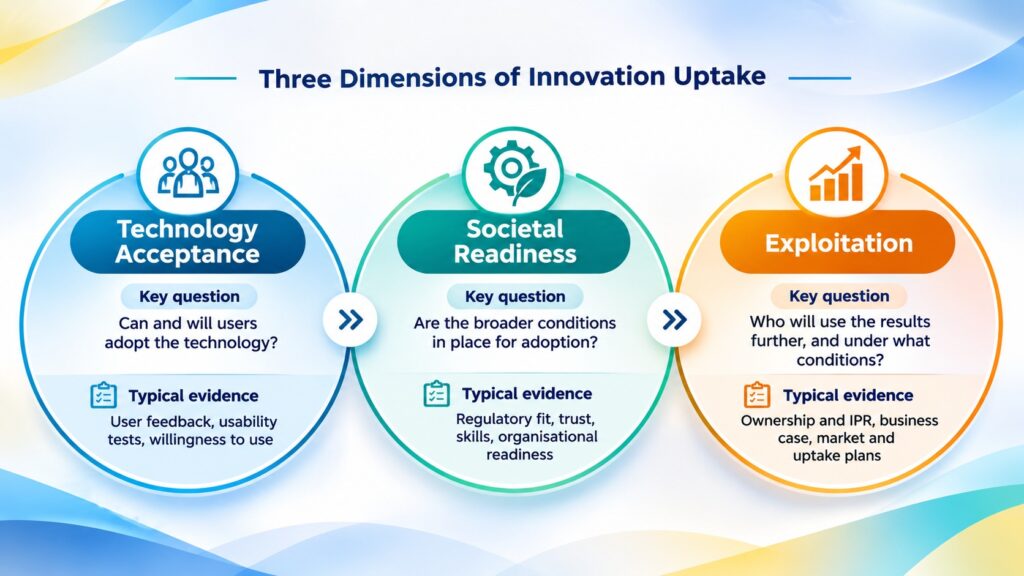
Acceptance feeds exploitation, but it is not a business model. This article covers acceptance evidence. Individual calls may set their own expectations, such as integration of social sciences and humanities or a multi-actor approach, and no single acceptance framework or indicator set applies to every Horizon Europe pilot.
Identify the actual users and decision-makers
“End users” is not a user group. For each pilot, name:
- direct users, who operate the technology day to day;
- affected roles, whose work changes because of it (maintenance, quality, IT security);
- decision-makers, who approve purchase or deployment;
- gatekeepers, such as works councils, safety officers, regulators or procurement rules.
User acceptance alone does not establish deployment readiness. Operators may be willing to use a system that the decision-maker cannot approve, and a system approved for purchase can still fail in daily use, so the pilot needs evidence from both sides.
Map practical adoption barriers
Before the pilot, list the barriers each group might face, and decide how the pilot will test each one.
Barrier type | Example questions |
Usability | Can users complete real tasks without support after training? |
Workflow fit | Does it add steps, change shifts or duplicate existing systems? |
Trust | Do users understand and accept its outputs or recommendations? |
Skills | What training is needed, and who will provide it after the project? |
Organisational | Who is accountable when the system is wrong? |
Regulatory and safety | Does deployment require certification or approval? |
Cost and procurement | Can the buyer purchase it under its rules and budget cycles? |
Design acceptance questions into the pilot
Acceptance evidence depends on decisions that are easy to get wrong if they are left to the end:
- Realistic conditions. Real users, real tasks and real time pressure, not demonstrations by the developer’s engineers.
- Baselines. Measure the current process before the pilot so that changes can be compared.
- Duration. Long enough for novelty effects to wear off.
- Participant selection. Include sceptical and less experienced users, not only volunteers.
- Ethics and data protection. Research involving people, such as interviews and observations, has to be covered in the ethics self-assessment. Treat informed participation and data protection as separate questions. Participants need clear information and, where research ethics requires it, agreement to take part. Under the GDPR, each partner processing personal data needs an appropriate lawful basis, which is not necessarily consent, together with transparency, data minimisation and secure handling. Settle both with the partners’ data protection officers before recruitment.
Choose qualitative and quantitative evidence
Use several methods so that what users say can be checked against what they do.
Feed findings back into development
Acceptance evidence is only useful if it can still change something. Schedule user findings as inputs to technical tasks: a first pilot iteration, a review point, then design changes before the final validation. The work plan should show this as a dependency, with time and effort for the changes.
A fictional example. A consortium pilots an AI-assisted visual inspection system on two production lines at a mid-sized manufacturer. Technical tests meet the detection target. Usability observation shows operators override alerts when lines are running fast, because confirming each alert takes too long, and interviews show shift supervisors do not trust alerts they cannot explain. The consortium simplifies confirmation to one action and adds a short explanation of each alert before the second pilot phase. The quality manager then reviews the second-phase data as the decision-maker.
Report acceptance evidence without overstating it
Acceptance evidence should be recorded as a decision record, not just a survey result: user group, baseline, tested barrier, observation method, observed outcome, unresolved limitation, owner of the next design decision and deadline.
- State the sample and context: how many users, which sites, how long.
- Separate stated intentions from observed behaviour.
- Report unresolved barriers alongside positive findings.
- Do not generalise from one site to a whole market.
- Treat letters of support and expressions of interest as interest, not adoption.
Evidence of change is more credible than evidence of activity; our article on measuring impact with KPIs and evidence explains the difference.
Acceptance-readiness checklist
- ☐ User groups named, including decision-makers and gatekeepers
- ☐ Barriers mapped, with a plan to test each in the pilot
- ☐ Baseline measurement planned before the pilot
- ☐ Realistic conditions, duration and participant mix defined
- ☐ Ethics self-assessment, informed participation and GDPR lawful basis covered for research with people
- ☐ Mixed methods selected, linking stated and observed evidence
- ☐ Review point scheduled so findings can change the design
- ☐ Reporting rules agreed: samples, limitations, unresolved barriers
Nexuswelt can contribute to stakeholder engagement and acceptance work either as a funded consortium partner or under a separately scoped, contracted assignment, depending on the project and the call rules; see technology acceptance and societal readiness.