Under the Implementation criterion, experts assess the quality and effectiveness of the work plan, the assessment of risks, the appropriateness of the effort assigned to work packages and the resources overall, and the capacity and role of each participant. In practice they read section 3.1 of Part B with three questions: does this work produce the promised results, can these people do it with these resources, and do the tables agree with each other? A work plan that divides the proposal into administrative sections answers none of them.
Start from objectives and expected results
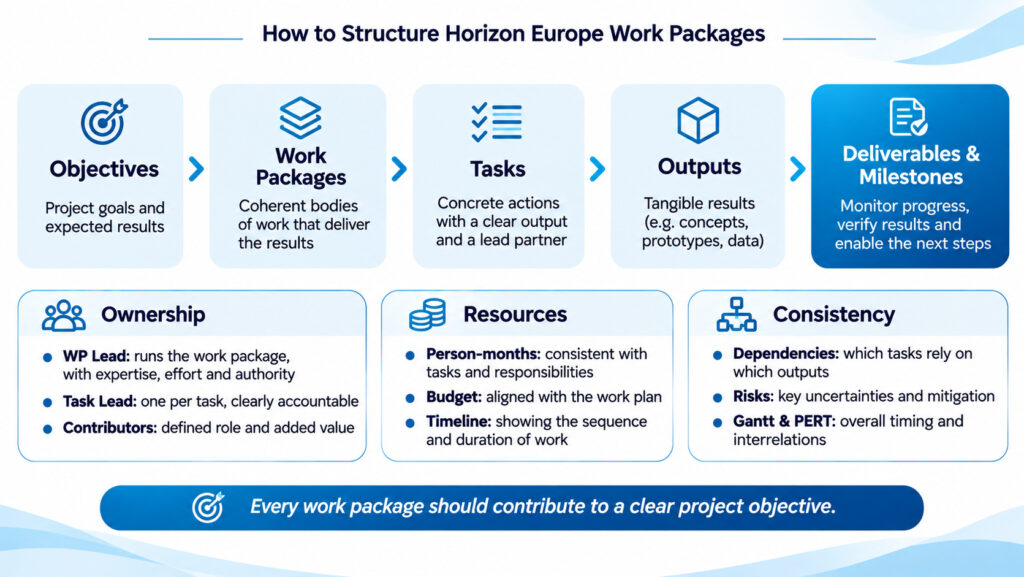
List the project’s objectives and the results that will exist at the end, then derive the work. Each work package should exist because it produces something the project needs, and every objective should be traceable to at least one work package.
A useful test: for each work package, can you state in one sentence what it delivers and which objective it serves? If not, it is probably a heading rather than a unit of work.
Set logical work package boundaries
There is no correct number or length of work packages. The Online Manual’s advice is as many as necessary and as few as possible, normally with a separate work package for management and coordination. The application form also asks for due visibility of data management, dissemination and exploitation, and communication, through distinct tasks or distinct work packages, and advises a distinct project management work package.
Good boundaries follow the logic of the work, not the organisation chart:
- one work package per coherent body of work with its own outputs, such as a technology component, a validation campaign or an uptake programme;
- not one per partner, which hides dependencies and duplicates management;
- not separate work packages for each phase of the same activity, unless the phases have different owners and outputs.
Under lump sum funding, payment is linked to the completion of work packages, which gives their boundaries a financial dimension. That is a consideration for lump sum topics, not a general design rule; our article on lump sum funding covers it.
Define tasks and dependencies
The work package table asks for a description of work, broken down into tasks where appropriate, with the lead partner and role of participants, and quantification of the work per task. Write tasks as actions with an output, not as topics: “Develop and test the data ingestion module”, not “Data”.
Make dependencies explicit. Section 3.1 asks for a timing chart (Gantt or similar) and a graphical presentation of how components interrelate (PERT or similar). Evaluators look for the critical path: which tasks wait for which outputs, and what happens if one is late.
Assign genuine ownership
Each work package needs a lead with the expertise, effort and authority to run it, and the effort assigned to that lead must be consistent with its role and tasks in the work plan. A lead with a small share of the effort in their own work package is a visible inconsistency.
Each task needs one lead partner. Shared leadership of a task usually means no one is accountable. Contributors should have a stated role, not just a line in the effort table.
Distinguish deliverables from milestones
Deliverable | Milestone | |
What it is | An output submitted to the granting authority to enable monitoring, such as a report, a data management plan or a demonstrator with documentation | A control point that helps chart progress, often marking a key result that allows the next phase to begin |
What the template asks | Only deliverables essential for effective monitoring | How you will verify that the milestone has been reached |
Typical mistake | Listing every internal document | Milestones that cannot be verified, such as “progress achieved” |
The number of deliverables may be adjusted during grant preparation, so list those that matter for monitoring rather than padding the table.
Link effort and resources to the actual work
The staff effort table shows person-months per partner per work package, and the template requires the work plan to match the costs in the budget table. Evaluators cross-read them.
Check that effort is proportionate to the tasks, that effort is distributed over time in line with the Gantt chart, and that major equipment, subcontracting and other costs appear where the work needs them. Effort concentrated in the final months describes a project that intends to catch up. For cost categories and rates, see our guide to budget categories and rates.
Integrate risks and mitigation
The template defines a critical risk as a plausible event or issue that could have a high adverse impact on achieving the objectives. For each, state the likelihood, the work packages involved and a concrete mitigation measure. Generic risks such as “partner leaves” with “replace partner” as mitigation add nothing. Risks drawn from the actual dependencies (a pilot site not available in time, a component failing validation) show that the plan has been thought through.
Test cross-work-package consistency
Before submission, check that:
- every objective is served by at least one work package, and every work package serves an objective;
- each deliverable and milestone sits in the right work package and month, consistent with the Gantt chart;
- outputs needed by one work package are produced by another before they are needed;
- effort and budget per partner and work package match between the tables and the narrative;
- the roles described in section 3.2 match the leads and tasks in section 3.1.
A fictional example
The example below is entirely fictional and shows the level of detail that makes a work package easy to follow.
WP3: Pilot validation in two manufacturing sites (months 12–30)
- Objective: validate the inspection system in operational conditions at two sites and confirm readiness for uptake.
- Lead: Partner D (industrial end user), 18 person-months; contributors Partner A (technology developer), 12 person-months, and Partner C (research institute), 8 person-months.
Task | Lead | Months | Output | Depends on |
T3.1 Site preparation and baseline measurement | D | 12–15 | Baseline data for both sites | Integrated prototype from WP2 (M12) |
T3.2 Pilot operation at site 1 | D | 15–22 | Operating data, user feedback and an interim lessons note (M18) | T3.1 |
T3.3 Pilot operation at site 2 | D | 19–26 | Operating data and user feedback | T3.1; interim lessons note from T3.2 (M18) |
T3.4 Performance and acceptance analysis | C | 22–30 | Validation results against baseline | Site 1 data from T3.2 (M22) to start; site 2 data from T3.3 (M26) for the final comparison |
- Deliverables: D3.1 Pilot protocol (M14); D3.2 Validation report (M30).
- Milestones: MS4 Both sites operational, verified by signed site readiness checklists (M19); MS5 Validation results accepted by the steering committee (M30).
- Critical risk: site 2 unavailable because of production schedules (medium likelihood); mitigation: agreed pilot windows in month 10, and an alternative line at Partner D.
- Effort assumption: 38 person-months in total. Partner D: 4 for site preparation and baseline, 8 for one engineer at about half time at each site during its eight months of operation, and 6 for pilot coordination (18). Partner A: 12 for technical support and fixes across both pilots. Partner C: 8 for the analysis in T3.4.
Work plan review checklist
- ☐ Each work package has one sentence stating what it delivers and which objective it serves
- ☐ Boundaries follow the work, not the partners
- ☐ Tasks are actions with outputs, each with one lead
- ☐ Dependencies shown in a Gantt and PERT chart, with the critical path visible
- ☐ Deliverables essential for monitoring; milestones verifiable
- ☐ Effort proportionate to tasks and consistent with the budget
- ☐ Critical risks specific to this project, with concrete mitigation
- ☐ Tables, narrative and section 3.2 roles consistent
Nexuswelt reviews and strengthens work plans as part of its proposal development and support service.