In June 2026, the Festival of the New European Bauhaus in Brussels brought together policymakers, architects, cultural actors, city representatives, civil society organisations and innovation stakeholders around one central question: how can Europe create living environments that are not only sustainable, but also inclusive, beautiful, resilient and connected to people’s everyday lives?
For Nexuswelt, one of the most meaningful discussions during the Festival was the session on strategic reconstruction in times of emergency, with a strong focus on Ukraine.
The discussion was highly relevant because Ukraine’s reconstruction is not only a question of infrastructure, funding or technical capacity. It is also a question of dignity, community, local ownership, memory, public space, schools, safety, culture and long-term resilience.
This is exactly where the values of the New European Bauhaus become important.
The European Commission describes the New European Bauhaus as an initiative that connects sustainability, inclusion and beauty and brings the green transition closer to citizens. It is not only about buildings. It is about how spaces can improve well-being, belonging and quality of life.
This perspective is especially important in the Ukrainian context, where reconstruction is taking place under conditions of war, uncertainty and ongoing emergency.
Ukraine cannot wait for a perfect post-war moment to start rebuilding. Communities need schools, shelters, hospitals, cultural spaces, workplaces and safe public environments now. At the same time, the decisions made today will shape the quality of life, resilience and local development of Ukrainian communities for decades.
That is why the key question is not only “how fast can we rebuild?” but also “how can we rebuild in a way that supports people, strengthens communities and prepares Ukraine for a more resilient future?”
Why the New European Bauhaus matters for Ukraine
The New European Bauhaus initiative is based on three core values: sustainability, beauty and togetherness.
In normal urban development, these values may sound like design principles. In the context of war and reconstruction, they become much more practical and urgent.
Sustainability means that reconstruction should not create future dependencies, waste or fragile infrastructure. It means thinking about energy efficiency, circular materials, renewable energy, climate adaptation and long-term maintenance.
Beauty means more than aesthetics. In crisis contexts, beauty can support dignity, psychological safety and the feeling that people are still treated as human beings, not only as recipients of emergency aid. A school, shelter or community centre can be functional and still create a sense of calm, hope and belonging.
Togetherness means local ownership and participation. Reconstruction should not be designed only from outside. Ukrainian municipalities, architects, communities, civil society organisations, cultural actors and local businesses need to be part of the process from the beginning.
This is one of the most important lessons from the New European Bauhaus approach: sustainable transformation is not only technical. It is also social and cultural.
The official Festival of the New European Bauhaus framed the conversation around life, spaces and buildings. This order is important. First comes life, then spaces, then buildings. Reconstruction should follow the same logic.
Buildings matter. But they should serve communities, not replace them.
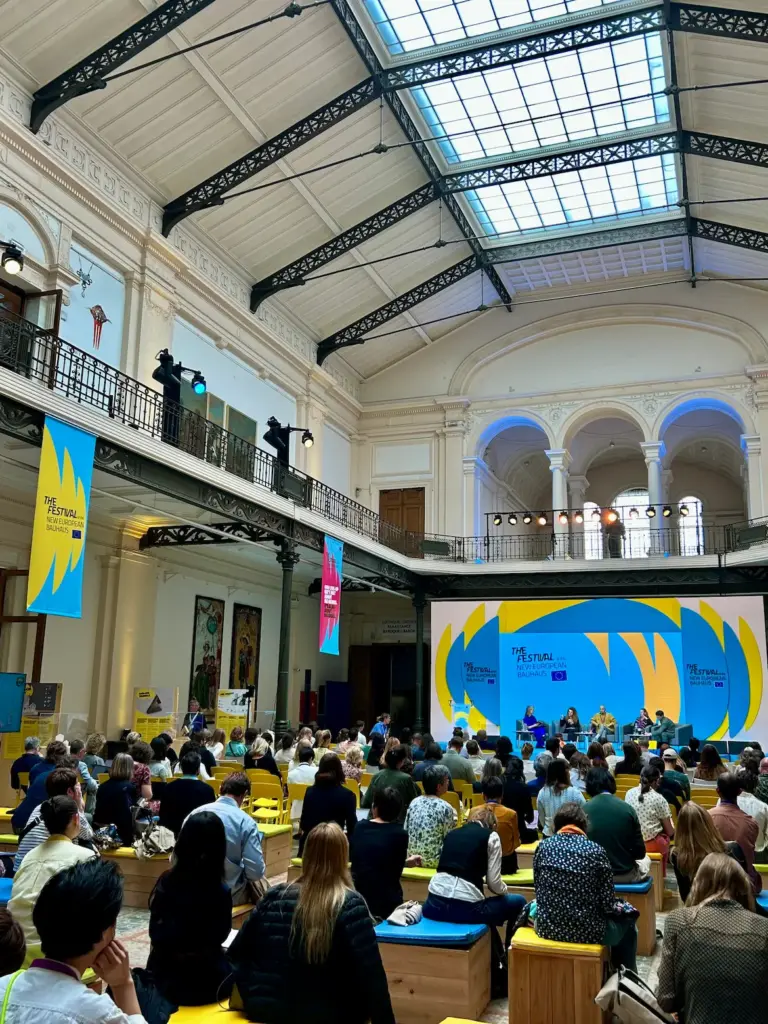
Reconstruction in times of emergency
The panel discussion focused on reconstruction under emergency conditions. This is a difficult but very real situation for Ukraine.
Traditional reconstruction frameworks often assume that war or disaster has ended, damage has been assessed, funding has been secured, and then rebuilding begins. Ukraine challenges this model because destruction and reconstruction are happening at the same time.
Communities continue to live, work, learn and care for each other while infrastructure is being damaged. Schools need to operate. Businesses need to survive. Families need safe spaces. Local authorities need to make decisions quickly, often with limited resources and under constant pressure.
This creates a complex question for European partners: how can we support reconstruction without creating slow, fragmented or externally imposed processes?
The discussion showed that strategic reconstruction in Ukraine needs to combine speed with quality. It needs to respond to urgent needs, but also avoid temporary solutions that become permanent problems.
This is especially relevant for schools, shelters and public buildings. Temporary structures can be necessary in emergency situations, but if they remain in use for years, they must also be safe, dignified, sustainable and adapted to community needs.
One important message from the discussion was that “nothing is more permanent than temporary.” This is particularly true in crisis response. What is built quickly may shape lives for a long time.
From infrastructure to community resilience
One of the strongest ideas from the discussion was that resilience is not something people simply “have” in unlimited amounts.
Ukrainians are often described as incredibly resilient. This is true, but it should not lead to the assumption that resilience is automatic or inexhaustible. Resilience needs to be supported.
It is built through communities, institutions, trusted spaces, local networks, resources, meaningful participation and the ability to act.
This idea connects strongly with the New European Bauhaus objective of empowering citizens through participatory processes and creating more inclusive, democratic and resilient neighbourhoods.
In practical terms, reconstruction should not only restore damaged buildings. It should also strengthen the social fabric around them.
A school is not only a school building. It is a place where children learn, parents meet, teachers organise daily life, communities maintain routines and the future becomes visible again.
A cultural centre is not only a cultural building. It can become a place where displaced people meet local residents, where businesses connect with civil society, where identity and memory are protected, and where communities regain a sense of agency.
A shelter is not only a safety structure. It can also be designed in a way that supports psychological comfort, accessibility, learning and human dignity.
This is why the built environment matters so much in the Ukrainian reconstruction context. It is not only about walls, roofs and technical standards. It is about the conditions that allow people to continue living, working and imagining the future.
Promprylad and community-led transformation
One of the examples discussed during the session was Promprylad in Ivano-Frankivsk, a former industrial site that has been transformed into an innovation, business, cultural and community space.
Promprylad is relevant because it shows how old industrial infrastructure can become a place for entrepreneurship, culture, displaced businesses, civic initiatives and community resilience. In the context of Ukraine’s wartime reality, such spaces can play a critical role. They are not only redevelopment projects; they become ecosystems.
They offer places where people can work, meet, organise, create and support each other.
This matters for European reconstruction thinking because it shows that rebuilding Ukraine is not only about replacing destroyed assets. It is also about creating environments where local economies, communities and civic life can continue to function.
Projects like Promprylad also show the importance of blended approaches: social impact, investment, culture, entrepreneurship and local ownership can work together.
For future EU-funded projects, this is highly relevant. Horizon Europe, Interreg, LIFE, the New European Bauhaus Facility and other EU instruments can support approaches that connect infrastructure, community development, innovation, culture and sustainability.
However, to make these projects successful, consortia need the right mix of partners: local actors, municipalities, research organisations, architects, civil society, businesses, investors, communication partners and exploitation experts.
Schools, shelters and the meaning of safety
Another important topic from the discussion was the role of schools and shelters in Ukraine.
In wartime Ukraine, a school can no longer be understood only as an educational building. It is also a safety space, a community anchor and a symbol that life continues.
The discussion mentioned school and shelter concepts designed to respond to the realities of war while still thinking about quality, participation and future use. This is a crucial point: infrastructure built during wartime should not only respond to danger. It should also support long-term recovery.
If underground shelters are designed only as emergency spaces, they may remain psychologically heavy and disconnected from everyday life. But if they are designed with educational, social and community functions in mind, they can become part of a broader resilience strategy.
This is where New European Bauhaus values become very practical.
- Sustainability can mean using renewable energy, reducing operational costs and making buildings more adaptable.
- Beauty can mean designing spaces where children, teachers and families feel safe, respected and calm.
- Togetherness can mean involving local communities, educators, architects and municipalities in planning.
This is not a luxury. It is part of recovery.
The Ukraine Facility and the wider EU reconstruction context
Ukraine’s reconstruction is also part of a much wider European policy and funding context.
The European Union has created the Ukraine Facility to provide predictable financial support for Ukraine’s recovery, reconstruction and modernisation. The Ukraine Plan linked to the Facility connects financial support with reforms, investment and long-term European integration.
At the same time, the scale of Ukraine’s reconstruction needs is enormous. According to the latest World Bank, European Commission, United Nations and Ukrainian Government reconstruction assessment, rebuilding Ukraine is estimated to require hundreds of billions of dollars over the next decade, with housing, transport and energy among the most affected sectors.
This scale shows why reconstruction cannot rely only on public funding or isolated projects. It will require coordinated action between Ukrainian institutions, European partners, international organisations, private investors, municipalities, civil society and innovation ecosystems.
The New European Bauhaus can contribute to this wider process by keeping reconstruction human-centred.
It reminds us that recovery is not only about macro-financial support or physical reconstruction. It is also about how people experience their neighbourhoods, schools, homes, public spaces and local institutions.
Why local ownership matters
One of the most important takeaways from the Festival discussion was the need to avoid copy-paste reconstruction.
International partners often bring valuable experience, technical expertise and funding. But reconstruction cannot be successful if solutions are designed without Ukrainian ownership.
Local context matters. Ukrainian communities know their needs, risks, culture, social dynamics and priorities. Ukrainian architects, municipalities and civil society organisations are not only beneficiaries of reconstruction; they are co-creators of it.
This is also a practical issue. Projects designed without local ownership often struggle with acceptance, maintenance, implementation and long-term sustainability.
The New European Bauhaus approach supports participatory processes, grassroots engagement and community-led transformation. This is exactly what Ukraine’s reconstruction needs.
For EU-funded projects, this means that stakeholder engagement should not be treated as a communication exercise at the end of the project. It should be integrated from the beginning.
Stakeholder mapping, participatory workshops, local needs assessment, communication with communities, policy alignment and exploitation planning should be part of the project design.
This is especially important in projects related to urban resilience, infrastructure, reconstruction, public services, cultural heritage, housing and community spaces.
Reconstruction as European innovation policy
Ukraine’s reconstruction is often discussed as a humanitarian, security or geopolitical priority. It is all of these things.
But it is also an innovation challenge.
Rebuilding under conditions of war and uncertainty forces new approaches to architecture, governance, participation, financing, digital transparency, modular construction, energy resilience and public infrastructure.
Ukraine’s experience can provide important lessons for Europe.
Climate-related disasters, migration, housing pressure, energy insecurity and security risks are not only Ukrainian issues. European cities and regions are also facing increasing uncertainty. The ability to build resilient, inclusive and adaptable communities will become one of the central challenges of the coming decades.
In this sense, Ukraine is not only learning from Europe. Europe can also learn from Ukraine.
The Ukrainian experience shows the importance of speed, adaptability, decentralised action, community agency and practical resilience. These lessons are relevant for future European policies on urban development, disaster recovery, climate adaptation and social cohesion.
This is why the New European Bauhaus is a relevant framework. It can help connect Ukraine’s reconstruction with Europe’s wider transformation agenda.
What this means for EU-funded projects
For organisations preparing Horizon Europe, Interreg, LIFE, Digital Europe, New European Bauhaus or EU-Ukraine cooperation projects, the discussion offers several practical lessons.
First, reconstruction projects need to connect infrastructure with people. Technical solutions should be designed around community needs, safety, accessibility and long-term use.
Second, sustainability should be integrated from the beginning. Energy efficiency, renewable energy, circular materials and climate adaptation should not be added later as formal requirements.
Third, communication and stakeholder engagement are essential. Communities must understand, trust and participate in the process.
Fourth, local ownership should be visible in the consortium structure. Ukrainian partners should not only be pilot sites or beneficiaries. They should have meaningful roles in design, implementation and decision-making.
Fifth, exploitation and impact planning matter. Reconstruction projects should create long-term value beyond the project lifetime: skills, methodologies, local capacities, partnerships and replicable models.
Sixth, cultural and psychological dimensions should not be ignored. Public spaces, schools and community buildings shape how people recover, connect and imagine the future.
These points are highly relevant for EU-funded innovation projects. They show why communication, dissemination, exploitation, impact strategy and stakeholder engagement are not administrative tasks. They are part of project success.
Nexuswelt’s perspective
For Nexuswelt, the discussion at the Festival of the New European Bauhaus was highly relevant to our work in EU-funded innovation projects and EU-Ukraine cooperation.
Through Nexuswelt Ukraine, we see strong potential to support practical connections between Ukrainian organisations and European partners. This includes universities, SMEs, municipalities, research organisations, innovation actors, civil society initiatives and regional stakeholders.
Our role is to help build bridges between policy priorities and practical project implementation.
In the context of Ukraine reconstruction and the New European Bauhaus, this can include:
- consortium and proposal support for EU-funded projects
- communication and dissemination strategies
- stakeholder engagement with Ukrainian and European actors
- impact and exploitation planning
- visibility for project results and local initiatives
- support for EU-Ukraine cooperation in Horizon Europe, Digital Europe, LIFE, Interreg and related programmes
- community-focused communication around reconstruction projects
- support for positioning Ukrainian partners in European innovation ecosystems
The discussion in Brussels confirmed that Ukraine’s reconstruction should not be treated only as a technical or financial challenge. It is also a European cooperation and innovation challenge.
The goal should be to rebuild in a way that strengthens communities, respects local identity, supports resilience and creates long-term opportunities.
Related Nexuswelt support:
For organisations working on Ukraine reconstruction, New European Bauhaus, resilience or EU-Ukraine cooperation projects, Nexuswelt supports proposal writing and strategic proposal support, partner search and consortium building, and impact-oriented project communication, dissemination and visibility.
Conclusion: rebuilding with dignity, resilience and trust
The Festival of the New European Bauhaus showed why Ukraine’s reconstruction requires more than speed.
Speed is necessary. But speed alone is not enough.
Ukraine needs reconstruction that is sustainable, inclusive, beautiful and community-driven. It needs schools and shelters that support safety and dignity. It needs public spaces that restore trust and belonging. It needs cultural and innovation hubs that help communities continue to work, learn and create. It needs local ownership, transparent governance and strong cooperation between Ukrainian and European partners.
The New European Bauhaus offers a valuable framework for this discussion because it connects the built environment with people’s lives.
For Ukraine, this means that reconstruction should not only restore what was destroyed. It should help build the conditions for a resilient, democratic and future-oriented society.
For Europe, it means that Ukraine’s experience can become a source of learning, innovation and deeper cooperation.
And for EU-funded projects, it means that the future of reconstruction will depend on partnerships that can connect infrastructure, sustainability, community engagement, communication, exploitation and real impact from the very beginning.
#NewEuropeanBauhaus #UkraineReconstruction #EUUkraine #SustainableReconstruction #Resilience #CommunityResilience #BuiltEnvironment #UrbanResilience #HorizonEurope #EUProjects #Interreg #LIFEProgramme #DigitalEurope #EuropeanInnovation #ImpactStrategy #Exploitation #NexusweltUkraine #Nexuswelt