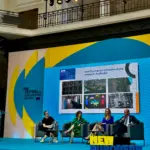
European Sustainable Energy Week 2026 in Brussels brought together policymakers, industry representatives, innovators, researchers, public authorities and energy stakeholders around one central theme: a clean, secure and competitive Energy Union.
For Nexuswelt, the event was especially relevant because it connected several priorities that are becoming central for future EU-funded projects: energy security, clean industrial transformation, renewable energy deployment, energy efficiency, resilience, competitiveness and EU-Ukraine cooperation.
The official EUSEW Policy Conference took place on 9-11 June 2026 in Brussels and online. According to the official European Commission page, the EUSEW Policy Conference is Europe’s biggest event dedicated to renewables and efficient energy use, gathering policymakers, innovators and energy stakeholders to discuss the future of clean energy in Europe. The 2026 edition included policy sessions, the Energy Fair, the EUSEW Awards and youth-focused activities.
Official links: European Sustainable Energy Week | EUSEW Policy Conference | EUSEW Energy Fair | REPowerEU
The most important takeaway from the sessions and discussions was clear: Europe’s energy transition is no longer only about climate targets. It is also about security, industrial competitiveness, strategic autonomy and resilience.
This makes EUSEW highly relevant for Horizon Europe, LIFE, the Innovation Fund, Digital Europe, Clean Industrial Deal-related calls and future EU-Ukraine cooperation projects.
Key messages from EUSEW 2026
Theme | What it means for EU-funded projects |
Energy security | Projects need to show how clean energy solutions reduce dependency, increase resilience and support security of supply. |
REPowerEU implementation | Policy commitments need practical enforcement, monitoring, authorisation procedures, stakeholder coordination and clear national implementation. |
Phase-out of Russian energy | Energy independence requires not only diversification, but also transparency, customs checks and prevention of indirect imports. |
Clean technologies and industry | Energy transition is linked to industrial competitiveness, affordable energy, grids, renewable gases and deployment-ready solutions. |
Ukraine cooperation | Ukraine is part of the wider European resilience discussion through energy infrastructure, storage, reconstruction and renewable potential. |
1. Energy security is now a competitiveness issue
One of the strongest messages from EUSEW 2026 was that energy security can no longer be separated from competitiveness. Secure, affordable and clean energy is essential for European industry, SMEs, cities, infrastructure operators and citizens.
The session recording around REPowerEU and the phase-out of Russian fossil fuels repeatedly returned to this point: reducing dependency is not only a geopolitical objective. It is also a condition for industrial stability, investment certainty, resilience and Europe’s ability to compete globally.
This is important for EU-funded projects. Clean energy projects are increasingly expected to demonstrate multiple forms of impact at the same time: decarbonisation, energy security, affordability, stakeholder acceptance, deployment potential and contribution to industrial transformation.
For proposal development, this means that clean energy and industrial decarbonisation proposals should not present technology as an isolated solution. They should explain how the solution fits into Europe’s broader energy security and competitiveness agenda.
2. REPowerEU is moving from strategy to enforcement
REPowerEU was launched by the European Commission in response to Russia’s full-scale invasion of Ukraine and the resulting energy crisis. The official European Commission page describes REPowerEU as the EU’s plan to phase out Russian fossil fuel imports by saving energy, diversifying energy supplies and producing clean energy.
At EUSEW 2026, the discussion had clearly moved beyond the original emergency response. The central question was no longer only whether Europe should reduce dependency on Russian energy. The question was how to make the phase-out operational, transparent and enforceable across Member States and market actors.
The recordings highlighted several practical implementation issues:
- clear authorisation procedures for gas imports
- monitoring of direct and indirect imports
- customs and documentation checks
- national diversification plans
- cooperation between regulators, customs authorities, companies and EU institutions
- handling of exemptions and simplified procedures for trusted suppliers
- the need to prevent circumvention through third countries or unclear supply chains
This enforcement perspective is very relevant for EU-funded projects because it shows a wider shift in EU policy: implementation capacity matters. Projects must be able to demonstrate not only ambition, but also practical pathways, governance, monitoring, stakeholder engagement and evidence of uptake.
3. Phasing out Russian energy is a resilience challenge, not only a political statement
The debate around Russian gas, LNG, oil and nuclear-related dependencies showed that Europe’s energy independence is a complex process. The official REPowerEU page states that the EU plans to stop all imports of Russian pipeline and liquefied natural gas by November 2027 and requires Member States to prepare national diversification plans for the gradual elimination of direct and indirect imports of Russian gas and oil.
The EUSEW discussion also underlined that progress can be uneven across the European Union. Some Member States have moved faster than others, while certain countries and industrial actors still face economic, technical or political barriers. The recordings mentioned the importance of avoiding delays, strengthening enforcement and ensuring that national implementation does not undermine the overall European objective.
For Europe, the phase-out of Russian energy is not only about replacing one supplier with another. It is about building a more resilient energy system based on diversification, clean technologies, renewable energy, efficiency and better infrastructure.
This is a crucial message for future clean energy proposals: EU projects should show how their results support long-term resilience, not only short-term substitution.
4. Clean energy deployment must be faster and more practical
EUSEW 2026 showed that the clean energy transition is entering a more practical and implementation-oriented phase. Europe does not only need targets; it needs faster deployment of renewable energy, grids, renewable gases, energy efficiency measures, storage, electrification and clean technologies that can work in real industrial and regional contexts.
The European Commission’s REPowerEU page highlights several priorities that remain central for this transition: rolling out renewables faster, investing in energy infrastructure and interconnections, improving energy efficiency and boosting industrial decarbonisation.
The discussions at EUSEW also pointed to the importance of renewable gases and biomethane. The recordings touched on biomethane production, regulatory conditions, demand creation and the role of renewable gases as part of Europe’s energy diversification pathway.
For project consortia, this creates a clear opportunity. Future EU-funded projects in clean energy should connect technical development with:
- deployment and demonstration activities
- market readiness and business models
- stakeholder acceptance
- public authority and industry engagement
- exploitation and scale-up pathways
- communication that explains the solution in terms of security, affordability and competitiveness
5. Ukraine is part of Europe’s energy security and reconstruction discussion
A particularly important point from the EUSEW discussions was the role of Ukraine. Ukraine was not only present as a country affected by Russia’s energy aggression, but also as a strategic partner in Europe’s future energy resilience.
The recordings referred to Ukraine in several contexts: energy infrastructure under pressure, energy security, gas storage, reconstruction, renewable energy potential and cooperation with European partners. This is important because it shows how Ukraine can be connected to Europe’s clean energy transition not only through emergency support, but also through long-term project cooperation.
Ukraine has potential to contribute to future EU cooperation through:
- energy resilience and infrastructure reconstruction
- renewable energy and renewable gas projects
- regional and municipal energy transition pilots
- energy efficiency in buildings and public infrastructure
- digital tools for monitoring and resilience
- research organisations, universities and innovative SMEs
- cooperation with European clusters, public authorities and technology providers
For Nexuswelt, this is a strategic direction. Through Nexuswelt Ukraine, we aim to support practical cooperation between Ukrainian organisations and European partners, especially in Horizon Europe, Digital Europe, clean energy, resilience, reconstruction, communication, dissemination, exploitation and impact strategy.
6. The Energy Fair shows why stakeholder engagement matters
The EUSEW Energy Fair was also relevant from a project communication and exploitation perspective. The official EUSEW website describes the Energy Fair as a platform for showcasing innovative projects and technologies in clean energy and energy efficiency, allowing exhibitors to engage with stakeholders shaping Europe’s clean energy future.
This format is important because it demonstrates what EU-funded projects often need: visibility, stakeholder interaction, market feedback and opportunities for future cooperation. For many projects, the challenge is not only to produce results, but to make those results visible and useful for policymakers, regions, companies, investors and end users.
From a Nexuswelt perspective, this confirms why communication and dissemination should be linked with exploitation and stakeholder engagement. A project’s visibility is strongest when it is connected to a clear value proposition, target audiences and long-term uptake strategy.
7. What this means for future EU-funded projects
The main lesson from EUSEW 2026 is that clean energy projects need to become more implementation-oriented. Strong proposals will need to show how they contribute to the European energy transition while also addressing security, competitiveness, resilience and market adoption.
For future Horizon Europe, LIFE, Innovation Fund, Digital Europe and Clean Industrial Deal-related proposals, several points are especially important:
- connect technical innovation with EU policy priorities such as REPowerEU, the Clean Industrial Deal and energy security
- show practical implementation pathways, not only research ambition
- include stakeholder engagement from the beginning
- link communication, dissemination and exploitation to real uptake
- explain how results can support energy security, resilience and industrial competitiveness
- consider Ukraine and EU-Ukraine cooperation where relevant
- build consortia that combine research, SMEs, industry, public authorities and communication/exploitation expertise
This is also where Nexuswelt can create value. We support EU-funded innovation projects with proposal and consortium support, communication, dissemination, exploitation, impact strategy, stakeholder engagement, project visibility and EU-Ukraine cooperation.
8. Nexuswelt’s perspective: from clean energy policy to project impact
EUSEW 2026 confirmed that Europe’s clean energy transition is not only a technical challenge. It is a cooperation challenge.
To make clean energy solutions work in practice, projects need to connect policy, technology, market needs, stakeholder trust, public acceptance, investment and long-term sustainability. This requires consortia that can translate high-level European priorities into practical project structures and visible outcomes.
Nexuswelt supports this process by helping projects build stronger narratives, clearer impact pathways, better stakeholder engagement and more visible exploitation strategies. Our role is to help consortia communicate not only what they develop, but why it matters, who benefits and how the results can be used after the project ends.
In clean energy, this is especially important because results often depend on complex stakeholder ecosystems: public authorities, grid operators, industry, investors, SMEs, citizens, municipalities, research organisations and regulators. Without a strong communication and exploitation approach, even technically strong solutions may struggle to reach adoption.
Related Nexuswelt support:
For clean energy, REPowerEU, EU-Ukraine cooperation and energy resilience projects, Nexuswelt supports project communication, dissemination and visibility, proposal writing and strategic proposal support, and partner search and consortium building for EU-funded innovation projects.
Conclusion: energy security, clean technologies and cooperation will define the next phase
European Sustainable Energy Week 2026 showed that the next phase of Europe’s energy transition will be shaped by implementation.
The key questions are no longer only about targets. They are about how Europe can deliver clean energy faster, reduce dependencies, strengthen resilience, phase out Russian fossil fuels, support Ukraine, protect industrial competitiveness and create practical pathways for innovation uptake.
For EU-funded projects, this creates both responsibility and opportunity. Clean energy proposals need to show technical excellence, but also implementation capacity, stakeholder engagement, exploitation potential and contribution to Europe’s wider resilience agenda.
For Nexuswelt, EUSEW 2026 confirmed a clear strategic direction: supporting partners, SMEs, research organisations and innovation actors in building EU-funded projects that are visible, useful, policy-relevant and ready for real impact.
If your organisation is preparing a Horizon Europe, LIFE, Innovation Fund, Digital Europe, Clean Industrial Deal or EU-Ukraine cooperation proposal and is looking for a partner for communication, dissemination, exploitation, impact strategy or stakeholder engagement, Nexuswelt would be glad to connect.
#EUSEW2026 #EuropeanSustainableEnergyWeek #REPowerEU #EnergySecurity #CleanEnergy #RenewableEnergy #EnergyTransition #CleanIndustrialDeal #HorizonEurope #EUProjects #UkraineReconstruction #EUUkraine #ImpactStrategy #Exploitation #Nexuswelt