Why the choice has to be made before submission
The core difference is between delivering a project responsibility and buying a defined service. A beneficiary signs the Grant Agreement and takes on its obligations. A subcontractor or supplier signs a contract with a beneficiary, which stays responsible towards the granting authority. The Annotated Grant Agreement warns that each role carries a fairly rigid set of conditions and that the wrong role causes problems later. The participant list, work plan and budget in the proposal become the basis of the Grant Agreement, and changing roles afterwards is possible only under the limited conditions of grant preparation or through an amendment. A procurement contract does not turn a service provider into a consortium beneficiary. Payment, however close the working relationship, gives no rights as a beneficiary, no seat in governance and no share of the grant.Model 1: D&C expertise as a consortium beneficiary
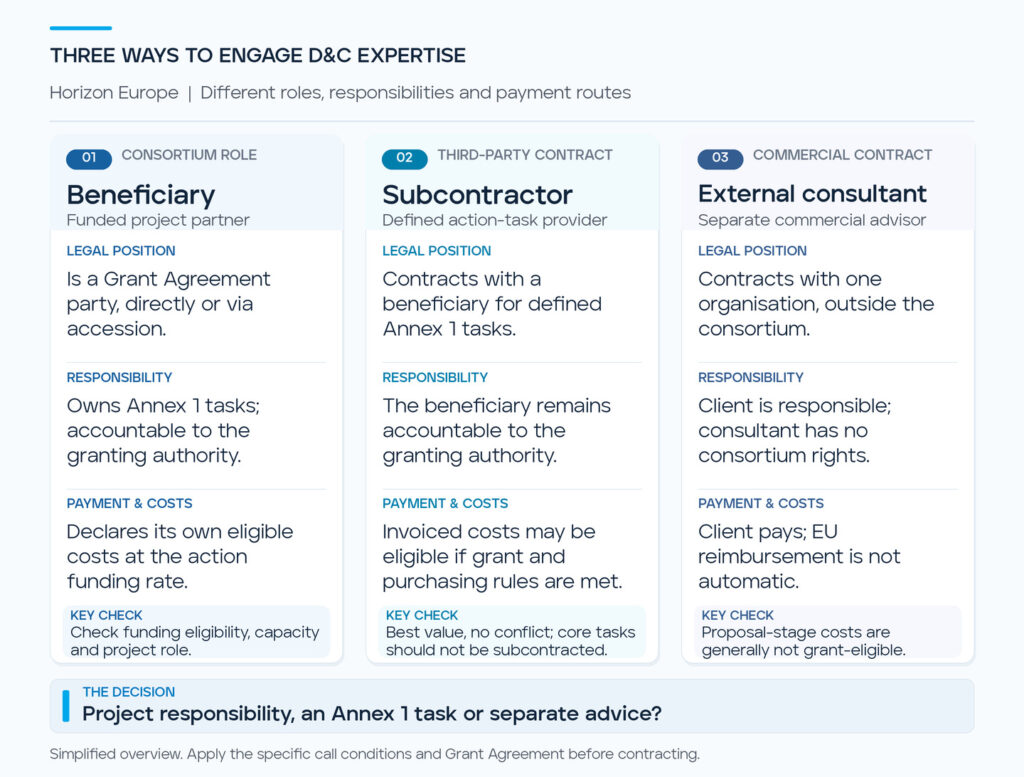
A beneficiary signs the Grant Agreement directly (the coordinator) or through an Accession Form. It implements the tasks assigned to it in Annex 1, complies with all Grant Agreement obligations, including the communication, dissemination and visibility rules of Article 17, and takes part in consortium governance. It has its own budget and declares its own eligible costs, reimbursed at the funding rate of the action: up to 100% for Research and Innovation Actions and Coordination and Support Actions, and 70% for Innovation Actions (up to 100% for non-profit entities), plus a 25% flat rate for indirect costs. Grants may not produce a profit. The organisation must be eligible to participate and, to be funded, eligible for funding under the call. It needs a validated PIC and a LEAR by signature, may face a financial capacity check, and its operational capacity is assessed under the Implementation criterion. The application form requires every participant to have “a valid role, and adequate resources in the project to fulfil that role”, so a D&C beneficiary needs defined tasks and effort, not a general mandate to “handle visibility”. This model fits when the organisation will own a project responsibility for the duration, such as leading dissemination, exploitation support or stakeholder engagement tasks, and needs a say in decisions that affect it.Model 2: Subcontracting defined D&C action tasks
The test is whether a contract covers an action task described in Annex 1. A subcontract implements action tasks; a purchase buys goods, works or services needed for the work that are not themselves action tasks. The Annotated Grant Agreement’s examples sit close to D&C: organising a conference that is an Annex 1 task is a subcontract, while translation, printing brochures, room hire and catering, or a website that is only a project management tool are normally purchases. The same activity can fall on either side depending on how Annex 1 describes it. Not every task can be subcontracted:- coordinator tasks may not be delegated or subcontracted, with narrow exceptions for public-body coordinators and sole beneficiaries (MGA Article 7);
- the application form states that core tasks of the project should not be subcontracted, and requires each subcontracted task to be described and justified per participant (table 3.1g);
- subcontracting should normally be a limited part of the action and must go to third parties, never to another beneficiary or affiliated entity.
Model 3: External consultancy paid outside the grant
An organisation can hire a consultant under an ordinary commercial agreement paid from its own resources. The consultant is not a participant and is not named in the Grant Agreement, and the client remains responsible for everything it submits or delivers. Two points matter. Costs of preparing, submitting and negotiating a proposal are generally not eligible, because they arise before the action starts. And being paid by a beneficiary does not make a cost reimbursable: consultancy fees can be charged to the grant only if they qualify as purchase or subcontracting costs under the rules above. This model fits advice to a single organisation, such as a review of a draft impact section, where no project responsibility or Annex 1 task is involved.Roles not to confuse with these models
Affiliated entities have a legal or capital link to a beneficiary that goes beyond the project. They implement Annex 1 tasks and charge their own costs, but do not sign. A commercial service relationship alone does not establish the legal or capital link needed for affiliated-entity status. Associated partners implement Annex 1 tasks and are named in the Grant Agreement, but cannot charge costs, and beneficiaries must ensure that key obligations apply to them (MGA Article 9.1). This can suit an organisation, such as a sector association, that contributes D&C reach at its own cost. Roles can be combined only in limited cases. An associated partner may, for instance, compete for a subcontract for other parts of the action if it offers best value, but a beneficiary cannot act as subcontractor to another beneficiary.Comparison matrix
|
Beneficiary |
Subcontractor |
External consultant |
|
|
Legal or contractual position |
Party to the Grant Agreement and Consortium Agreement |
Contract with a beneficiary |
Commercial contract with one organisation |
|
Who performs and owns the work |
Its Annex 1 tasks; results follow the Grant Agreement and Consortium Agreement |
The subcontracted tasks; rights set in the subcontract, which must let the beneficiary meet its obligations |
Delivers to the client under the consultancy contract |
|
Responsible to the granting authority |
The beneficiary itself |
The contracting beneficiary |
Not involved |
|
Financing |
Own eligible costs at the funding rate, plus 25% indirect |
Invoiced price as the beneficiary’s subcontracting cost, if all conditions are met |
Client’s own resources unless the cost separately qualifies |
|
Procurement |
None to join; chosen by the consortium |
Best value, no conflict of interest, public procurement law where applicable, call-specific rules |
Client’s own rules |
|
Description of the Action |
Named participant with tasks, effort and budget |
Tasks and estimated cost set out and justified |
Not described |
|
Main risks |
Validation, financial capacity, multi-year commitment |
Core tasks excluded; procedure must be defensible; obligations must flow down |
Costs may not be reimbursable; no project rights |
Questions to settle before choosing
- Is the work an Annex 1 action task, a supporting purchase, or advice to one organisation? Is any of it a core or coordinator task?
- Who holds the budget and cash flow, and at what funding rate? Under an Innovation Action, who carries the co-financing?
- Can the scope be specified as outputs in a contract, or is it an evolving responsibility that needs a voice in project decisions?
- Is the help needed for the proposal, which is not a project cost, during implementation, or both?
- Is the contracting beneficiary a public buyer, and can it run a selection that shows best value and no conflict of interest?
- Does the provider have the staff continuity for a multi-year project, and must that be shown to evaluators as consortium capacity?
Checklist before submission
- ☐ Each D&C contributor has one role, recorded consistently in Part A, the work plan tables and the budget
- ☐ No coordinator or core task is shown as subcontracted
- ☐ Every subcontract is described and justified per participant in table 3.1g
- ☐ Printing, translation and venues are budgeted as purchases, not subcontracting
- ☐ Call conditions checked for extra subcontracting rules
- ☐ D&C activities are visible in the work plan, through distinct tasks or a distinct work package
- ☐ Associated partners’ tasks are described, and they know they cannot charge costs
- ☐ Proposal-stage consultancy is paid by the organisation that ordered it, not budgeted in the project