Munich, 16 September 2026 · Nexuswelt Group
Almost every problem that surfaces at a mid-term review was created in the first twelve months. Not by anything dramatic – by a cadence that never got established, a partner who went quiet in month four, a consortium agreement nobody read after signing, and a reporting system built in the week before it was due.
Year one is where a project’s operating shape is set, and once set it is hard to change. This article is about that year: the transition that nobody prepares for, the six failures that recur, and what a well-run first twelve months actually looks like.
The transition nobody prepares for
Winning the grant and delivering the project are different jobs, and the second one usually starts with the wrong team.
A proposal is written by a small group working intensively toward one deadline, largely by consensus, with no formal decision rights and no consequences for slippage. Delivery is a distributed operation across several years, dozens of people, formal obligations and real financial exposure. The habits that produced a funded proposal – informality, ad-hoc coordination, everyone contributing to everything – are actively unhelpful once the grant is signed.
Many of these implementation problems can already be reduced during consortium formation by defining roles, responsibilities and decision-making more clearly.
The coordinators who struggle are usually the ones who continue the proposal-writing mode into implementation. The ones who do well recognise, in the first weeks, that the job has changed.
What actually has to happen in the first six months
| Item | Why it matters | When it goes wrong |
| Consortium agreement in force | It governs decision-making, IP, results ownership and dispute resolution – none of which the grant agreement settles between partners | Signed under deadline pressure and never referred to again until there is a conflict |
| Governance actually operating | A general assembly and executive board that meet, decide and record decisions | Bodies exist on paper; real decisions are made in email threads with unclear authority |
| Reporting infrastructure | Where effort, evidence, deliverable drafts and engagement records live | Built retrospectively in the weeks before the first periodic report |
| Meeting cadence set | Predictable rhythm so that partners plan around the project rather than react to it | Meetings called when problems appear, which trains partners to associate contact with trouble |
| The plan for dissemination and exploitation | Usually an early deliverable, and the framework for everything stakeholder-facing | Written as a formality and rewritten at the first review |
| Stakeholder engagement started | Uptake requires involvement before results exist | Deferred to the final year, when nothing can still change in response |
| Risk register that is used | Early warning, and evidence of active management at review | Copied from the proposal and never updated |
Six failures that recur
1. Coordinating by email
Email is a poor coordination instrument for a fifteen-partner consortium: decisions become unfindable, action ownership is ambiguous, and nobody can reconstruct why something was agreed. Within a year, institutional memory lives in individual inboxes.
What works: a single shared workspace for documents, one place where decisions are recorded with date and rationale, and one place where actions have an owner and a date. The tool matters far less than the discipline of having exactly one of each.
2. Treating the kick-off as ceremonial
A kick-off spent presenting work packages back to the people who wrote them is a wasted day. The meeting’s job is to establish how the project will run.
- Who decides what, and what needs a formal vote.
- The meeting rhythm for the whole first year, in everyone’s calendar before they leave.
- What partners must report, in what format, and by when.
- How problems get escalated, and the explicit statement that early warning is welcome rather than penalised.
- Who to contact for what, by name.
Set the norm at the kick-off that a partner reporting a delay early is doing the right thing. Consortia that punish early warning receive late warning instead, which is far more expensive.
3. No early warning system
Most coordinators discover a problem when a deliverable is late – which is to say, after it is too late to prevent. A short structured check with each work package lead every four to six weeks, asking what is on track, what is at risk and what is blocked, surfaces the same information three months earlier.
This matters more under lump sum funding, where payment is tied to completed work packages. A slipping work package is no longer only a schedule problem; it can hold up an interim payment for partners who did deliver.
4. The silent partner
In almost every consortium one partner goes quiet – no responses, no attendance, no drafts. The usual coordinator response is to wait, then absorb the work, which is the worst available option because it removes the visibility the situation needs.
A workable sequence: direct contact with the named person; then contact with their institutional decision-maker, since the individual may have been reassigned without anyone informing the project; then formal escalation through the governance structure with the situation recorded; then, if unresolved, a discussion about redistributing tasks or amending the grant.
Document each step as it happens. A consortium that can show it managed the situation is in a different position at review from one that quietly absorbed the work and reports a gap.
5. Leaving horizontal work packages to run themselves
Management, communication, dissemination and exploitation run across the whole project and belong to nobody’s technical priorities. Without deliberate attention they receive input only when a deadline forces it, and the substance – which must come from technical partners – never arrives.
Two practical fixes. Put horizontal contributions on the same reporting cycle as technical work, so they are visible rather than assumed. And under lump sum, split long horizontal work packages across reporting periods, which converts a single late payment into regular ones and gives the work visible checkpoints.
6. Discovering the reporting requirements at month seventeen
Periodic reporting asks for evidence that has to be collected as the work happens. Effort, deliverable status, engagement records, indicator data, uptake evidence – reconstructing any of it retrospectively is difficult and visibly reconstructed.
Set the collection mechanism in month one and run it continuously, even when nothing is due. The first periodic report should be an assembly job rather than an investigation.
What a good year one looks like
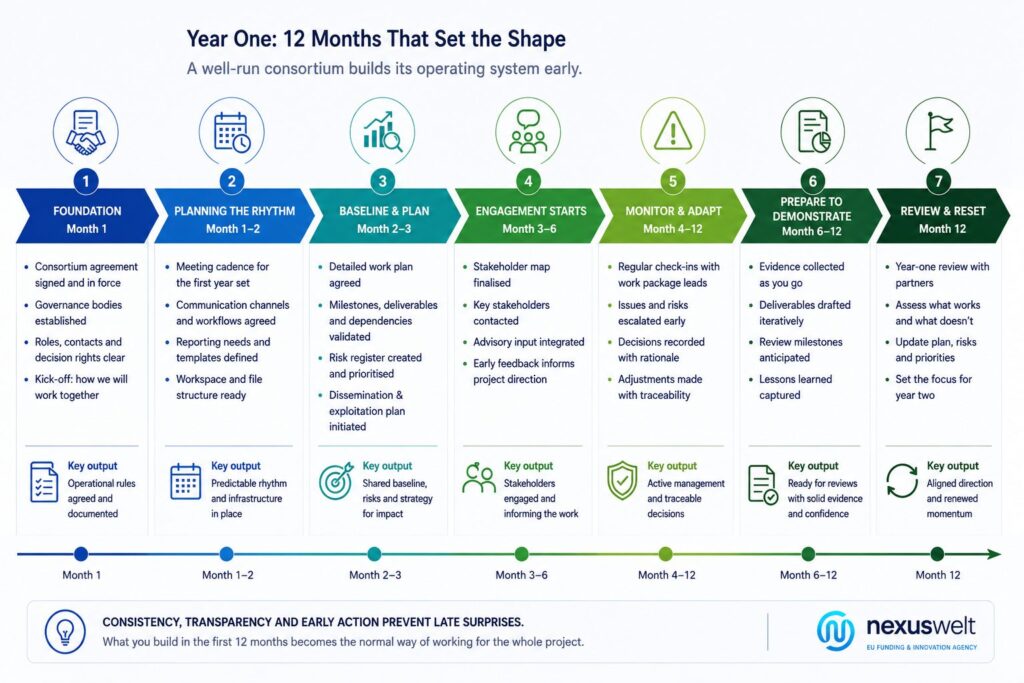
By month six, the dissemination and exploitation plan should already be a working management document, not a formality.
When to amend, and when not to
New coordinators tend to avoid amendments, treating them as an admission of failure, and then discover at the review that the project has drifted from what the grant agreement describes.
Amendments are a normal instrument. What genuinely requires one includes changes to the consortium composition, redistribution of budget or lump sum shares between partners or work packages, changes to the duration, and substantive changes to the described work. Minor internal reorganisation usually does not.
Raise it with the project officer early. A project officer told about a difficulty in month ten has options; the same officer informed at the mid-term review has fewer, and a worse impression of how the project is being run.
The coordinator’s actual job
It is not producing the technical work, and it is not administration. It is three things: keeping the consortium’s attention on what the project promised, making sure information moves between partners who would otherwise not talk to each other, and noticing problems while they are still small.
Everything in this article is a mechanism for one of those three. A coordinator who is personally writing deliverables in year one has usually stopped doing the actual job, and the project will show it by year two.
How Nexuswelt supports coordinators
Nexuswelt contributes to EU-funded projects as a partner on communication, dissemination, stakeholder engagement and exploitation – the horizontal layer that year one most often neglects, and where neglect is hardest to repair later. The broader treatment of coordinator obligations is in our guide to communication, dissemination and exploitation, and more on the firm is on the Nexuswelt about page.