Munich, 18 September 2026 · Nexuswelt Group
The next Framework Programme starts on 1 January 2028. That sounds distant until you work backwards: consortia for the first calls will form during 2027, positioning for those consortia happens in 2026, and the strategic decisions that determine whether you are in the room are being made now.
This is not a policy summary. It is an account of what has been proposed, what remains genuinely unsettled, and which of it should change how a research organisation, a deep-tech company or a prospective coordinator plans over the next eighteen months.
What has been proposed
The Commission published its legislative proposal on 16 July 2025 as part of the Multiannual Financial Framework package for 2028–2034, with a second package following on 3 September 2025. Despite the informal shorthand, the programme will keep the Horizon Europe name; FP10 simply denotes the tenth edition.
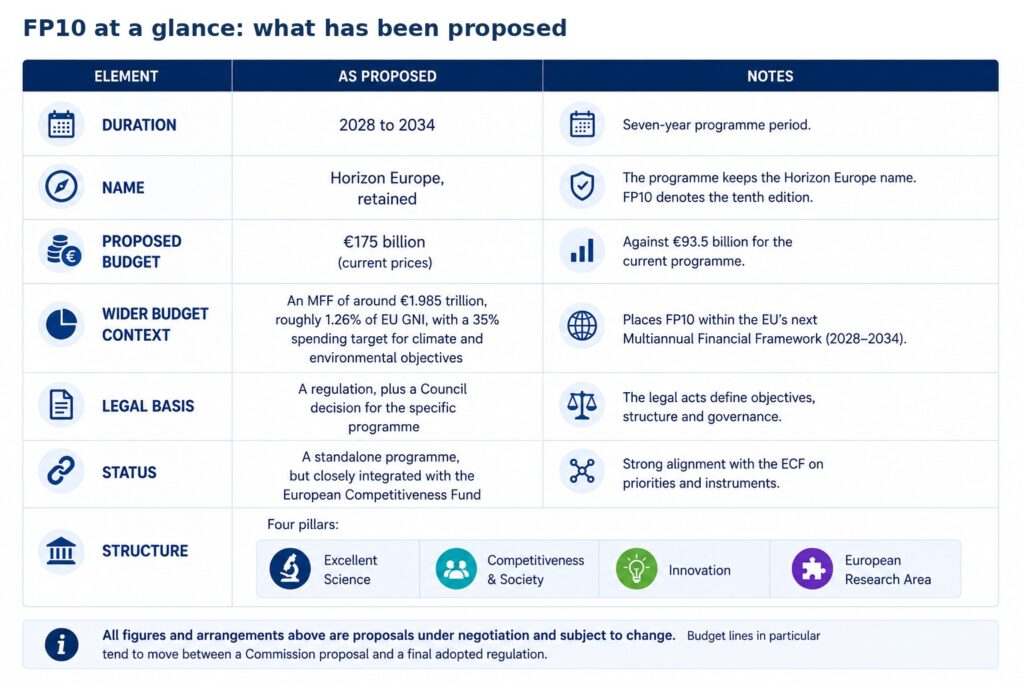
| Element | As proposed |
| Duration | 2028 to 2034 |
| Name | Horizon Europe, retained |
| Proposed budget | €175 billion in current prices, against €93.5 billion for the current programme |
| Wider budget context | An MFF of around €1.985 trillion, roughly 1.26% of EU gross national income, with a 35% spending target for climate and environmental objectives |
| Legal basis | A regulation, plus a Council decision for the specific programme |
| Status | A standalone programme, but closely integrated with the new European Competitiveness Fund |
| Structure | Four pillars: excellent science; competitiveness and society; innovation; and the European Research Area |
Every figure above is a proposal under negotiation, not a settled allocation. Budget lines in particular tend to move between a Commission proposal and a final adopted regulation.
The four pillars, and what changed
The structure is recognisable but not identical to the current programme. Excellent science continues broadly as before. Innovation becomes its own pillar. The European Research Area is elevated. And the second pillar – competitiveness and society – is where the substantive change sits.
Collaborative research under that second pillar is the part most closely linked to the European Competitiveness Fund, and it is intended to fund the same priority areas. In practice this means the thematic direction of collaborative research will be set with industrial competitiveness objectives explicitly in view, rather than alongside them.
On the Commission’s proposal, analysis suggests the European Innovation Council would be the largest relative gainer, with the European Research Council also strengthened. If that holds through negotiation, the balance shifts toward company-facing and frontier-science instruments and away from the middle of the current structure.
The European Competitiveness Fund: the real argument
The ECF is a new instrument of roughly €409–451 billion, aimed at strategic autonomy, industrial capacity and investment in priority technologies. FP10 sits beside it, and the relationship between the two is the central unresolved question.
The Commission’s position is close integration: the two are to be tightly connected, ECF work programmes are expected to include collaborative research and innovation actions in a dedicated part, and the ECF may contribute to European Partnerships established under FP10. A new Competitiveness Joint Undertaking has been proposed for applied and breakthrough industrial research, partly financed through the Framework Programme in the way that Joint Undertakings are today.
The European Parliament has pushed back. Rapporteur Christian Ehler published a draft report on 3 March 2026 opening parliamentary negotiations, and the direction is clear: reinforce FP10 as a distinct, stand-alone programme with autonomous, expert-led governance. The underlying concern is that research and innovation becomes subordinated to industrial policy if it is absorbed too fully into the competitiveness framework. A concrete example of this direction is the expansion of European AI and data infrastructure through the Digital Europe Programme.
The Council agreed a partial negotiating position on the ECF regulation on 16 June 2026, which also points to a close link between the two instruments.
For a research organisation, this is not an abstract governance dispute. It determines whether the thematic agenda for collaborative research is set primarily through scientific and societal priorities or primarily through industrial ones – and therefore what a competitive proposal will need to argue.
What is settled, and what is not
| Reasonably settled | Genuinely open |
| There will be a standalone Framework Programme | How autonomous its governance will be |
| It will run 2028–2034 and keep the Horizon Europe name | The final budget figure |
| The budget will be substantially larger than the current programme | How tightly FP10 and the ECF are coupled in practice |
| Collaborative research remains at the core | How much of the thematic agenda the competitiveness framework sets |
| Simplification continues, with lump sum proposed as the default model | The balance between pillars and instruments |
| The EIC and ERC are strengthened on current proposals | Sectoral shares – clean energy advocates note the climate, energy and mobility share falling from around 16% to around 14.5% |
The timeline that matters for planning
That is why building consortium relationships before the first work programmes appear matters more than reacting once calls are published.
The organisations that participated well in the first Horizon Europe calls were, almost without exception, organisations already inside consortia that formed before the programme launched. The same will be true in 2028.
Six implications for how you plan now
Do not wait for the regulation. Building consortium relationships now is what positions organisations for the first-wave calls, and no part of that work depends on the final legal text.
- Assume lump sum funding. It is already around half of the current call budget and is proposed as the default in the successor programme. Building the internal capability to estimate work-package budgets accurately at proposal stage is a durable investment, not a compliance chore.
- Learn to argue competitiveness. Whatever the final governance settlement, collaborative research is moving closer to industrial policy language. A proposal that can express its contribution in those terms without abandoning its scientific case will be better positioned than one that cannot.
- Reassess your instrument mix. If the EIC and ERC are strengthened relative to the middle of the programme, organisations that only ever apply to collaborative calls should look at whether that remains the right allocation of effort.
- Watch your sector’s share rather than the headline. A larger overall budget does not mean a larger budget for your field; the clean energy example shows a rising total with a falling share.
- Treat the current programme as preparation. Delivery in a 2026–2027 project is what establishes the track record that makes you a credible partner in 2028 – and there is no other way to acquire it in time.
What to watch
- The trilogue outcome on FP10 governance and its relationship to the ECF – the single most consequential open question.
- The first Strategic Plan, expected with the regulation in summer 2027, which sets thematic direction before any work programme appears.
- The final budget figure and the distribution across the four pillars.
- The shape of the proposed Competitiveness Joint Undertaking and what it means for existing partnerships.
- Association arrangements for non-EU countries, which are settled separately and matter to any consortium with international partners.
How Nexuswelt works on this
Nexuswelt works with research organisations, deep-tech companies and coordinators on strategic positioning across programme cycles – instrument selection, consortium building, and the impact and exploitation logic that both the current programme and its successor are increasingly built around. Our analysis of what has already changed in the current period is in the Horizon Europe 2026–27 work programme guide, and more on the firm is on the Nexuswelt about page.