Key takeaways from the Networking and Matchmaking event on Horizon Europe Clean Industrial Deal Calls in Brussels
Prepared for Nexuswelt | Event date: 8 June 2026 | Location: NCBR Office in Brussels
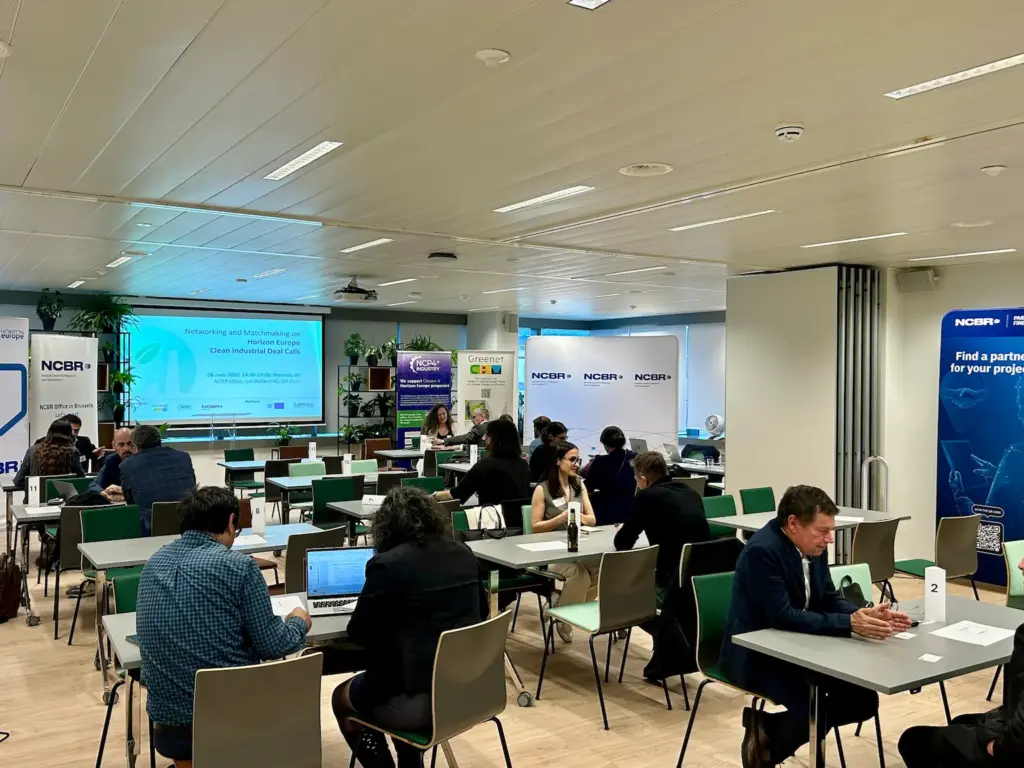
On 8 June 2026, Nexuswelt participated in the Networking and Matchmaking event on Horizon Europe Clean Industrial Deal Calls, hosted at the NCBR Office in Brussels. The event was organised together with NCP4Industry Plus, GRENET, A.SPIRE and the Enterprise Europe Network, and brought together European Commission representatives, National Contact Points, industrial stakeholders, clean-tech actors and potential Horizon Europe applicants.
The event provided a clear and practical message for applicants: the Clean Industrial Deal is not only about decarbonisation. It is also about European competitiveness, industrial resilience, value-chain integration, market readiness and the deployment of clean technologies in real industrial environments.
For companies, research organisations, technology providers, clusters and innovation partners preparing for Horizon Europe 2026, this is an important signal. Future proposals will need to show not only technical excellence, but also a credible route towards industrial use, investment readiness and market uptake.
Why the Clean Industrial Deal matters for Horizon Europe 2026
The Clean Industrial Deal was presented as a strategic policy direction for Europe. It follows the Competitiveness Compass and aims to direct investment towards infrastructure and industry in order to support industrial decarbonisation, growth and competitiveness.
A strong message from the event was that Europe needs to move faster from research and demonstration towards deployment. This is why the Clean Industrial Deal calls are designed to support technologies that are already mature enough to be tested, optimised, validated and prepared for wider industrial use.
This creates a bridge between Horizon Europe and later-stage funding instruments such as the Innovation Fund. Horizon Europe can support the step from promising innovation to fit-for-deployment solutions, while later instruments can support scale-up and large-scale industrial investment.
For applicants, this means that a proposal cannot be built only around scientific excellence. It also needs to show why the technology matters for European industry, how it can reduce costs or emissions, how it can strengthen value chains and how it can reach users and markets after the project.
Important information for applicants highlighted during the presentations
Based on the event slides and discussions, several points are especially relevant for organisations preparing a proposal.
1. The call is about competitiveness and decarbonisation together
- The Clean Industrial Deal is framed as a business and industrial strategy, not only as a climate policy.
- Projects should support industrial decarbonisation while also strengthening the competitiveness of European industry.
- The European Commission expects clear business incentives, lead markets for clean technologies and stronger demand for clean energy and manufacturing solutions.
2. Energy-intensive industries and clean-tech sectors are central
- The policy context focuses strongly on energy-intensive industries and clean-tech sectors.
- Relevant sectors can include manufacturing, energy, transport, steel, chemicals, materials, clean energy technologies, circular economy and industrial processes.
- Applicants should clearly explain which sector or value chain they address and why it matters for European competitiveness.
3. Proposals should be fit for deployment
- The event repeatedly stressed the importance of solutions that can move closer to full technological maturity and market readiness.
- Projects should not remain abstract or purely research-oriented. They need a credible pathway towards deployment, replication and future investment.
- Applicants should explain what happens after the project and how the results can be used by industry.
4. Strong consortium composition is critical
- A good consortium should include the actors needed for future deployment, not only research partners.
- This may include technology providers, industrial users, suppliers, research organisations, clusters, associations, regional actors, investors and exploitation partners.
- The consortium should show effective cooperation across the relevant value chain.
5. Business plan and market-readiness strategy will matter
- Applicants should prepare a sound business plan and market-readiness strategy.
- The proposal should explain market needs, user groups, deployment barriers, investment logic, exploitation routes and scale-up potential.
- A strong exploitation approach should be integrated into the project from the beginning, not added only at the end.
Clean Tech for Climate: expected outcomes
One of the key topics presented during the event was Clean Tech for Climate. The expected outcomes are highly practical and measurable. Applicants should demonstrate how their solution can strengthen the competitiveness, sustainability and resilience of an innovative clean-tech solution.
Expected outcome | What applicants should show |
Increase circular material use | Projects should show how the proposed solution improves the circular material use rate. This should be based on a sound and realistic baseline. |
Reduce the levelised cost of energy | Proposals should show how the solution can reduce the levelised cost of energy delivered to end-users. Where relevant, this includes production, distribution and storage costs, as well as different geographic scenarios. |
Improve industrial leadership and supply-chain security | Projects should show how the solution supports Europe’s industrial leadership, resilience and supply-chain security, in line with the objectives of the Net-Zero Industry Act. |
Move closer to market readiness | Solutions should be brought to full technological maturity and close to market readiness, with a view to accelerating deployment or integration in key industrial sectors such as manufacturing, energy and transport. |
Scope of the Clean Tech for Climate topic
The presentations identified three clean-tech areas with strong growth potential in Europe. Proposals are expected to address one or more of these areas.
Integrated net-zero emissions energy systems
This includes energy grids, networks, smart systems and integrated solutions that can support a flexible, resilient and low-carbon European energy system.
Enhanced zero-emission power technologies
This includes renewable electricity, heat and energy technologies that can contribute to the clean energy transition and reduce industrial emissions.
Storage technologies, renewable fuels and carbon capture and utilisation
This includes batteries, energy storage solutions, renewable hydrogen, advanced biofuels, synthetic renewable fuels, carbon capture and utilisation and related enabling technologies.
Principles and features of the call
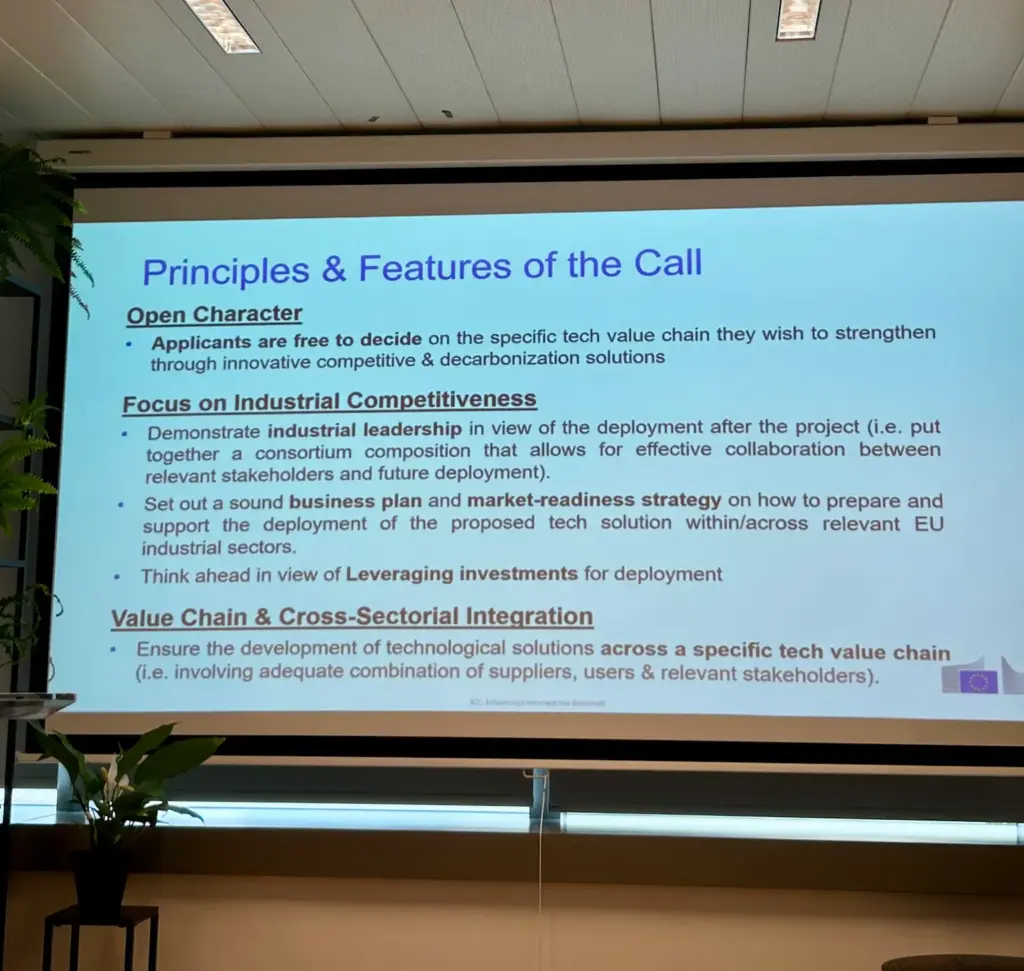
Open character
Applicants are expected to have flexibility in selecting the specific technology value chain they want to strengthen. This creates room for different industrial sectors, but it also requires a clear explanation of the selected value chain, its challenges and its European relevance.
Focus on industrial competitiveness
Proposals should demonstrate industrial leadership and show how the solution can be deployed after the project. The proposal should make clear why the project is relevant for European industry and how it contributes to competitiveness.
Market-readiness strategy
Applicants should present a sound business plan and market-readiness strategy. This should cover user needs, deployment routes, investment logic, exploitation potential and realistic post-project steps.
Value-chain and cross-sectoral integration
Projects should involve an adequate combination of suppliers, users and relevant stakeholders. Clean-tech deployment usually requires cooperation across several sectors and actors, so the proposal should show that the full value chain is represented.
The role of NCP4Industry Plus and GRENET
The event also highlighted the role of European National Contact Point networks in supporting applicants before, during and after proposal preparation.
NCP4Industry Plus is the European network of Horizon Europe Cluster 4 Industry National Contact Points. It supports applicants through information services, matchmaking, webinars, training sessions, proposal guidance and access to relevant European networks.
GRENET is the European network of National Contact Points for Cluster 5, covering Climate, Energy and Mobility. According to the presentation, GRENET was launched in July 2022 and runs until the end of December 2027, with 19 beneficiaries and an extended Cluster 5 NCP community.
For applicants, these networks can be very useful for partner search, topic understanding, proposal checks and guidance on whether an idea fits a specific Horizon Europe call.
Practical checklist for applicants
The following checklist can help organisations assess whether they are ready for the Clean Industrial Deal 2026 calls.
- Is the technology mature enough to be demonstrated, validated or optimised in a real industrial context?
- Can the project show a clear contribution to industrial decarbonisation and European competitiveness?
- Is there a strong industrial use case with real end-users or deployment partners?
- Does the consortium cover the relevant value chain, including suppliers, users and stakeholders?
- Are circularity, cost reduction, resilience or supply-chain indicators clearly measurable?
- Is there a sound business plan and market-readiness strategy?
- Does the proposal explain what happens after the project and how further investment can be leveraged?
- Is exploitation connected to the technical work, stakeholder engagement and communication activities?
- Can the project demonstrate a credible route towards deployment, replication or integration in industry?
- Has the consortium already started preparing the proposal early enough before the September 2026 deadline?
Nexuswelt approach: why dissemination, exploitation and stakeholder engagement matter
For Nexuswelt, the Clean Industrial Deal calls are directly connected to our work in Horizon Europe and industrial innovation projects.
In deployment-oriented clean-tech projects, dissemination and communication should not be limited to visibility. They should help the consortium reach the right industrial stakeholders, end-users, policy actors, clusters, investors and innovation communities.
Exploitation should also be treated as a strategic activity from the beginning of the project. It should support market validation, business planning, stakeholder adoption, sustainability planning and the pathway towards future deployment.
This is where Nexuswelt can support European consortia: by connecting proposal communication, stakeholder engagement, exploitation and impact planning with a clear market-oriented approach.
Our approach is especially relevant for projects that need to explain complex industrial technologies in an understandable way, create visibility across European ecosystems and build trust with potential users and deployment partners.
Who should follow the Clean Industrial Deal 2026 calls?
- Clean-tech companies and technology providers
- Industrial companies and manufacturing actors
- Energy-intensive industries and process industries
- Renewable energy, storage, hydrogen and carbon capture actors
- Research and technology organisations
- Universities and applied research centres
- Clusters, associations and innovation agencies
- Circular economy and resource-efficiency organisations
- Regional innovation ecosystems and public authorities
- Horizon Europe coordinators, proposal partners and exploitation or dissemination partners
Related Nexuswelt support:
For organisations preparing Clean Industrial Deal, clean-tech or Horizon Europe 2026 proposals, Nexuswelt supports Horizon Europe project support, proposal writing and strategic proposal support, and impact-oriented project communication, dissemination and visibility for deployment-focused EU-funded projects.
Conclusion: prepare early and think beyond the project
The Brussels Networking and Matchmaking event confirmed that the Clean Industrial Deal will be an important direction for Horizon Europe industrial innovation funding in 2026.
The strongest proposals will likely be those that combine a mature technology, a clear industrial use case, a strong value chain, measurable impact and a credible route towards deployment.
For applicants, the main message is simple: start early, build the right consortium and think beyond the project period. Clean Industrial Deal proposals should not only explain what will be developed during the project. They should also explain how the solution can be used, scaled, financed and adopted after the project ends.
Nexuswelt will continue following the Clean Industrial Deal 2026 calls and supporting European partners in building strong, visible and market-oriented Horizon Europe projects.
Acknowledgements and suggested mentions
Nexuswelt thanks the organisers, speakers and participants for the valuable exchange, practical insights and matchmaking opportunity in Brussels.
Organisations to mention or tag: NCBR Office in Brussels, NCP4Industry Plus, GRENET, A.SPIRE, Enterprise Europe Network, European Commission, DG CLIMA, CINEA, Clean Energy Transition Partnership, Horizon Europe, Zabala Innovation Europe, Zabala Innovation Spain, Zabala Innovation France, Zabala Innovation Portugal.
People to mention or tag if available on LinkedIn: Waldemar Dubaniowski, Diego Coglitore, Noemi Tesauro, Antonio Ferrandez-Garcia and Edoardo Paganelli.
Source note
This article is based on Nexuswelt event notes and photos from the Networking and Matchmaking event on Horizon Europe Clean Industrial Deal Calls in Brussels, complemented by publicly available information from the event organisers and European Commission materials on the Clean Industrial Deal. Speaker content is summarised and paraphrased, not quoted verbatim.
#CleanIndustrialDeal, #HorizonEurope, #EUFunding, #CleanTech, #IndustrialInnovation, #Cluster4, #Cluster5, #InnovationFund, #NetZeroIndustry, #Decarbonisation, #CleanEnergy, #CircularEconomy, #EnergyTransition, #Manufacturing, #MarketUptake #Dissemination,#EuropeanInnovation,#IndustrialCompetitiveness, #Brussels, #Nexuswelt