Winning an EU-funded project is only one milestone. Successful organisations need support throughout the entire project lifecycle—from identifying the right funding opportunity and building the right consortium to delivering measurable impact after the grant ends. This guide maps Nexuswelt’s services to each stage so organisations can identify exactly where they are and what support they need next.
- 6 project stages
- 8 Nexuswelt services
- Evaluator insights
- Programme-specific expertise
- Practical next steps
Why a Stage Map, Not a Service List
A service list answers “what do you offer.” A stage map answers a more useful question: “where are we right now, and what do we actually need next.” Most organisations approaching EU funding for the first time don’t need all of Nexuswelt’s services at once — they need the one or two that match their current stage, and a clear view of what comes after.
Nexuswelt’s track record and programme-specific memberships sit behind each of the six stages below, in the places where they matter most rather than as a single upfront claim.
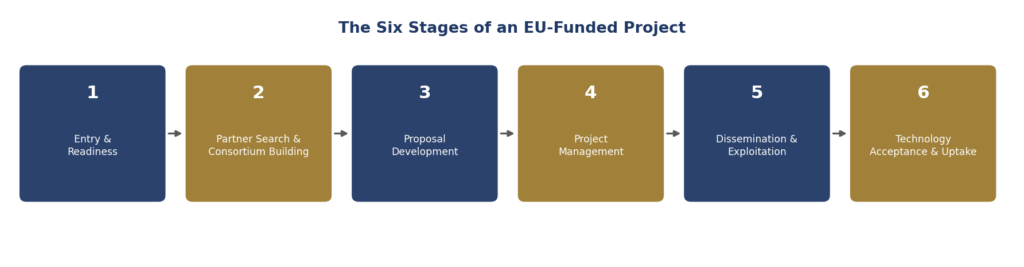
The Six Stages of an EU-Funded Project
AI & Applied Innovation and EU Project Training & Onboarding sit alongside this sequence rather than inside it — the former strengthens proposals and delivery wherever AI-based methods are relevant, and the latter builds internal capacity so a coordinator or partner organisation can run more of the process independently over time.
Stage 1 — Entry & Readiness
Before any consortium conversation, EU Funding Entry support answers the question covered in more depth in our companion entry-roadmap article: which programme, which role, and what needs to be in place first. This is the stage most first-time applicants skip — and the one that determines whether every later stage goes smoothly.
Evaluator angle: a proposal that misjudges its own readiness rarely fails on “Excellence” — it fails on “Quality and Efficiency of Implementation,” because the mismatch shows up in the work plan, not the idea.
Stage 2 — Partner Search & Consortium Building
Our Partner Search & Consortium Building service includes a review of your organisation’s profile, relevance and likely role in a consortium context, support preparing a clearer and more credible basis for approaching coordinators or partners, and a structured view of the most realistic next actions toward EU proposal participation. In practice, this draws on platforms such as B2Match, CORDIS Partner Service, and National Contact Point (NCP) matchmaking networks to identify complementary partners, alongside our in-house partner relationships across Germany, Cyprus, Ukraine, and the wider EU. It also helps clarify which programme environment — Horizon Europe, Chips JU, Digital Europe, Interreg, or another — is the more relevant route for your specific case.
Evaluator angle: consortium balance is scored explicitly — evaluators look for complementary, non-overlapping expertise across partners, not simply geographic spread for its own sake.
Stage 3 — Proposal Development
Once a consortium role is confirmed, Proposal Support covers analysis of work programmes and call texts, definition of project concepts and objectives, logical Work Package structuring, clear impact pathways and KPIs, and full drafting and editing of Part B sections according to EC templates — across Horizon Europe, Digital Europe, Chips JU, and the European Defence Fund. This stage draws most directly on the experience behind Nexuswelt’s 100 million euro-plus track record in EU-funded project activity, since proposal quality at this stage is what most determines everything that follows.
Evaluator angle: Excellence, Impact, and Quality/Efficiency of Implementation are scored separately — a strong idea with a weak work plan still loses marks it can’t recover elsewhere in the proposal.
Stage 4 — Project Management & Delivery
Once a project is funded, EU Project Management support covers kick-off meetings and governance structures, progress reports and milestone tracking, risk management plans, financial coordination and EC portal documentation, and consortium communication channels — the operational backbone that keeps a multi-partner, multi-country project on track.
Evaluator angle: this stage is reviewed against the commitments made in the proposal itself — project officers check delivery against the original work plan, not against good intentions.
Stage 5 — Communication, Dissemination & Exploitation
Our Project Dissemination & Communication service covers visual identity and branding, websites and digital campaigns, press releases and newsletters, events and clustering activities, exploitation and innovation management plans, and ongoing KPI and impact monitoring — the work that turns a technically successful project into one evaluators and stakeholders can actually see and measure. Nexuswelt’s membership in the INSIDE Industry Association, the private-sector partner within the Chips Joint Undertaking, is one concrete example of the stakeholder network this stage can draw on.
Evaluator angle: dissemination and exploitation sit inside the Impact criterion, not as an afterthought to it — vague plans (“we will publish results”) score visibly worse than named channels, audiences, and KPIs.
Stage 6 — Technology Acceptance & Long-Term Uptake
The stage most projects underinvest in: Technology Acceptance & Innovation Uptake support focuses on stakeholder acceptance, real-world uptake, and positioning a project’s results for follow-on funding — so a project’s impact doesn’t end when the final report is submitted. It also supports replication, commercialisation and preparation for future EU funding opportunities.
Evaluator angle: this is where “Impact” is judged retrospectively in follow-on calls — a coordinator’s uptake track record from a prior project is often read as a proxy for how seriously to take their next proposal’s impact claims.
Across Every Stage: Programme-Specific Expertise
Alongside the six stages, Nexuswelt maintains dedicated programme expertise so guidance is never generic:
- Horizon Europe — nexuswelt.com/horizon-europe-support/
- Digital Europe — nexuswelt.com/digital-europe-proposal-writing-application-support/
- Chips JU — nexuswelt.com/chips-ju-proposal-support/ (including call-fit review between Chips JU and Horizon Europe)
- European Defence Fund — nexuswelt.com/edf-propolsal-support/
- Interreg Europe — nexuswelt.com/interreg-application-support/
What to Do Now
- dentify which of the six stages your organisation is actually at — not which stage feels most urgent, but which one is genuinely next.
- If you’re not sure, start with Entry & Readiness rather than jumping to Proposal Support — skipping stages is the most common source of delay later.
- If you’re mid-project already, Stage 5 and 6 are worth revisiting even on projects that are technically “on track” — dissemination and uptake are the areas most often under-resourced relative to their evaluation weight.
Frequently Asked Questions
Do we need to start with Stage 1, or can we come in partway through?
Most organisations enter at whichever stage matches their current situation — a coordinator with a funded project starts at Stage 4, not Stage 1. The map is there to clarify what’s next, not to impose a fixed starting point.
Can Partner Search & Consortium Building help us decide which programme to target?
Yes. Because eligible partners and realistic entry routes differ by programme, working through your partner options tends to surface the better-fitting programme as a by-product — it is rarely a separate, standalone decision.
Is this relevant for organisations with no prior EU project experience?
This stage map is built with first-time applicants specifically in mind — Stage 1 exists precisely because organisations new to EU funding usually need more clarity on fit and positioning than a seasoned coordinator would.
What happens after Proposal Support if our project isn’t funded?
An unsuccessful proposal is rarely wasted work — the consortium relationships, positioning, and draft materials typically carry forward into the next relevant call, often with stronger footing the second time.
Do AI & Applied Innovation and Training sit inside one specific stage?
No — both run alongside the six-stage sequence rather than inside a single stage. AI & Applied Innovation strengthens proposals and delivery wherever AI-based methods are relevant; Training & Onboarding builds internal capacity so your organisation can independently handle more of the process over time.
Sources & Further Reading
Related Nexuswelt resources for readers who want to go deeper on a specific stage:
“Which EU Programme Should Your Company Enter First? A Practical Entry Roadmap” — companion piece, to be linked once published (publish this stage-map article after the entry-roadmap pillar, or add the link retroactively).
- Nexuswelt — EU Funding & Innovation Support: How Nexuswelt Helps Organisations Enter and Succeed in EU-Funded Projects — https://nexuswelt.com/eu-funding-innovation-support/
- Nexuswelt — How to Build a Strong EU Funding Consortium: Why Partner Search Is Not Enough — https://nexuswelt.com/eu-funding-consortium-strategy-partner-search/
- Nexuswelt — About Nexuswelt — https://nexuswelt.com/about-us/