Why this topic matters now
Many organisations start EU funding preparation with the same question: “Who can join our consortium?” This is understandable. Horizon Europe, Digital Europe, LIFE, the Innovation Fund, the EIC Accelerator and other EU programmes often require cooperation across countries, sectors and types of organisations. But partner search is only the beginning. A fundable EU project does not emerge from collecting logos. It emerges from a clear consortium strategy.
For autumn calls, this distinction becomes critical. If partners are added too late, they usually receive weak tasks, unclear budgets, limited visibility and little influence over the concept. If the consortium is built strategically from the beginning, each organisation has a defined reason to be there: technical development, validation, end-user access, policy relevance, market uptake, dissemination, exploitation, regulatory understanding or coordination capacity.
The first strategic step is not even partner search. It is programme fit. The European Commission describes Horizon Europe as the EU’s key research and innovation funding programme until 2027, with an indicative funding amount of EUR 93.5 billion for 2021-2027. It supports collaboration, excellent knowledge and technologies, and policy impact. However, not every innovation project belongs in Horizon Europe. Some projects are better positioned under Digital Europe, LIFE, the Innovation Fund, CEF, EIC or the European Defence Fund.
Official link: Horizon Europe official programme page
Partner search vs. consortium strategy
Partner search asks: “Who can join?” Consortium strategy asks a more important question: “Who makes the proposal fundable, implementable and impactful?”
A strong consortium should answer the following questions before writing starts:
- Who develops the core solution, methodology or technology?
- Who validates it in a real environment?
- Who brings access to data, pilots, infrastructure, users or markets?
- Who understands the policy and stakeholder landscape?
- Who owns exploitation and long-term impact?
- Who leads communication, dissemination and stakeholder engagement?
- Who can manage the administrative and reporting workload?
- Who has the credibility to coordinate or lead a work package?
A proposal with many partners can still be weak if the roles are decorative. A smaller consortium can be stronger if every partner is necessary, the work package logic is clear, and the route from research to use is credible.
Official link: Funding & Tenders Portal Partner Search
Start with the right programme
A common mistake is to force every idea into Horizon Europe. This can lead to weak proposals because the project logic does not match the programme logic. Before building a consortium, organisations should check whether the project is research-driven, deployment-driven, climate-driven, infrastructure-driven, startup-driven or defence-related.
Programme | Example project logic | Official link |
Horizon Europe | A research-industry consortium validating an AI-enabled manufacturing solution in several pilot environments | |
Digital Europe | A network deploying AI, cybersecurity or advanced digital skills capacity for SMEs and public administrations | |
LIFE | A regional circular economy or biodiversity project with practical implementation and local impact | |
Innovation Fund | A clean-tech industrial site proving greenhouse gas reduction and business viability | |
CEF | A cross-border infrastructure project in energy, mobility or digital connectivity | |
EIC Accelerator | A deep-tech SME with TRL 6-8 innovation and market-disrupting potential | |
European Defence Fund | A multinational consortium developing interoperable defence technology or security-relevant systems |
This table is not a substitute for reading the call text. It is a first filter. The final decision should always be based on the official work programme, call conditions, eligibility rules, expected outcomes and the evaluation criteria on the Funding & Tenders Portal.
Official link: EU Funding & Tenders Portal
Example 1: Digital Europe is not “another Horizon Europe”
Digital Europe is often misunderstood. The official Digital Europe page explains that the programme focuses on bringing digital technology to businesses, citizens and public administrations. It provides strategic funding in areas such as supercomputing, artificial intelligence, cybersecurity, advanced digital skills and the wide use of digital technologies across the economy and society. It also supports European Digital Innovation Hubs and includes semiconductor-related capacity building through the Chips for Europe Initiative.
Official link: Digital Europe Programme official page
This means that the consortium logic is different from a classical R&I proposal. A Digital Europe consortium should usually show deployment capacity, user uptake, training or skills impact, digital infrastructure, measurable adoption and European added value.
Saveable question: Are we creating new knowledge, or are we deploying digital capacity at scale?
Example 2: Clean-tech project – Horizon Europe or Innovation Fund?
Clean-tech projects often sit between several funding programmes. If a technology still needs research, validation, pilots or collaborative development, Horizon Europe may be the right route. If the project is closer to industrial deployment and can demonstrate innovative low-carbon technology, greenhouse gas reduction and a credible investment case, the Innovation Fund may be a stronger fit.
The official Innovation Fund page describes it as one of the world’s largest funding programmes for the demonstration of innovative low-carbon technologies. That is a different logic from a research proposal: the consortium must be able to show industrial readiness, technical feasibility, financial credibility and emissions impact.
Official link: Innovation Fund official page
Before choosing the programme, ask:
- What is the current TRL and what should the project achieve?
- Is there a real industrial site or demonstration environment?
- Can greenhouse gas reduction be quantified credibly?
- Is there a business model and investment route?
- Are permitting, procurement and supply-chain risks understood?
- Does the consortium include the right industrial, financial and technical partners?
Example 3: EU Missions need ecosystems, not only research partners
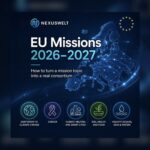
EU Missions are not normal research topics with a mission label attached. The official EU Missions page explains that Missions are large-scale Horizon Europe initiatives with clear, time-bound goals addressing major challenges such as climate change, cancer, ocean restoration, soil health and climate-neutral cities. Missions bring together researchers, policymakers, citizens and stakeholders to deliver concrete societal solutions.
Official link: EU Missions in Horizon Europe official page
For Mission proposals, a strong consortium should normally include more than universities and technology providers. Depending on the topic, it may need cities, regions, hospitals, soil actors, farmer networks, citizen organisations, public authorities, industry, clusters, standardisation bodies, replication sites and communication partners.
Example: A soil-related proposal may need a research partner for methodology, a technology provider for monitoring or remediation, farmers or land managers for testing, a region or municipality for policy uptake, a living lab or lighthouse site, and a partner responsible for stakeholder engagement and replication. Without this ecosystem logic, the proposal may look technically interesting but weak in impact.
Saveable question: Who will use, test, adopt or scale the result after the project?
Example 4: AI proposals need compliance thinking from day one
AI is no longer enough as a buzzword. A proposal that simply says “we use AI” will not be convincing. EU-funded AI projects need to explain why AI is necessary, what data is used, how the model is validated, which risks exist, and how the system will be used after the project.
The EU AI Act is also relevant for proposal design. The official AI Act implementation timeline states that the legislation applies progressively, with full roll-out foreseen by 2 August 2027. Key stages include general provisions and prohibitions from February 2025, general-purpose AI rules from August 2025, most rules and high-risk Annex III rules from August 2026, and rules for high-risk AI embedded in regulated products from August 2027.
Official link: EU AI Act implementation timeline
Official link: EU AI Act official overview
Before including AI in an EU proposal, the consortium should clarify:
- What data will be used and who owns it?
- Is the AI system potentially high-risk?
- How will bias, quality and representativeness of data be managed?
- What human oversight is needed?
- How will transparency and explainability be addressed?
- What cybersecurity risks exist?
- How will the system be validated in the pilot environment?
- Who will maintain, deploy or commercialise the AI system after the project?
This affects consortium building. A credible AI proposal may need not only AI developers, but also data owners, end users, domain experts, legal or ethics expertise, cybersecurity competence, validation sites and communication partners who can explain the value and limitations of the technology.
Example 5: Civilian technology and dual-use potential
Dual-use innovation is becoming more visible in Europe. Civilian technologies may become security-relevant when they involve AI, cybersecurity, sensors, drones, space data, secure communication, advanced materials, resilience technologies or critical infrastructure protection. However, defence funding is not the same as standard Horizon Europe participation.
The official European Defence Fund page explains that the EDF supports companies across Member States to develop competitive and collaborative defence projects that deliver innovative and interoperable defence technologies and equipment. It also states that the EDF budget is nearly EUR 7.3 billion for 2021-2027, split between collaborative defence research and collaborative capability development projects.
Official link: European Defence Fund official page
Before entering defence or dual-use discussions, organisations should check:
- Eligibility and country participation rules
- Security restrictions and classification issues
- End-user involvement and national requirements
- Intellectual property and ownership conditions
- Ethical and legal constraints
- Whether the technology is genuinely defence-relevant or only loosely connected
- Whether the organisation is ready for a more regulated project environment
What makes a consortium credible?
A credible consortium is not necessarily the largest one. It is the one where every partner has a clear reason to be there. Evaluators should be able to understand the consortium logic quickly: why these partners, why now, why this structure, and why this team can deliver the expected outcomes.
A useful internal checklist before submission:
- The coordinator has the capacity and credibility to lead the project.
- Each work package has a logical owner, not just an available partner.
- The budget matches the tasks, person-months and responsibilities.
- Pilot sites and validation environments are realistic and accessible.
- End users are involved early enough to shape requirements and uptake.
- Exploitation is not postponed until the final year.
- Communication and dissemination support impact, not only visibility.
- The stakeholder map is specific, not generic.
- Regulatory, ethical, data and AI risks are visible where relevant.
- The timeline allows real drafting, review, partner input and quality control.
Official link: Funding & Tenders Online Manual
Official link: Horizon Europe reference documents
Why autumn calls should be prepared before summer
September is usually too late to start serious consortium building for autumn deadlines. By the time a call is open, strong consortia often already have a concept note, initial partner roles, a draft budget logic, work package ownership and a first impact storyline. Last-minute partner search often creates weak roles, rushed budgets and unclear deliverables.
Before the writing sprint begins, prepare:
- A two-page concept note with problem, solution, target call, expected outcomes and consortium logic.
- A partner role matrix showing who leads which task and why.
- A draft work package structure with dependencies and outputs.
- A budget logic based on real responsibilities, not equal shares.
- A pilot or validation plan with concrete sites, users and data access.
- A first impact pathway: who benefits, what changes, and how results are used.
- A dissemination and exploitation approach linked to stakeholder needs.
- A compliance check for ethics, data, AI, security, IP and procurement issues.
- An internal review calendar with deadlines for partner input and final quality control.
Conclusion: build the project logic before you collect logos
A list of partners is not a consortium. A strong EU funding consortium is a project logic translated into people, organisations, work packages, budget, pilots, impact and implementation capacity. The earlier this logic is built, the stronger the proposal becomes.
For organisations planning EU proposals in 2026-2027, the practical message is simple: do not wait until the call deadline is close. Start with programme fit, define the value chain, identify the missing roles, clarify the impact route, and build a consortium where every partner has a clear reason to be there.
Related Nexuswelt support:
For organisations preparing EU proposals, Nexuswelt supports partner search and consortium building, proposal strategy, and early programme-fit assessment across Horizon Europe, Digital Europe and other EU funding routes.