Evaluators will not tell you what your consortium is missing before you submit. They assess proposals as submitted and are instructed not to recommend changes such as a different consortium composition, so any gap in capability, ownership or evidence simply shows up as a lower score. The deadline is the last point at which the consortium can still close it.
This article is for coordinators and grant offices with a consortium core and a selected topic, typically some weeks before the deadline. It does not cover finding partners, which is the subject of our article on consortium strategy and partner search. It covers testing whether the partners you already have can credibly deliver the proposed work.
Eligible is not the same as capable
Formal eligibility is a fixed check. Unless the topic says otherwise, a collaborative action needs at least three independent legal entities as beneficiaries: at least one in an EU Member State and at least two others, each in a different Member State or Associated Country. Topics can add conditions. A consortium either meets them or it does not.
Implementation quality is an expert judgement under the criterion “Quality and efficiency of the implementation”. It covers the work plan, risk assessment, the effort assigned to work packages and the resources overall, and the capacity and role of each participant and whether the consortium as a whole brings together the necessary expertise. Operational capacity is assessed within this criterion, based on the competence, experience and resources of each participant.
Passing the first test says nothing about the second. Partner names and countries are not evidence that the work can be delivered, and a particular geographical spread does not by itself raise a score. Where a topic sets conditions on participant types, countries or widening participation, they apply to that topic only.
Start from expected outcomes and planned work
Run the review in one direction, from what the project must deliver to who delivers it and how that is shown:
- List the topic’s expected outcomes and specific conditions, such as participant types, TRL, pilots, end-user involvement or access to data and infrastructure. These vary between calls, so check the topic text.
- List the work packages with their main tasks, deliverables and milestones.
- Name the capability each item requires.
- Only then look at the partners: who is assigned, and what in the proposal shows they can do it.
The evidence has fixed places in the proposal. Section 3.1 holds the work plan, including deliverables, milestones, critical risks and staff effort, which must match the budget. Section 3.2 asks how the members complement one another and requires each participant to have “a valid role, and adequate resources in the project to fulfil that role”, including any affiliated entities and associated partners. Part A carries each participant’s researchers, relevant publications or achievements, previous projects and infrastructure.
Five potential consortium gaps
These categories organise a review. None is an automatic evaluation failure; whether a gap matters depends on the topic and the proposed work.
- Missing technical or interdisciplinary expertise. A task requires a method or discipline no partner can evidence, or depends on one person with no backup.
- Weak work package ownership and dependencies. A work package has no lead with the capacity to run it, effort is spread too thinly, or a critical dependency has no owner and no risk measure.
- Insufficient end-user, pilot-site or validation capacity, where needed. The project claims validation in a relevant or operational environment, but no partner controls the site, data or users. Check first whether the topic calls for this at all.
- Missing exploitation, stakeholder engagement or uptake capability. The Impact section describes routes to users or markets that no partner has the role, relationships or resources to pursue.
- Commitments that are not convincingly supported. Effort, budget, equipment or access are claimed but do not appear in the effort table, the budget or the partner descriptions, or a partner has not confirmed its contribution internally.
A consortium capability matrix
The rows below are illustrative, for a fictional project. They show the format, not real evaluation findings.
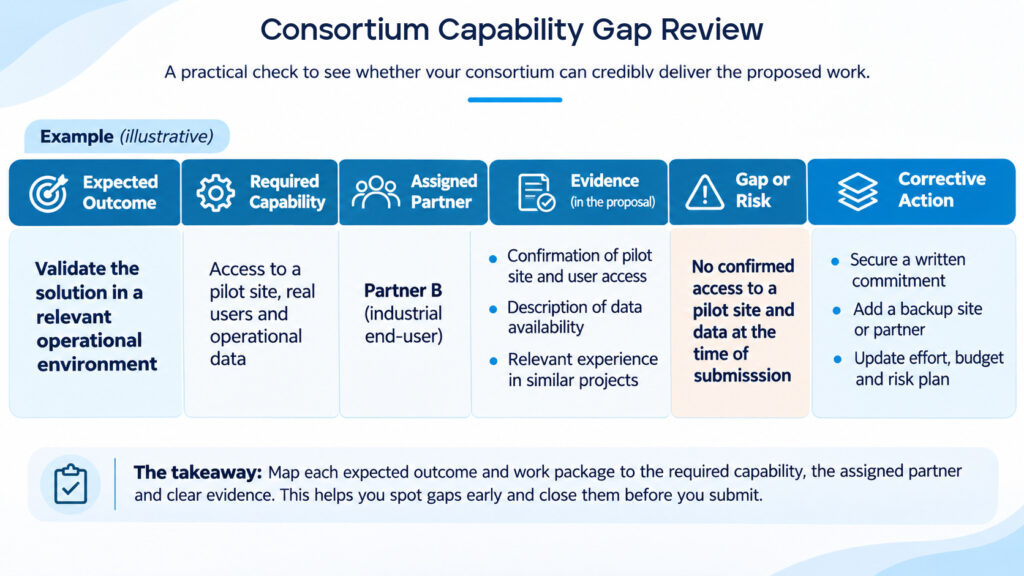
Expected outcome or task | WP | Required capability | Assigned partner | Evidence | Gap or risk | Corrective action | Owner, deadline |
Illustrative: validate prototype on an industrial line | WP4 | Access to a production line and operators | Partner C (research institute) | Lab facilities only | No partner controls an industrial site | Check whether an industrial beneficiary can host; otherwise recruit a host or reduce the validation claim | Coordinator, week 2 |
Illustrative: data pipeline for sensor fusion | WP2 | Data engineering at scale | Partner A | Two relevant projects in Part A | Single named expert | Name a second team member and add effort | Partner A lead, week 1 |
Illustrative: exploitation plan for key results | WP6 | Market analysis and route to users | Not assigned | None | No owner | Assign to the industrial partner with D&C support; add tasks and effort | WP6 lead, week 2 |
Illustrative: regulatory compliance check | WP5 | Sector-specific regulatory expertise | Partner B | General legal office | Expertise not sector-specific | Clarify scope; consider a justified subcontract for a bounded task | Partner B, week 3 |
Use one row per expected outcome or major task. An empty evidence cell is the most useful finding the matrix can produce.
What to do when a gap is found
Each option is subject to the applicable rules, and none automatically fixes an eligibility or implementation weakness.
Option | When it can help | Constraints |
Strengthen an existing beneficiary’s role | The capability exists but was under-described or under-resourced | Effort and budget must match; evidence must be real |
Recruit a new beneficiary | A capability central to the work is genuinely missing | Eligibility, validation, budget redistribution and time to agree roles |
Involve an associated partner | An organisation can contribute tasks, sites or access without funding | Cannot charge costs; key Grant Agreement obligations must apply to it; describe it in section 3.2 |
Subcontract | A bounded, non-core task can be bought from a third party | Core tasks should not be subcontracted; justify per participant; best value for money and no conflict of interest |
Redesign the task | The gap cannot be closed in time | The work must still address the topic’s expected outcomes |
The rules also allow operational capacity to be shown, exceptionally, through concrete measures to obtain the competence by the time the tasks start, such as planned recruitment. That does not replace capability the project needs from day one.
Prioritising gaps
Use explicit criteria, not a score:
- Critical: affects formal eligibility, a mandatory topic condition or an expected outcome the project claims. Resolve or redesign first.
- Significant: leaves an important Impact or Implementation claim without credible evidence, ownership or resources. Fix it, or reduce the claim.
- Manageable: the capability exists but the proposal does not show it clearly or consistently. Fix the text, tables and Part A.
Critical gaps come first because they have the longest lead times: a new beneficiary must be agreed, registered and built into the budget before submission.
What an independent consortium review should produce
- a completed capability matrix for the selected topic;
- a prioritised gap list using the criteria above;
- for each critical or significant gap, realistic options and the rules that constrain them;
- a short list of decisions for the consortium, with owners and dates;
- where recruitment is needed, a defined profile of the missing role, of the kind described in our article on the Horizon Europe partner profile.
A review cannot predict a score, guarantee a stronger evaluation or take decisions that belong to the consortium.
Nexuswelt’s partner search and consortium-building service can support a defined capability-gap assessment and subsequent partner search, with the scope and commercial terms agreed before work starts.