Insights from the Horizon Europe Cluster 5 Info Day and GREENET Brokerage Event, Brussels, 19 November 2026
Key takeaways for proposal teams
- The six destinations in Cluster 5 cover climate research, cross-sectoral transition solutions, energy supply and use, transport technologies and smart mobility. The appropriate consortium depends on the topic, not the size of the partner list.
- Demonstration and additionality: identify who can validate the solution, which existing EU-funded results it builds on and what new contribution it will deliver.
- Different actions need different designs: an Innovation Action requiring operational proof is not the same as a Coordination and Support Action connecting existing results and actors.
- First-time coordination is not automatically excluded. Relevant eligibility, financial and operational capacity requirements still apply.
- Societal readiness is substantive where a topic explicitly requires it, notably industrial CCUS clusters; it is not a blanket requirement across the entire cluster.
- For selected energy-grid topics, consortium composition and grid-operator participation are prescribed. Check requirements in the published topic text before recruiting.
On 19 November 2026, the European Commission presented the 2027 topics of the Horizon Europe Cluster 5 Work Programme in Brussels, with an estimated €873 million available for climate, energy and mobility research and innovation. The afternoon belonged to the GREENET brokerage event, where organisations pitched project ideas and looked for partners for the coming calls.
What I heard in the room, alongside the published topic texts, points to a practical question that extends across Climate, Energy and Mobility: does the consortium bring together the evidence, users and implementation capabilities that its particular topic needs? A strong technical idea remains essential, but it is only part of a credible project design.
This analysis distinguishes published call requirements, oral clarifications in the European Commission Q&A, and claims made by organisations pitching their own concepts. It draws practical lessons for consortium builders, while keeping the full 2027 topic requirements and deadlines in view.
The wider picture: six destinations, different types of collaboration
Cluster 5 covers six destinations: (1) climate sciences and responses; (2) cross-sectoral solutions for the climate transition; (3) sustainable, secure and competitive energy supply; (4) efficient, sustainable and inclusive energy use; (5) clean and competitive solutions for all transport modes; and (6) safe, resilient transport and smart mobility services for passengers and goods. Social sciences and humanities can be relevant across these destinations, but topic-specific provisions vary.
The Brussels programme and brokerage pitches illustrated a broad range, from AI-enabled electricity grids and industrial carbon management to building renovation, transport emissions, circular e-mobility and community-led mobility. The central consortium-building task is therefore to match the proposed approach to the chosen topic, expected outcomes, action type and route to real-world use.
Four submission windows for selected 2027 topics
The selected topics below have four distinct 2027 deadline windows, not a single Cluster 5 closing date. Each window calls for a different preparation plan, particularly where operational partners, pilots or relevant societal expertise are essential. This is a selective calendar, not a complete inventory of Cluster 5 topics.
Call | Examples of topics discussed | Opens | Deadline |
HORIZON-CL5-2027-02 Batteries and Energy | D3-24: (Generative) AI tools for a next-generation digital energy system (IA, €20m) D3-30: Advancements in Direct Air Capture (IA, €16m) | 3 Dec 2026 | 31 Mar 2027 |
HORIZON-CL5-2027-03 Mobility | D5-03: Data-driven circular economy for e-mobility (IA, €24m) D5-17: Environmental impact of waterborne transport (RIA, €14m) | 15 Dec 2026 | 14 Apr 2027 |
HORIZON-CL5-2027-05 Energy use | D4-06: Waste heat recovery in IT rooms and edge data centres D4-09: Industrial waste heat to power | 5 May 2027 | 15 Sep 2027 |
HORIZON-CL5-2027-07 Energy | D3-25: TSO control rooms · D3-26: Distribution management systems D3-27: Retrofitting with energy storage · D3-28: Community of practice (CSA) D3-32: Industrial CCUS clusters – Societal Readiness pilot | 4 Aug 2027 | 1 Dec 2027 |
Dates, topic codes and illustrative budgets are based on the original article’s 21 November 2026 review of published topic texts and have been checked against the relevant official call listings where available. Recheck the live Funding & Tenders Portal before submitting or publishing time-sensitive details.
For the March 2027 deadline, a consortium without identified operational grid access or suitable demonstration facilities faces a material delivery risk, particularly where a call requires operational validation. For the December 2027 energy topics, identifying the required DSOs, TSOs and pilot sites early will help applicants establish feasibility before detailed writing and budgeting. These are planning recommendations, not formal cut-off dates for partner recruitment.
AI for the grid: frugal, proportionate and validated
HORIZON-CL5-2027-02-D3-24: what the call text requires
Topic D3-24 asks projects to validate and scale secure, open-source (generative) AI tools for grid monitoring, balancing, forecasting and consumer empowerment, on a demo site and an operational grid, reaching TRL 7–8 by the end of the project. The call text defines the AI it expects as “frugal”: energy-, resource-, data- and cost-efficient, and locally deployable.
The underlying problem was described clearly at the event: more renewables, more distributed generation and storage, and higher demands on reliability and resilience. AI can help, but it also consumes computing power and energy. A proposal therefore has to show a net operational benefit, not simply the presence of AI.
Frugal AI is a set of criteria, not a model size
Asked whether smaller or lighter generative models automatically count as frugal, the Commission did not offer a numerical threshold. The answer pointed to energy, resource, data and cost efficiency, security and suitability for the operational use case, assessed by independent experts. In practice, applicants should quantify the computing and energy cost of their models against measurable gains, for example reduced curtailment, better use of existing storage or faster congestion management.
Generative AI is optional, and so is a single architecture
The word “generative” appears in parentheses in the topic title. In the Q&A, the Commission clarified that generative AI is not mandatory: conventional AI is acceptable where it fits the application. Edge or on-site deployment may be appropriate depending on the use case, and the topic asks projects to use the European AI Factories “where relevant and possible”. No single AI architecture is prescribed, which places the burden on applicants to justify the one they choose.
A digital twin is not an AI system
The discussion also distinguished AI from digital twins. A digital twin is a virtual representation of physical infrastructure that supports simulation, validation and decision-making without every test running on the live grid. It may host AI, but it is not AI in itself. D3-24 asks for an AI development environment within the digital spine of the energy system, including its digital twin. Proposals that keep the two concepts distinct, and explain how the twin de-risks testing before operational deployment, will read as technically credible.
Build on what Europe has already funded
D3-24 explicitly builds on earlier actions: the digital spine of the energy system in Cluster 5, cloud-edge and AI data processing work in Cluster 4, and Digital Europe’s Common Reference Framework for energy consumer applications and the Common European Energy Data Space. Several 2027 energy topics, including D3-24, D3-26, D3-27 and D3-28, also expect funded projects to take part in the BRIDGE initiative of smart grid, storage and digital projects.
The Commission’s message in the Q&A was direct: it does not want to fund developments that earlier projects have already achieved. Asked whether the organisations behind those earlier projects must join new consortia, the answer was no. What is required is a credible account of the additional progress a new project will deliver.
For proposal teams, this means mapping prior results before writing the objectives. Which data connectors, open-source components and interoperability models will be reused? What is genuinely new beyond previous EU investment? And how does the exploitation plan continue earlier work rather than restart it? Reviewers familiar with the field will recognise reinvented components quickly.
Not every Cluster 5 opportunity funds new technology
Topic HORIZON-CL5-2027-07-D3-28, “Community of practice – Data-Driven Decision-Making in Energy”, is a Coordination and Support Action (CSA). The Commission’s Q&A clarified that its emphasis is on connecting existing activities in electricity-grid planning and operation, not launching a separate technology-development programme. The published scope refers to coordinating energy-system actors, fostering interoperability, building open-source repositories and methodologies, and transferring usable knowledge between research, grid operators and other stakeholders.
This distinction matters beyond Topic D3-28. Before designing a work plan, applicants should check whether the call funds research, demonstration, coordination or uptake-enabling activities. A CSA needs clear evidence of the communities, outputs, knowledge-transfer methods and governance arrangements it will mobilise. It should not be written as a small Innovation Action without a demonstrator.
Grid operators are core partners, not names on a list
The two grid-management topics in the August 2027 call set mirror-image consortium requirements. The distinction between what is mandatory and what is encouraged is easy to confuse, and it was a recurring subject in the Q&A.
HORIZON-CL5-2027-07-D3-25 and D3-26: operator requirements
Topic | Mandatory | Encouraged |
D3-25 TSO control rooms | At least two TSOs At least two universities or research organisations At least two pilots in different Member States or Associated Countries | At least one control-room technology supplier At least two DSOs whose grids connect to a partner TSO Cooperation with a project funded under D3-26 |
D3-26 Distribution management systems | At least three DSOs At least two universities or research organisations At least two pilots in different Member States or Associated Countries | At least one ADMS technology supplier At least one TSO whose grid connects to a partner DSO Cooperation with a project funded under D3-25 |
The word “connected” carries weight. As the Q&A stressed, assembling unrelated utilities does not demonstrate the system-level integration these topics aim for. Demonstrations must also match the target TRL and operational conditions in the topic. A strong proposal states what each operator will validate, with which data, at which site, and why that site is representative.
Societal readiness as project design, not dissemination
HORIZON-CL5-2027-07-D3-32: a Societal Readiness pilot
D3-32, on delivering industrial CCUS clusters, is designated a Societal Readiness pilot. The topic requires relevant social sciences and humanities (SSH) expertise in the consortium, deliberative engagement with end users and societal stakeholders such as civil society organisations and local associations, and allows two additional pages for societal readiness (42 in total). A separate Coordination and Support Action monitors and evaluates the Societal Readiness pilots across Cluster 5.
The Commission representative described what “meaningful” means here: identify the relevant societal groups, analyse both expected benefits and potential burdens, reflect them in the project objectives and consortium, involve those groups across work packages, and allocate resources accordingly. A single engagement task added to the dissemination work package does not meet that standard.
These requirements apply to the topics designated as Societal Readiness pilots, not to every Cluster 5 call. The broader lesson still travels. For CO2 transport, storage retrofits or grid reinforcement, local acceptance determines permitting, timelines and long-term uptake. D3-27 on retrofitting, for instance, asks proposals to optimise socio-economic and environmental sustainability alongside storage capacity. Technology acceptance cannot be left to a communication campaign at the end of a project.
CCUS and direct air capture: decarbonisation meets commercial reality
The policy anchor is the Net-Zero Industry Act, which sets an EU objective of at least 50 million tonnes of annual CO2 injection capacity by 2030. The presentation on industrial carbon management set out the obstacles: storage concentrated in the North Sea region, first-of-a-kind project risk, uncertain costs, coordination along the value chain, transport infrastructure, contractual frameworks and public concern.
HORIZON-CL5-2027-07-D3-32: Delivery of industrial CCUS clusters
D3-32 (€30m, TRL 6–8) treats projects as a de-risking first step towards local or regional CCUS clusters with multiple sources and sinks for hard-to-abate industries. Its scope includes business models for regional CO2 transport networks, including links from dispersed industrial sites, assessment of storage services and preparation for permitting. Proposals must also present an exploitation plan that identifies public and private funding for CAPEX and OPEX, naming routes such as private equity, InvestEU, the EU Catalyst Partnership and the Innovation Fund. These are follow-on options to plan for, not commitments.
HORIZON-CL5-2027-02-D3-30: Advancements in Direct Air Capture
D3-30 on direct air capture (€16m) asks projects to scale existing solutions to at least pilot demonstration in relevant environments (TRL 7 or higher), with improved cost efficiency of capture and regeneration, durable materials, manufacturability and flexible operation under intermittent renewable supply. A Commission speaker cautioned against rushing DAC to market before cost and technical challenges are resolved. The stronger proposals will therefore present a credible cost-reduction pathway rather than early market-entry claims.
First-time coordinators: no automatic exclusion
During the Q&A, a Commission representative responded directly to a question about organisations leading a consortium for the first time. The answer was that previous coordination experience is not a universal formal prerequisite. Proposals are assessed by external experts against the relevant call and evaluation criteria; the capability of the coordinator and the consortium still matters, as do financial validation and any topic-specific restrictions.
For applicants, the lesson is neither to rule out a new coordinator automatically nor to assume the role is easy. The practical test is whether the proposed coordinator has the resources, governance, track record or complementary partner support needed to manage the action credibly.
What the pitching session showed about 2027 consortia
The brokerage pitches are statements of interest by prospective applicants, not evidence of Commission policy or confirmed funded projects. They reveal how organisations are assembling complementary capabilities for 2027. The examples below are paraphrased from the event and deliberately separate project intentions from verified outcomes.
- A grid-AI consortium still filling gaps. A university-led consortium presented ten partners across six countries, including grid operators, universities, research centres, a supercomputing centre and specialist SMEs. The slide then identified missing capabilities: decision-support AI, digital twin and energy-management integration, live DSO testing with rooftop PV and EV charging, and control-system security against IEC 62443. The slide labelled two partners as “grid operators”, without establishing whether both were TSOs. This is the practical difference between a long partner list and a complete implementation team.
- Governance as a work package. A standards and conformity assessment organisation offered AI governance, AI risk management, EU AI Act readiness and life-cycle assessment to an AI-for-energy consortium. This fits D3-24, which asks projects to use and help develop European standards and to cooperate with standardisation bodies.
- Pilot sites as an asset. A technology SME with an operating energy platform for virtual power plants, demand response and industrial digital twins offered itself as a technology partner and potential host of demonstration sites.
- Community first, technology second. A Baltic mobility organisation working with schools and communities since 2021 presented first- and last-mile access to public transport, starting from residents’ needs and testing solutions locally rather than launching another app.
These examples are not comparable proposals, but they show a useful pattern: prospective consortia are looking for gaps in technology, operational access, regulatory expertise and engagement with users. A useful first consortium meeting should therefore test missing capabilities and concrete partner commitments, not merely exchange organisational profiles.
Where to find project ideas and partners after the event
GREENET’s pitching session selected fourteen short presentations for live delivery. Organisers said that other submitted high-quality ideas would also be made available. The event slide directed participants to the brokerage website for presentation downloads and speaker contact details. Readers should use the live page to confirm which files are currently accessible, rather than assuming every pitch has been published.
The GREENET Partner Search Tool, available beyond the onsite brokerage event, offers an ongoing route to identify potential coordinators and partners by topic and cooperation interest. The Cluster 5 NCP network also offers guidance, events and contact points that can help applicants check the specific call conditions before engaging prospective partners.
GREENET Brokerage Event: https://greenet-brokerage-event-2026-calls.b2match.io/
Pitching presentations (link shown on the event slide, recheck before publication): https://greenet-brokerage-event-2026-calls.b2match.io/page-4481
GREENET Partner Search Tool: https://horizoneuropencpportal.eu/ncp-networks/cluster-5/greenet-partner-search-tool
Cluster 5 NCP information: https://horizoneuropencpportal.eu/cluster-5
Official 2026–2027 Cluster 5 Work Programme and Funding & Tenders Portal: https://research-and-innovation.ec.europa.eu/funding/funding-opportunities/funding-programmes-and-open-calls/horizon-europe/cluster-5-climate-energy-and-mobility_en
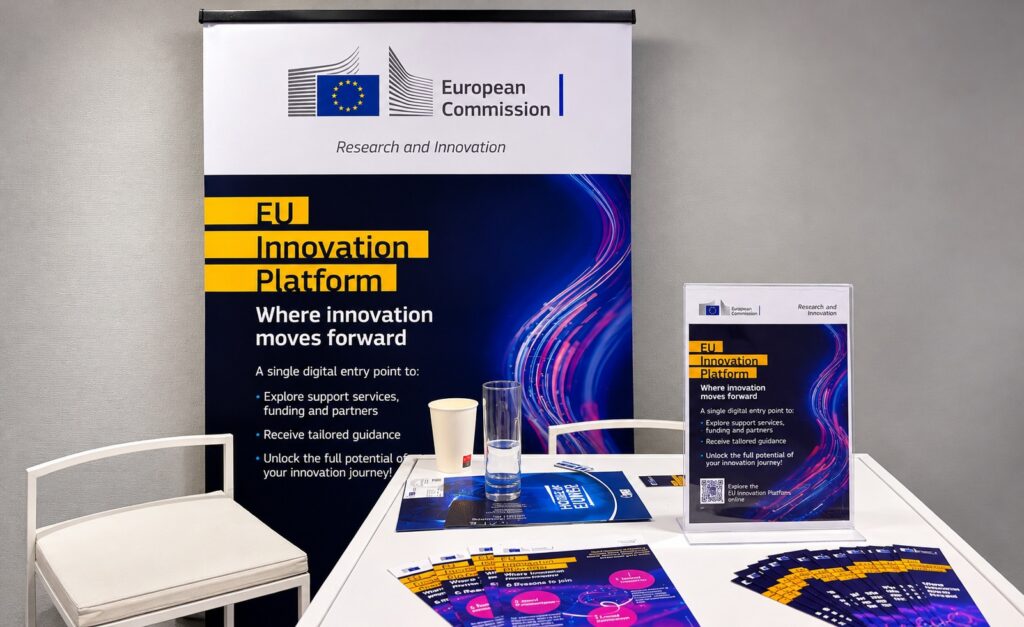
For organisations working with results of EU-funded innovation, the European Commission also provides the EU Innovation Platform as a separate entry point to support services, funding and market-uptake opportunities. It is not a Cluster 5 partner-search tool and currently targets EU-funded innovators (see the Commission’s dissemination and exploitation page): https://research-and-innovation.ec.europa.eu/strategy/dissemination-and-exploitation-research-results_en
The onsite 19 November brokerage event has ended. These resources should be treated as research and partner-search channels, not proof that any particular consortium vacancy is still open.
A practical five-part test before joining a 2027 consortium
- Topic and action fit: Does the idea respond to the expected outcomes, action type, target TRL, specific consortium conditions and other requirements in the topic text?
- Evidence and additionality: Which existing EU-funded results can the project reuse? What is new, and how will that contribution be demonstrated?
- Implementation partners: Who supplies operational data, pilot sites, end-user access or domain-specific validation? Are these resources committed and properly budgeted?
- Consortium gaps: What critical technical, regulatory, stakeholder, governance or uptake expertise is missing, and which partner will own each contribution?
- Impact and uptake: Who can use the results, what practical barriers could prevent adoption, and what is the credible route beyond the funded project? Where societal readiness is required, resource it across the work plan.
From research capacity to credible implementation
The 2027 opportunities span very different challenges, from climate science to smart mobility. The common practical task is to build a consortium around the work the specific call actually demands. The Brussels Q&A and pitching session showed why additionality, credible access to users or infrastructures, operational capability and the way results will be used cannot be afterthoughts.
The most useful question is not “How many partners do we have?” but “What expertise, evidence and implementation pathways are still missing?” Answering it before drafting may save substantial proposal effort. Nexuswelt works with European R&I consortia on stakeholder engagement, exploitation planning and technology acceptance; enquiries about a relevant collaboration can be addressed to anna.lackner@nexuswelt.com.
Evidence note (22 November 2026): numerical call parameters and eligibility conditions should be checked against the live official topic page immediately before submission. Observations from the Brussels Info Day are paraphrases of recorded discussion, not binding interpretations of programme rules. Brokerage examples represent the presenters’ stated intentions and capabilities, not confirmed project partnerships.
About the author
Anna Lackner is the founder and managing director of Nexuswelt Group (Nexuswelt UG, Germany, and Nexuswelt LTD, Cyprus). She has more than ten years of consulting experience in semiconductors, IoT, digitalisation and Industry 4.0, and supports consortia across Horizon Europe, the Chips Joint Undertaking and Digital Europe with consortium strategy, dissemination, communication and exploitation.