A positive evaluation result is not a signed grant. It opens grant agreement preparation, in which the consortium and the granting authority turn the proposal into a binding Grant Agreement while the authority completes its legal and financial checks. Decisions taken in these weeks fix who signs, what the Description of the Action commits the consortium to, how money flows between partners and what the Consortium Agreement allows when something goes wrong.
Throughout, this article separates requirements set by the Grant Agreement, the call conditions or Portal procedures from recommended practice. It covers multi-beneficiary grants under the Horizon Europe main work programme, managed in the EU Funding & Tenders Portal; Joint Undertakings and other programmes use the same Portal, but their own call documents govern the details.
1. From evaluation result to grant preparation invitation
Every applicant receives an evaluation result letter with the Evaluation Summary Report. Successful proposals are invited to grant preparation; others are placed on a reserve list or rejected, and a reserve-listed proposal can be invited later if funds become available.
Requirement to understand: the invitation is not a funding commitment. Legal entity validation, financial capacity verification, exclusion checks and, where relevant, ethics review and security scrutiny still have to be completed.
Unless the topic states otherwise, the indicative timetable is around 5 months from the submission deadline to the result and around 8 months to signature of the Grant Agreement. Two-stage calls follow a different timetable.
2. The invitation letter, deadlines and responsibilities
The invitation letter is the reference document for this phase: the Description of the Action must comply with it, and the budget must match both the proposal and the letter. Read it for the maximum grant amount (which may be lower than requested), any changes the granting authority asks for, conditions to be met before signature, deadlines and the project officer’s contact.
The Online Manual sets standard deadlines; your letter and the project officer’s instructions take precedence.
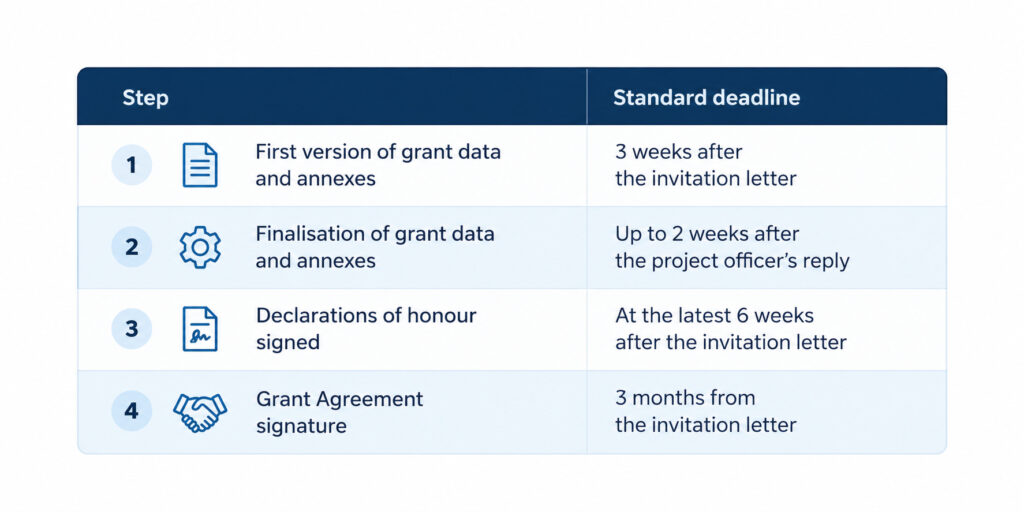
Extensions are granted only in exceptional circumstances. Missing a deadline without one can end grant preparation and lead to rejection of the proposal.
Role | Responsibility during grant preparation |
Coordinator (Primary Coordinator Contact) | Submits the grant data for the consortium, completes the work plan tables, checks that every PIC is validated and that proposal, DoA and legal data are consistent; contact point for the project officer |
Each beneficiary (Participant Contact) | Completes its own participant and budget data, contributes to the DoA, supplies validation and any financial capacity documents |
LEAR (one per organisation) | Manages the organisation’s Participant Register data and appoints its legal and financial signatories; without a validated LEAR the organisation cannot sign |
Project Legal Signatory | Signs the declaration of honour; signs the Grant Agreement (coordinator) or the Accession Form (other beneficiaries) |
Affiliated entities | Must be validated and sign a declaration of honour through their beneficiary; do not sign the Grant Agreement |
Associated partners | Need a registered PIC but no validation; do not sign and cannot charge costs |
Project officer | Enters the granting authority’s data and options, checks the submission and returns it for changes |
The Portal accepts one signature per organisation. Where internal rules require several signatories, one person signs under an internal mandate, and the authorisations are kept on file for controls and audits.
3. Grant data, Description of Action and legal checks
The consortium prepares the grant data together in the Portal and the coordinator submits it. The system generates the Grant Agreement from each participant’s legal, administrative and financial data; the Description of the Action (Annex 1), with Part A as structured tables of work packages, deliverables, milestones and risks, and Part B as the narrative derived from the proposal; the estimated budget (Annexes 2 and 2a); project variables such as starting date, reporting periods and pre-financing; and the declarations of honour.
In parallel, the granting authority completes its checks.
Check | What it involves |
Legal entity validation | Supporting documents for beneficiaries and affiliated entities, all validated before signature |
LEAR appointment | Signed by the legal representative, with identity documents and proof of authority |
Bank account | Normally the coordinator’s account |
Financial capacity | Normally checked for a coordinator requesting EUR 500,000 or more, unless it is a public body or international organisation, or requests EUR 60,000 or less; may also be checked for others. Outcomes can include pre-financing in instalments, no pre-financing, replacement or rejection |
Exclusion and double funding | All participants |
Ethics review and security scrutiny | May add conditions before signature or deliverables during the project; some projects need a facility security clearance before signature |
Gender equality plan | Required at signature for public bodies, research organisations and higher education establishments from Member States and Associated Countries |
Recommended practice: start validation and LEAR appointment for any partner that has never been validated as soon as the invitation arrives. These steps depend on central administrations and are often the slowest part of the process.
4. What can and cannot be changed before signature
Grant preparation is not a renegotiation. The DoA can be made more consistent, errors can be corrected and shortcomings identified in the ESR can be addressed, within the terms of the invitation letter.
Change | Position |
Correcting ESR shortcomings, errors and inconsistencies | Possible and expected |
Number of deliverables | The project officer may ask for fewer or more |
Consortium composition or the project | Only in exceptional, duly justified circumstances such as bankruptcy, a merger or the loss of key staff; the coordinator explains and proposes a solution |
Substantial changes to the proposal | Not allowed; changes must comply with the call conditions, match partners’ competences and maintain quality |
Budget | Must match the proposal and the invitation letter; the maximum grant amount is a ceiling |
Starting date | By default the first day of the month after entry into force; a fixed date if justified; a date before signature only exceptionally |
If no acceptable solution is found, for example when a partner withdraws, the consortium will be asked to withdraw the proposal. For lump sum topics, invited proposals receive ESR comments on the detailed budget table, and ineligible costs in that table can lead to a grant reduction later; see our explanation of lump sum funding.
Recommended practice: do not start work before signature. Activities before then carry the risk that the grant is never signed.
5. Consortium Agreement decisions and partner responsibilities
Requirement: participants must conclude a written Consortium Agreement unless the call says otherwise, and it should normally be signed before the Grant Agreement. It organises relations between partners, can redistribute EU funding under internal arrangements, and must not contain provisions contrary to the Grant Agreement. It is also the usual way beneficiaries ensure that associated partners carry out their tasks in line with the Grant Agreement. Costs of preparing it are not eligible, because they arise before the action starts.
The decisions below are recommended practice and are best settled before signature.
Decision | Why it matters at signature |
Governance bodies, voting and quorum | How the consortium decides once the project runs |
Distribution of pre-financing and later payments | Partners need to know when and on what basis they are paid |
Background and access rights | What each partner brings in, within the IP rules of the Grant Agreement |
Ownership of results | Avoids disputes once results exist |
Liability between partners | Beneficiaries are liable only for their own debts towards the EU; internal liability is a separate question |
Defaulting partner and exit | The procedure if a partner fails to perform or leaves |
Publication procedure | How partners are notified of, and can object to, planned publications |
Associated partner obligations | How tasks and confidentiality are secured, as they do not sign |
The Consortium Agreement is a legal document and should be reviewed by each partner’s legal office. This article is not legal advice.
6. Financial readiness, signature and accession
Pre-financing and any contribution to the Mutual Insurance Mechanism are governed by the applicable programme rules and the Data Sheet of the signed Grant Agreement. The amount, timing and any conditions are grant-specific. Finance teams should model cash flow from the actual grant data, not a generic percentage or assumption.
Step | Who |
Declaration of honour | Each beneficiary’s legal signatory; affiliated entities through their beneficiary |
Signature of the Grant Agreement | The coordinator’s legal signatory |
Signature by the granting authority | The Grant Agreement enters into force with this last signature |
Accession | Each other beneficiary signs an Accession Form within 30 days after entry into force; affiliated entities and associated partners do not sign |
The 30-day accession period runs from entry into force, not from the evaluation result or the invitation. If a beneficiary does not accede in time, the coordinator has a further 30 days to request the corresponding amendment.
Recommended practice for finance offices: plan cash flow for the weeks before pre-financing arrives; open project codes and time recording before the starting date; check that usual cost accounting practices fit the Grant Agreement’s personnel cost rules; and check whether certificates on the financial statements will be required.
7. A kick-off that sets the operating baseline
The kick-off turns the signed agreement into a working baseline. From the grant preparation side, it should confirm:
- the Data Sheet: starting date, duration, reporting periods, payment schedule and the deliverables and milestones in the Portal;
- that partners work from the signed DoA, not the proposal, especially where tasks or deliverables changed;
- owners for early deliverables, including any ethics or security deliverables added during preparation;
- working Portal roles for every partner: participant contact, legal signatory and financial signatory;
- governance bodies constituted under the Consortium Agreement and the pre-financing distribution;
- how partners will keep time records and supporting documents;
- EU funding acknowledgement from the first public communication.
For travel or other expenditure near the project starting date, check the signed Grant Agreement and the applicable cost-eligibility rules before committing expenditure. For running the project after the kick-off, see our article on consortium management in year one.
8. Coordinator checklist before the project begins
R = requirement, P = recommended practice.
- ☐ Read the invitation letter for requested changes, conditions and deadlines (R)
- ☐ Set internal deadlines for partners ahead of the official ones (P)
- ☐ Every beneficiary and affiliated entity validated or in validation; a LEAR and legal signatory for each beneficiary (R)
- ☐ Work plan tables and DoA Part B prepared; ESR shortcomings addressed without substantial change (R)
- ☐ Budget aligned with the proposal and the invitation letter; starting date proposed and justified if fixed (R)
- ☐ Ethics or security conditions due before signature resolved (R)
- ☐ Any partner change raised with the project officer immediately, with a proposed solution (R)
- ☐ All declarations of honour signed; coordinator’s bank account validated (R)
- ☐ Consortium Agreement signed or final, as the call requires (R/P)
- ☐ Every beneficiary accedes within 30 days after entry into force (R)
- ☐ Pre-financing distribution agreed; time recording and project codes in place (P)
When specialist support helps
Grant preparation compresses legal, financial and technical decisions into a few weeks, which is hard for coordinators without a project office or leading a large consortium for the first time. Two limits apply to outside help. Costs incurred before the action starts are not eligible. During the action, whether external support can be charged depends on your Grant Agreement and how the support is classified, and coordinator tasks cannot be delegated or subcontracted to other beneficiaries or third parties, apart from narrow exceptions for public-body coordinators and sole beneficiaries. Check with your project officer before relying on such costs being charged to the grant.
Nexuswelt supports coordinators through grant preparation and the transition to implementation as part of its EU project management service.