Exploitation of Results: Turning EU Project Outputs into Something That Survives the Grant
Munich, 28 October 2026 · Nexuswelt Group
Exploitation is the work package that gets written in the proposal, deferred through the project, and confronted in the final year – when ownership was never settled, the intended users were never consulted, and the consortium is three months from dissolving.
It is also the only part of the project that determines whether anything survives the grant. This article covers what exploitation actually requires, how to identify and mature the results worth exploiting, the ownership questions that have to be settled early, and the free support most consortia never use.
What exploitation actually means
The distinction from dissemination is not pedantry – it is the difference between a section that scores and one that does not.
| Dissemination | Exploitation | |
| What it is | Public disclosure of results so those who can use them find them | Actual use of the results by someone |
| Success looks like | The right audiences know the result exists and can access it | An organisation does something differently because the result exists |
| Typical instruments | Publications, open data, conferences, technical briefings, standards submissions | Licensing, commercialisation, policy input, standardisation, further research, education, internal use |
| Ends when | The results are available | It does not end with the project |
A credible communication, dissemination and exploitation plan should distinguish these activities and define how each contributes to project outcomes. Listing academic publications as an exploitation strategy is the single most common error in this area. Publications are dissemination. Exploitation is what somebody does with the result afterwards, and a section that lists conferences has effectively been left blank.
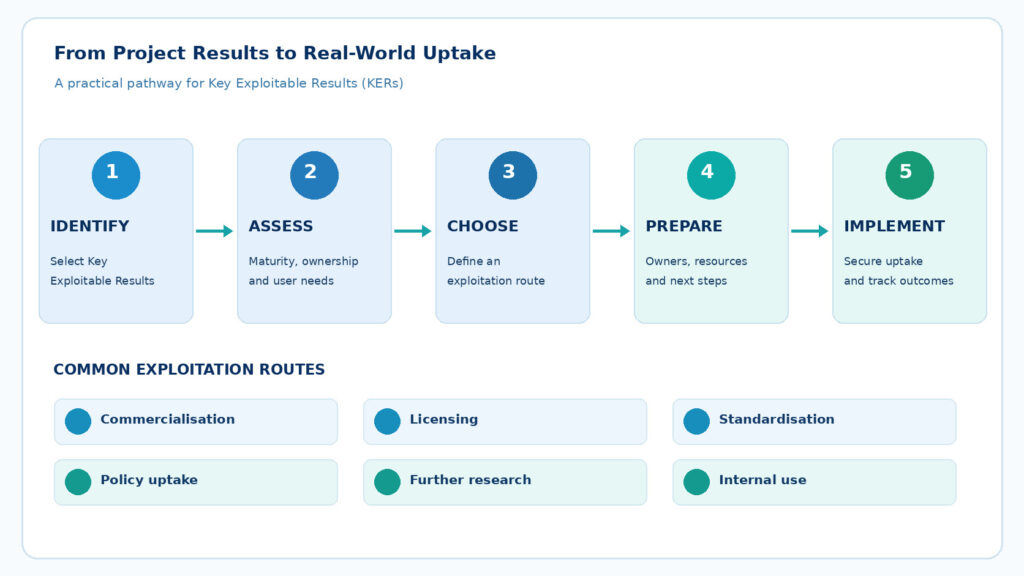
Key Exploitable Results: narrow, do not expand
A result is any output of the action – data, knowledge, software, a method, a dataset, a policy recommendation – together with the rights attached to it. Key Exploitable Results are the subset the partners prioritise as having genuine downstream value.
The instinct is to list everything. Resist it. Three well-supported KERs with named owners, identified users and credible routes will outperform twelve unowned ones at final review, and they will produce a better project along the way because the consortium has decided what matters.
A workable rhythm:
- Month six: identify candidate KERs, provisionally. This is early enough to be wrong and late enough to be informed.
- Each reporting period: assess each candidate for maturity, ownership clarity and user interest.
- Progressively narrow. A list that grows through the project is a list nobody is managing.
- Final year: the surviving KERs should each have an owner, a route and a stated next step beyond the grant.
Ownership, settled early
Results are owned by the partner that generates them, with access rights and exploitation arrangements set out in the grant agreement and negotiated in more detail in the consortium agreement. That sounds settled. In practice it is where exploitation most often fails.These responsibilities should be addressed during year-one consortium management, before ownership and access-rights questions become disputes.
The situations that cause trouble:
- Joint ownership arising from genuinely collaborative work, without an agreed regime for how it will be exploited or how revenues are shared.
- Background intellectual property that a partner brought in, without clear access rights for the others to exploit results built on it.
- Results generated by a partner who has no interest in exploiting them and no obligation to let anyone else.
- Software with dependencies whose licences constrain commercial use, discovered when a licence is being negotiated.
All of these are resolvable in year one and expensive in year three. Raise them while the relationships are new and nothing is at stake yet – a conversation about hypothetical revenue is considerably easier than one about actual revenue.
The exploitation routes
Exploitation is not a synonym for commercialisation. Most EU project results are exploited through routes that involve no sale at all.
| Route | What it looks like | What has to be true |
| Commercialisation | A product or service brought to market by a partner | A partner with the capacity and appetite, a viable business case, and cleared ownership |
| Licensing | A third party takes the result forward under licence | Protected IP, an identified licensee, and terms agreed between partners in advance |
| Standardisation | A result feeds into a formal or de facto standard | Engagement with the relevant body during the project, not after |
| Policy input | A public authority adopts a recommendation, method or dataset | A relationship with that authority built while the work was still shapeable |
| Further research | The result becomes the basis of a follow-on project | A credible next proposal and partners who intend to make it |
| Education and training | A method enters a curriculum or a professional training programme | An institution that has committed to adopt it |
| Internal use | A partner uses the result in its own operations or services | The least glamorous route, frequently the most realistic, and legitimate exploitation |
| Open release | Software, data or a method released openly with a sustaining community | Someone maintaining it after the grant, which is the part usually missing |
The post-project problem
Exploitation obligations continue for a defined period after the project’s end date. Most consortia dissolve at the end date. These two facts sit awkwardly together and the gap between them is where results die. Exploitation does not end at project closure. It remains part of the wider EU project lifecycle, with responsibilities for results, maintenance and stakeholder relationships continuing beyond the grant.
What has to be decided before the consortium disperses:
- Who holds each result, in writing, with contact details that will still work in two years.
- Who maintains anything that requires maintenance – a dataset, a piece of software, a platform. “The community” is not an answer unless a community exists.
- Who holds each stakeholder relationship. Relationships built by a project end with it unless someone inherits them.
- How any later uptake gets recorded and shared, since the impact case continues after the final review. Tracking post-project uptake requires clear impact pathways and KPIs that connect results with evidence of actual use.
- What happens to the project website and its content, which typically disappears within two years of the funding ending.
A project that answers none of these has not completed its exploitation work, whatever the final report says.
Free support most consortia never use
The Commission funds a support ecosystem specifically for this, and it is consistently underused. Engaging with it costs nothing and reviewers notice when a consortium has. The European Research Executive Agency’s dissemination and exploitation pages are the entry point.
| Instrument | What it does |
| Horizon Results Platform | A free repository and matchmaking space where consortia advertise Key Exploitable Results to the audiences they want to reach |
| Horizon Results Booster | Consultancy-style support at no cost, covering portfolio dissemination and exploitation strategy, business plan development and go-to-market guidance |
| Dissemination and Exploitation Support Facility | Market-oriented support focused on knowledge transfer, IP management and raising the maturity of exploitable results |
| European IP Helpdesk | Free advice on intellectual property questions, including ownership and licensing within consortia – best used before disputes arise |
| Innovation Radar | Data-driven identification of high-potential innovations from EU-funded work, with visibility for the innovators behind them |
A line in the periodic report noting which of these you engaged with and what came of it carries more weight than pages of activity counts.
Common failures
- Exploitation described as publications and conferences.
- “Too early to consider” at low TRL. Early-stage research has identifiable downstream users, and evaluators flag this answer explicitly.
- A KER list that grows rather than narrows, indicating nobody is managing it.
- Ownership left to the consortium agreement and then never revisited.
- An exploitation plan written by the communication partner without the technical partners who own the results and know the users.
- Commercialisation assumed as the only legitimate route, when internal use, policy input or standardisation is the realistic one.
- No named owner for results after the end date.
- Waiting for the final year, by which point ownership, maturity and user interest are all unresolved simultaneously.
A year-by-year rhythm
| When | What happens |
| Proposal stage | Exploitation logic designed, per result, with intended users named. This is what the Impact score rests on |
| Month 6 | Candidate KERs identified provisionally. Ownership questions raised while nothing is at stake |
| Each reporting period | KERs assessed for maturity, ownership and user interest. The list narrows |
| Mid-project | Engagement with the free support instruments. Standards and policy routes started, since both take years |
| Final year | Each surviving KER has an owner, a route and a next step. Licences and agreements negotiated |
| Before dissolution | Post-project ownership of results, maintenance and stakeholder relationships assigned in writing |
Exploitation planning starts with the Horizon Europe impact section, where the intended users, uptake pathways and expected outcomes must form a credible logic.
How Nexuswelt works on exploitation
Exploitation fails at the design stage more often than at the delivery stage, and by the final year the available options are whatever the earlier decisions left open. Nexuswelt contributes to EU-funded projects as a partner on communication, dissemination, stakeholder engagement and exploitation, working on KER identification, ownership clarity and route design from the proposal onward. The wider treatment of coordinator obligations is in our guide to communication, dissemination and exploitation, and more on the firm is on the Nexuswelt about page. Organisations preparing or implementing Horizon Europe projects can explore Nexuswelt’s support for communication, dissemination, stakeholder engagement and exploitation.