Resubmitting a Rejected Horizon Europe Proposal: How to Read Your Evaluation Report
Munich, 21 October 2026 · Nexuswelt Group
The evaluation summary report is the most valuable document a consortium receives from the European Commission, and most are read once, in irritation, and then filed. That is an expensive habit. At programme success rates of roughly 14 to 16%, rejection is the normal outcome, and a detailed account of exactly why is worth more than the submission cost.
This guide covers what the report contains, how to read what evaluators actually mean, how to decide whether to resubmit at all, and what genuinely changes a score on a second attempt.
What the report contains
For each of the three criteria – Excellence, Impact and Implementation – you receive a score out of five, a set of strengths and a set of weaknesses, and a consensus commentary reflecting the agreed view of the evaluation panel rather than any single expert’s opinion.
Three things to establish immediately:
- Which criterion scored lowest, and by how much. A proposal at 4.5, 3.0 and 4.5 has one problem; one at 3.5 across the board has a different one.
- Whether you passed all thresholds. A proposal above threshold everywhere was rejected on ranking, not on quality – a materially different situation from one that failed a threshold.
- How far you were from the funding line, where that information is available. Some calls indicate the cut-off score, and being two-tenths below it is a different problem from being a full point below.
Reading it properly, which means reading it late
The practical advice most consortia ignore: do not analyse the report in the first forty-eight hours. Read it once, then leave it for a week.
Evaluation reports are written in a restrained register, and the first reading almost always produces one of two wrong reactions – that the evaluators misunderstood the proposal, or that the criticisms are minor wording issues. Both readings prevent the report from being useful. The second reading, after the disappointment has cooled, is the one that finds the pattern.
When you do return to it, work through it criterion by criterion and convert every weakness into a specific change. A weakness that cannot be converted into a change is either something you disagree with – which is possible – or something you have not yet understood.
Decoding what evaluators write
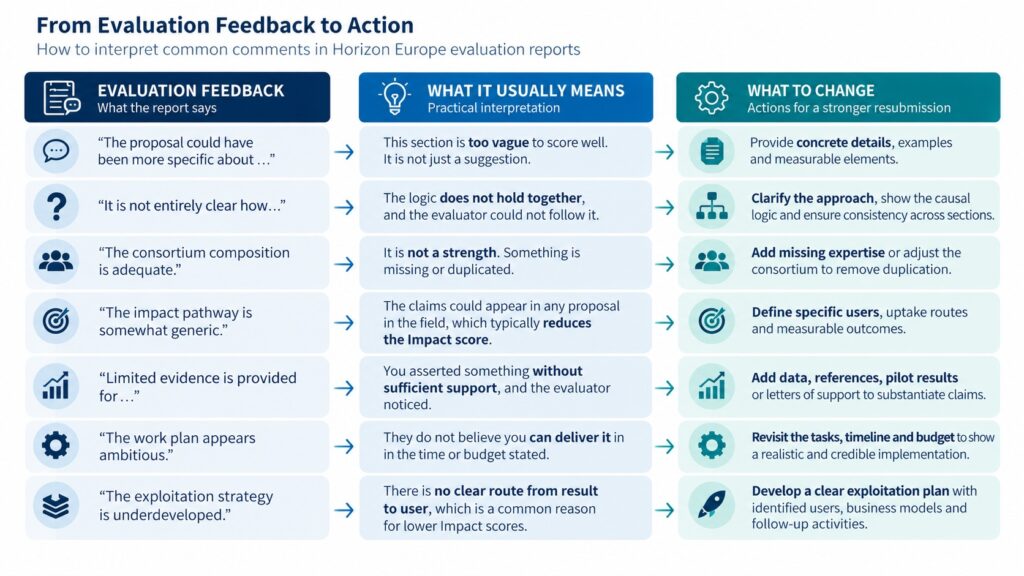
Evaluators write diplomatically and consortia read literally. This is the single largest source of wasted resubmissions.
| What the report says | What it usually means |
| The proposal could have been more specific about… | This section was too vague to score well. It is not a suggestion |
| It is not entirely clear how… | The logic does not hold together, and the evaluator could not follow it |
| The consortium composition is adequate | It is not a strength. Something is missing or duplicated |
| The impact pathway is somewhat generic | This cost you a point. The claims could appear in any proposal in the field |
| Limited evidence is provided for… | You asserted something without support, and the evaluator noticed |
| The work plan appears ambitious | They do not believe you can deliver it in the time or budget stated |
| The exploitation strategy is underdeveloped | There is no route from result to user, which is the most common reason Impact scores three |
| The proposal would benefit from… | This is a required change, phrased politely |
A useful discipline: read every weakness as though it cost you half a point, then work out how it did. Evaluators rarely mention something that did not affect the score.
Three questions before deciding to resubmit
- Is the topic coming back? Work programmes change, topics are dropped, and scopes shift. A resubmission to a topic that no longer exists is not a resubmission – it is a new proposal wearing an old one’s clothes.
- Are the weaknesses fixable within the time available? A vague impact section can be rewritten in weeks. A missing end-user partner takes months to recruit properly, and a fundamental scope mismatch may not be fixable at all. If the evaluation identifies missing capabilities or partners, revisit how to build a Horizon Europe consortium before committing to another submission.
- Was the rejection about quality or ranking? Above threshold everywhere means the proposal was fundable and the field was crowded. That usually justifies a resubmission with targeted improvement. A threshold failure means something structural was wrong.
What actually changes a score
In rough order of how much difference it makes on a second attempt:
| Change | Why it moves the score |
| Fixing the lowest-scoring criterion | The weakest score constrains the total. Improving a 4.5 to a 4.7 is worth far less than moving a 3.0 to a 4.0 |
| Adding a missing consortium capability | Duplicate profiles, no end user or no route to uptake are structural criticisms that no rewriting resolves |
| Rebuilding the impact pathway | Where most proposals lose. Named users, a specific route and stated conditions replace assertions |
| Making claims evidenced | “Limited evidence provided” is answered with preliminary data, letters of intent or comparable adoption figures – not with stronger adjectives |
| Aligning budget and effort with the narrative | An implementation criticism about ambition is usually a mismatch between what is promised and what is resourced |
| Choosing a less crowded topic | Sometimes the largest single improvement available, and it is not a rewriting exercise at all |
What does not change a score
- Better writing of the same content. A polished version of a generic impact section is still generic.
- Adding partners to look substantial. This adds coordination cost and gives the implementation section more to justify.
- Rebutting the evaluators in the text. The next panel has not read the last report, and the argument reads as defensiveness.
- Adding length. Page limits are enforced by truncation and, with shortened templates, padding is more exposed rather than less.
- Changing the title and the abstract while leaving the substance intact. This is the most common failed resubmission, and it scores worse than the original because the same weaknesses now appear after a cycle in which they could have been fixed.
Same topic or a different one?
The default assumption is to resubmit to the same topic in the next cycle. It is often wrong.
Consider a different topic when the report suggests a scope mismatch, when the topic was unusually oversubscribed, or when the expected outcomes have shifted in the new work programme. Success rates vary by a factor of several between topics within the same call, which means topic reselection can be worth more than any amount of rewriting.
Stay with the same topic when you scored above threshold across all criteria, the weaknesses are specific and fixable, and the topic returns with substantially the same scope. In that situation the consortium already has a proposal that the panel considered fundable. Understanding Horizon Europe success rates and topic selection can help consortia assess whether another application is worth the investment.
The rework sequence
- Week 1: read once, then stop.
- Week 2: convert every weakness into a specific, owned change. Anything that cannot be converted goes on a separate list for discussion.
- Week 3: decide whether the consortium changes. This decision has the longest lead time and blocks everything else, so it cannot wait.
- Week 4: confirm the topic – same, different, or a different call entirely – against the new work programme.
- Weeks 5–10: rebuild the weakest criterion first, from scratch rather than by editing. Sections that scored three are usually easier to rewrite than to repair.
- Weeks 11–12: cross-check the whole proposal for consistency, and confirm every claim in the impact section has a resourced task behind it.
- Before submission: have someone who did not write it read the report and the new proposal side by side, and ask whether each weakness is now answered.
When not to resubmit
Deciding against is a legitimate and often correct outcome. The signals:
- A threshold failure on Excellence, which usually indicates the concept rather than the writing.
- Weaknesses that require a partner nobody in the consortium can recruit within the cycle.
- A scope mismatch with the topic that would require redesigning the project rather than the proposal.
- A consortium that has lost commitment. A resubmission written by a smaller and more tired group than the original rarely improves on it.
- A topic that is not returning and no adjacent topic fits.
What the attempt produced regardless: a defined role and partner profile in circulation, working relationships with coordinators who will form consortia again, a documented impact logic, and a detailed external assessment of your project’s weaknesses that no consultant would have given you as candidly. Even when resubmission is not the right decision, a clear Horizon Europe partner profile can help the organisation position itself for future consortia.
How Nexuswelt works on resubmissions
A resubmission is won or lost in the decision phase rather than the rewriting phase – which criterion to rebuild, whether the consortium changes, and whether the topic is still the right one. Nexuswelt works with consortia on that analysis, on impact and exploitation logic, and contributes to funded projects as a partner for communication, dissemination, stakeholder engagement and exploitation. For consortia preparing another submission, Nexuswelt provides EU proposal development and support, including proposal strategy, evaluator-oriented review and improvements to the Excellence, Impact and Implementation sections. The companion article on where technically strong proposals lose points is our guide to the Horizon Europe impact section, and more on the firm is on the Nexuswelt about page.