Munich, 7 October 2026 · Nexuswelt Group
The budget is the part of a proposal most consortia treat as arithmetic and evaluators read as evidence. An implausible budget undermines the implementation section, and a budget that does not match the work plan is one of the easiest criticisms for a reviewer to make.
It is also where a surprising amount of money is left on the table through category placement alone. This guide covers the cost categories, how personnel costs actually work, the flat rate that makes classification a financial decision, and the mistakes that recur.
The cost categories
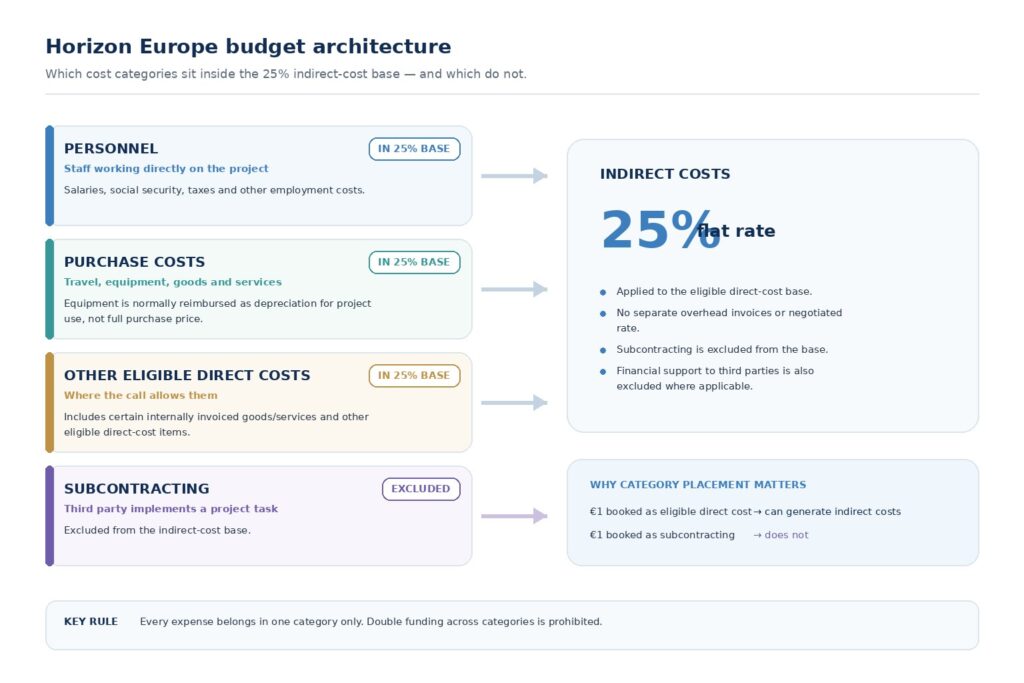
Every expense must sit in exactly one category. Double funding of the same cost across categories is explicitly prohibited.
Personnel: the two-thirds
Personnel is the largest line in almost every budget and the one with the most specific mechanics.
The daily rate
Horizon Europe works in daily rates rather than person-months. The rate is calculated from actual personnel costs over a reporting period, divided by the maximum declarable day-equivalents for that period. The horizontal ceiling is 215 day-equivalents per person per calendar year across all EU grants – a person cannot declare more than that in total, however many projects they work on.
For part-time staff the ceiling pro-rates by the working time factor. For a reporting period shorter than a year, the maximum day-equivalents are calculated proportionally from the annual ceiling.
Only time actually worked on the project may be reported. The budget is an estimate; the report is a record.
The unit cost option
Since May 2024 there is an optional simplified route: a beneficiary-specific personnel unit cost, derived from the last closed financial year and approved through a wizard in the Funding & Tenders Portal. Once approved it replaces the actual-cost personnel categories with a single daily rate, applies to subsequent proposals invited to grant preparation, and is fixed for at least two years.
For organisations running several EU projects, this removes a recurring administrative burden. It is worth investigating before your next proposal rather than after it.
The flat rate, and why category placement is a financial decision
Indirect costs are a flat 25% of eligible direct costs. You do not track overheads, produce invoices or justify a rate. The mechanism is simple and it has one consequence that repeatedly costs consortia money.
Subcontracting is excluded from the base on which the 25% is calculated. So is financial support to third parties, where applicable.
A euro booked as personnel generates indirect cost reimbursement. The same euro booked as subcontracting does not. Over a large budget the difference is material, and it is decided by how the work is structured rather than by any negotiation.
This is not an invitation to misclassify. Subcontracting has a specific definition – implementation of a described action task by a third party – and reviewers examine subcontracting closely against what the grant agreement foresaw. The point is that the structural choice between doing work in-house and subcontracting it has a financial dimension that should be made deliberately at budgeting stage.
Funding rates by action type
| Action type | Funding rate |
| Research and Innovation Actions (RIA) | 100% of eligible costs |
| Coordination and Support Actions (CSA) | 100% of eligible costs |
| Innovation Actions (IA) – non-profit entities | 100% of eligible costs |
| Innovation Actions (IA) – for-profit entities | 70% of eligible costs, leaving a 30% co-financing requirement |
| ERC, EIC Pathfinder, EIC Transition | 100% of eligible costs |
| EIC Accelerator grant component | 70% of eligible costs, with the grant capped at €2.5 million |
Two points that matter in practice. In a mixed Innovation Action consortium each partner’s rate is determined independently by its own legal status, so a company and a university in the same project receive different percentages of their own costs. And submitting a proposal structured for one action type to a call for another is a fatal error that reviewers identify immediately – the action type is dictated by the topic and by the maturity of the work, not by which rate looks better.
The 30% that companies discover late
For a for-profit participant in an Innovation Action, 30% of eligible costs are not funded. This is not a shortfall to be absorbed quietly – it is a co-financing requirement that has to have an identified source before submission.
Startups in particular reach selection and then discover that participation requires committing company money for several years. Identify where that comes from at budgeting stage: own resources, an investor, a national co-funding scheme, or a decision not to participate in that action type. For startups, this should be treated as part of co-financing readiness before the proposal is submitted.
Rules on the other categories
- Equipment is normally not reimbursed at purchase price. Only depreciation during the project, for the proportion of use attributable to the project, is eligible. Leasing can be eligible where it follows the organisation’s usual practice and does not exceed purchase cost.
- Travel must be necessary for the project and follow the organisation’s own travel policy. Consortium meetings, dissemination events and fieldwork should be budgeted realistically – under-budgeting travel is a common cause of mid-project friction.
- Subcontracting must correspond to tasks described in the project description. Unforeseen subcontracting appearing during implementation attracts scrutiny.
- Other goods and services covers consumables, publication costs, external expertise that is not a subcontracted task, certificates and similar items.
Common mistakes
- A budget that does not match the work plan. Effort concentrated in a work package whose narrative describes minor activity, or the reverse, is visible to reviewers and undermines the implementation score.
- Round numbers throughout. A budget built from estimates of actual effort does not consist of neat figures, and one that does reads as an allocation rather than a calculation.
- Under-budgeting horizontal work packages. Communication, dissemination and exploitation promising extensive multi-country engagement on minimal effort is not credible, and the mismatch is easy to spot.
- Forgetting the 30% for company partners in Innovation Actions until after selection.
- Classifying in-house work as subcontracting, or vice versa, without considering the indirect cost consequence.
- Budgeting equipment at purchase price rather than depreciation.
- Effort loaded into the final year, which describes a project that intends to catch up rather than one that intends to deliver.
Inconsistency between the budget table and the narrative. Reviewers cross-read them, which makes cross-checking against the narrative essential before submission.
What flexibility exists after signature
The estimated budget in Annex 2 of the grant agreement is not a rigid spending plan. There is flexibility to shift funds between categories and, within limits, between partners as the work develops, provided the total maximum grant amount is not exceeded and the work described is still delivered.
What does require a formal amendment includes changes to the consortium composition and substantive changes to the described work. Under lump sum grants, moving amounts between work packages or partners also requires an amendment, because the shares are fixed per work package in the grant agreement.
What changes under lump sum
Under a lump sum grant there is no reporting of actual costs and no financial audit of resources used, so the categories above are not reported. They do not disappear, though – for bottom-up lump sums a detailed budget table is a mandatory annex, cost estimations must follow the same eligibility rules, and evaluators assess whether the estimate is realistic.
The difference is when the work happens. In an actual-cost grant, budgeting imprecision can be absorbed because reality is reported later. Under lump sum the amount is fixed at signature and cannot be corrected, which moves the estimating effort forward into the proposal and raises the cost of getting it wrong.
A practical sequence
- Confirm the action type and the funding rate that applies to each partner. This determines the co-financing conversation before anything else.
- Estimate effort per partner per work package, in days, from the actual work described. Effort first, money second. That effort split should follow the consortium and work plan design, not be imposed on it afterwards.
- Apply each partner’s daily rate, checking the 215-day ceiling per person across all their commitments.
- Add direct costs – travel, equipment depreciation, consumables, other services – against specific planned activities.
- Decide subcontracting deliberately, with the indirect cost consequence in view.
- Apply the 25% flat rate to the eligible direct base, excluding subcontracting.
- Cross-check the budget against the narrative work package by work package, and against the effort profile over time.
- Confirm co-financing sources for any partner not funded at 100%.
How Nexuswelt works on this
Budget credibility is part of the implementation case rather than an administrative afterthought, and horizontal work packages are where under-budgeting most often shows. Nexuswelt contributes to EU-funded projects as a partner for communication, dissemination, stakeholder engagement and exploitation, which means budgeting that work from experience of delivering it. The companion article on lump sum mechanics is our guide to lump sum funding in Horizon Europe, and more on the firm is on the Nexuswelt about page. Nexuswelt is not a financial adviser; confirm eligibility and accounting treatment with your own finance function or a qualified professional.