Strong results alone do not guarantee impact in EU-funded projects. Project teams also need clear communication, targeted dissemination, correct visibility, and a realistic path from results to uptake.
This is especially relevant in Horizon Europe and other EU programmes, where communication is not just a nice extra. The European Research Executive Agency explains that communicating about your EU-funded project is a legal obligation under the grant agreement, while dissemination and exploitation are central to maximising the economic and societal impact of project results. (https://rea.ec.europa.eu/communicating-about-your-eu-funded-project_en)
For many consortia, the challenge is not whether communication matters. The challenge is how to structure it well from the beginning of the project, how to stay compliant, and how to make communication genuinely useful for stakeholders.
This EU Project Communication Guide explains the essentials in a practical way.
https://nexuswelt.com/wp-content/uploads/2026/03/EU-Project-Communication-Guide.pdf
Why communication matters from day one
One of the most common mistakes in EU-funded projects is waiting too long to communicate. Many consortia focus heavily on technical work at the start and leave communication for the final phase. In practice, that weakens visibility, reduces stakeholder engagement, and limits future uptake.
REA guidance is clear: project communication should help make EU-funded innovation visible, reach relevant stakeholders, and support the broader pathway from project activities to impact. REA also notes that beneficiaries are expected to maintain a web presence for their project, and social media alone does not replace that requirement. (https://rea.ec.europa.eu/communicating-about-your-eu-funded-project_en)
Early communication helps projects:
- explain why the project matters
- build trust around the consortium and its objectives
- create early contact with stakeholders who may later use the results
- support future dissemination, exploitation and policy relevance
Example:
A project on climate adaptation starts communicating only in its third year, when technical results are already available. By then, many municipalities have already defined their planning priorities. If that same project had started stakeholder outreach in year one, it could have shaped earlier discussions with local authorities and improved the chances of later uptake.
Communication, dissemination and exploitation: what is the difference?
This is one of the most important distinctions in EU project management.
According to REA, communication, dissemination and exploitation are connected, but they are not the same. (https://rea.ec.europa.eu/communicating-about-your-eu-funded-project_en)
Communication means explaining the project and its value to broad audiences, including non-specialists.
Dissemination means sharing project results with audiences that can use them, such as researchers, industry, policymakers or practitioners.
Exploitation means using project results in practice, for example in services, products, standards, operations, policy uptake or further research.
Simple use case:
Imagine a project developing an AI-based training tool for emergency planning.
Communication:
A website article and LinkedIn post explain why the project matters for regional resilience.
Dissemination:
A webinar presents validated results to civil protection authorities, researchers and training organisations.
Exploitation:
A municipality adopts the tool, or a training provider integrates it into a regular programme.
Projects that mix these three concepts often end up with weak planning. Projects that separate them clearly can define stronger tasks, outputs and impact pathways.
Start with audience mapping, not channels
Before choosing a website structure, newsletter, webinar or social media format, a project should first identify its audiences.
REA’s advice for EU projects includes specific guidance on outreach and on how to inform policymakers effectively, which underlines how important targeted communication is for impact. (https://rea.ec.europa.eu/guidance/advice-eu-projects_en)
Typical audiences in EU-funded projects include:
- policymakers and public authorities
- industry and SMEs
- universities and research actors
- practitioners and end users
- civil society organisations
- local communities
- media and multipliers
A useful planning question is:
Who needs to know, who can use the results, and who can help scale them?
Example:
A cybersecurity project may need one message for policymakers, another for SMEs, another for technical researchers, and another for end users. A policy brief, a scientific article, a technical workshop and a short non-technical explainer may all be necessary, but for different audiences and at different moments.
That is why a strong Horizon Europe communication strategy starts with audience logic, not channel logic.
Choose communication channels and outputs based on purpose
Projects often use the same standard outputs because they seem expected: website, LinkedIn page, brochure, newsletter. These can all be useful, but only if each one serves a clear purpose.
A practical EU project communication toolkit may include:
- a project website or landing page
- LinkedIn posts and partner amplification
- newsletters and mailing lists
- webinars and stakeholder events
- factsheets
- policy briefs
- short videos
- partner interviews
- conference visibility
- media outreach
REA’s guidance and Horizon Europe implementation logic both support practical dissemination and communication measures that are suitable for maximising outcomes and impacts. (https://rea.ec.europa.eu/dissemination-and-exploitation_en)
A simple way to think about channels by phase:
Early phase
Use website launch content, a short factsheet, introductory social posts, and early stakeholder outreach.
Mid-project
Use partner interviews, first-results updates, webinars, targeted workshops and conference participation.
Late phase
Use policy briefs, uptake-oriented events, result explainers, user materials, exploitation-focused outreach and final visibility assets.
This staged approach is much stronger than publishing isolated content without a plan.
EU visibility rules are mandatory
Communication in EU-funded projects also means complying with funding visibility rules.
REA states that beneficiaries must acknowledge EU funding and display the EU emblem prominently on communication materials, dissemination activities and funded results. REA also explains that the European Commission logo must not be used instead of the EU emblem. (https://rea.ec.europa.eu/communicating-about-your-eu-funded-project_en)
In practice, that affects:
- project websites
- presentations
- reports
- event banners
- brochures
- videos
- social media visuals
- factsheets
- publications
Example:
A consortium publishes a professional brochure with only partner logos and no EU emblem or correct funding statement. Even if the design looks polished, it is not compliant.
This is why every project should have a simple visibility checklist from the start.
Data protection matters in project communication
Another issue that projects often underestimate is data protection.
REA explicitly reminds beneficiaries that data protection must be considered in communication activities. This is especially relevant for mailing lists, registration forms, event photos, videos, testimonials, interviews and social media content that includes identifiable individuals. (https://rea.ec.europa.eu/communicating-about-your-eu-funded-project_en)
This means project teams should think in advance about:
- consent and notices
- storage of personal data
- publication rights
- photo and video handling
- mailing list compliance
- internal partner responsibilities
Use case:
A consortium runs a stakeholder workshop and wants to post photos afterwards on LinkedIn and the project website. If participants are identifiable, the project should already have appropriate notices and consent handling in place.
For multi-partner projects, this is even more important because communication responsibilities are often distributed.
Open science improves discoverability and reuse
For Horizon Europe projects, communication should also be linked to open science.
REA states that open science is a legal obligation under Horizon Europe and explains that beneficiaries must provide open access to peer-reviewed publications and maintain a Data Management Plan, among other obligations and recommended practices. (https://rea.ec.europa.eu/open-science_en)
From a communication perspective, this means thinking beyond promotion.
A result becomes more valuable when it is:
- easy to find
- easy to understand
- easy to access
- easy to reuse
Example:
A project publishes a peer-reviewed article in open access but does nothing else. The article exists, but few policymakers or practitioners will ever discover it.
A stronger approach would combine:
– the open-access publication
– a plain-language summary
– a website news article
– a LinkedIn post
– direct stakeholder outreach
– a webinar or conference presentation
That is how open science and communication can reinforce each other.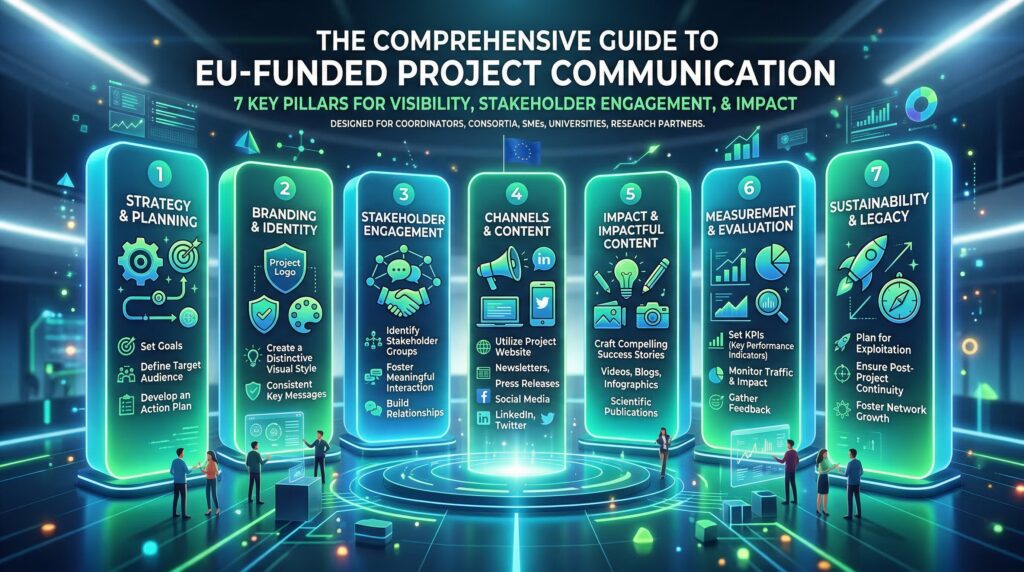
Communication should support the pathway to impact
Projects should not ask only, “What should we publish?” They should also ask:
- What result are we communicating?
- Who needs to see it?
- What should happen next?
- How does this support uptake, exploitation or wider impact?
This aligns closely with Horizon Europe logic. The General Annexes explain that proposals are assessed on the suitability and quality of measures to maximise expected outcomes and impacts through dissemination and exploitation, including communication activities. (https://research-and-innovation.ec.europa.eu/document/download/9d9a75d4-6da8-4902-95c4-34a4de01ebe5_en)
A practical sequence looks like this:
results → dissemination → stakeholder uptake → exploitation → wider impact
Example:
A project develops a digital tool for workforce training.
Weak approach:
One final press release, one closing event, a few generic social media posts.
Stronger approach:
Early content on the project challenge, mid-project stakeholder workshops, result-focused dissemination to training providers, a policy brief for decision-makers, and follow-up materials for long-term use.
The second approach makes communication part of the impact pathway.
Make communication part of project management
Communication works best when it is embedded in project governance.
That means:
- assigning clear communication responsibilities
- agreeing approval processes for public materials
- using shared key messages
- collecting content from technical teams regularly
- linking communication with dissemination and exploitation planning
- keeping communication plans and data-related plans updated where required
REA’s guidance for EU projects and grants/reporting obligations supports this integrated approach. The grant agreement is based on the successful proposal and defines the work, rights and obligations of the project, while REA also provides project advice and support on communication, dissemination and open science. (https://rea.ec.europa.eu/horizon-europe-grants-reporting_en)
Use case:
A technically strong project struggles to communicate because partners send content too late. A simple quarterly content collection routine with one contact point per partner can significantly improve consistency and speed.
Common mistakes to avoid
Across many Horizon Europe and EU-funded projects, the same communication mistakes appear repeatedly:
- waiting too long to start communication
- confusing communication, dissemination and exploitation
- using the wrong EU visibility elements
- choosing channels before mapping audiences
- neglecting data protection in events and media content
- focusing only on activity metrics instead of usefulness and uptake
Avoiding these mistakes already improves project quality.
How Nexuswelt supports EU-funded projects
At Nexuswelt, we support EU-funded projects with:
- dissemination and communication strategies
- stakeholder engagement and ecosystem outreach
- visibility and positioning of innovation results
- impact-oriented communication support
For many consortia, the problem is not the lack of strong results. It is translating those results into communication activities that reach the right audiences and support long-term value.
Useful official EU resources
These official sources are especially useful for project teams:
- Communicating about your EU-funded project — https://rea.ec.europa.eu/communicating-about-your-eu-funded-project_en
- Dissemination and exploitation — https://rea.ec.europa.eu/dissemination-and-exploitation_en
- Open science — https://rea.ec.europa.eu/open-science_en
- Advice for EU projects — https://rea.ec.europa.eu/guidance/advice-eu-projects_en
- Communication, dissemination & exploitation: what is the difference and why they all matter — https://rea.ec.europa.eu/publications/communication-dissemination-exploitation-what-difference-and-why-they-all-matter_en
FAQ
What is the difference between communication and dissemination in Horizon Europe?
Communication explains the project and its value to broad audiences, while dissemination shares project results with people or organisations that can use them, such as researchers, policymakers, industry or practitioners. REA treats them as related but distinct activities. (https://rea.ec.europa.eu/communicating-about-your-eu-funded-project_en)
Is communication mandatory in EU-funded projects?
Yes. REA states that communicating about your EU-funded project is a legal obligation under the grant agreement. (https://rea.ec.europa.eu/communicating-about-your-eu-funded-project_en)
Do Horizon Europe projects need to use the EU emblem?
Yes. Beneficiaries must display the EU emblem and the correct funding statement prominently on communication materials, dissemination activities and funded results. (https://rea.ec.europa.eu/communicating-about-your-eu-funded-project_en).
Does data protection apply to project communication activities?
Yes. REA explicitly states that data protection should be considered in communication activities, including images, videos, forms and mailing lists. (https://rea.ec.europa.eu/communicating-about-your-eu-funded-project_en)
How does communication support project impact?
Communication helps make results visible, reach relevant stakeholders, support uptake and reinforce the pathway from results to wider impact. Horizon Europe evaluation also considers the quality of measures for dissemination and exploitation, including communication activities. (https://research-and-innovation.ec.europa.eu/document/download/9d9a75d4-6da8-4902-95c4-34a4de01ebe5_en)