Horizon Bridging 2027: How to Turn Finished Horizon Europe Projects into Investment-Ready Results
Most Horizon Europe projects end at the point where the hard part begins. The results are validated in a lab or a pilot, the consortium disbands, and nobody is funded to take the next step towards customers, investors or deployment. The 2027 Horizon Bridging calls are designed for exactly that gap.
At the European Research & Innovation Days in Brussels on 10 and 11 November 2026, the European Commission presented the Bridging actions as part of what it calls the “innovation to investment journey”. This article explains what the calls fund, who can apply, the deadlines that matter, and five checks to run before you start writing.
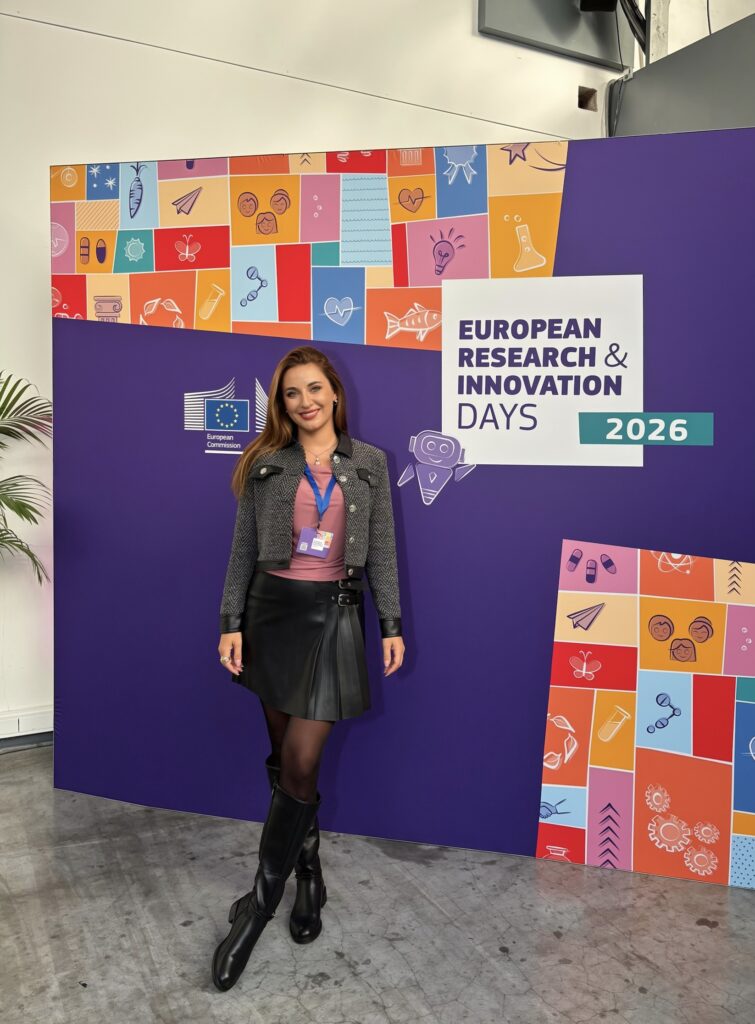
Anna Lackner, Managing Director of Nexuswelt Group, at the European Research & Innovation Days 2026 in Brussels.
What the Horizon Bridging calls are
The Bridging call is part of the Horizon Europe Work Programme 2026–2027 (Horizontal Activities). According to the work programme, it “aims to facilitate a smooth transition between Horizon Europe 2021–2027 and the next EU R&I Framework Programme”. Its focus is the innovation to investment journey, linked to the future European Competitiveness Fund.
The calls cover three areas:
- Knowledge valorisation and data access, including the main topic for advancing Pillar II results
- Research infrastructures and data access
- Artificial intelligence, through large Apply AI actions
At R&I Days, DG Research and Innovation described the journey from idea to market in terms that every project coordinator will recognise:
“Highly iterative, non-linear, not fully controllable, shaped by founder skills, the availability of diverse finance, robust networks, and a supportive policy environment.”
DG Research and Innovation, session “Bridging the innovation to investment journey”, R&I Days 2026
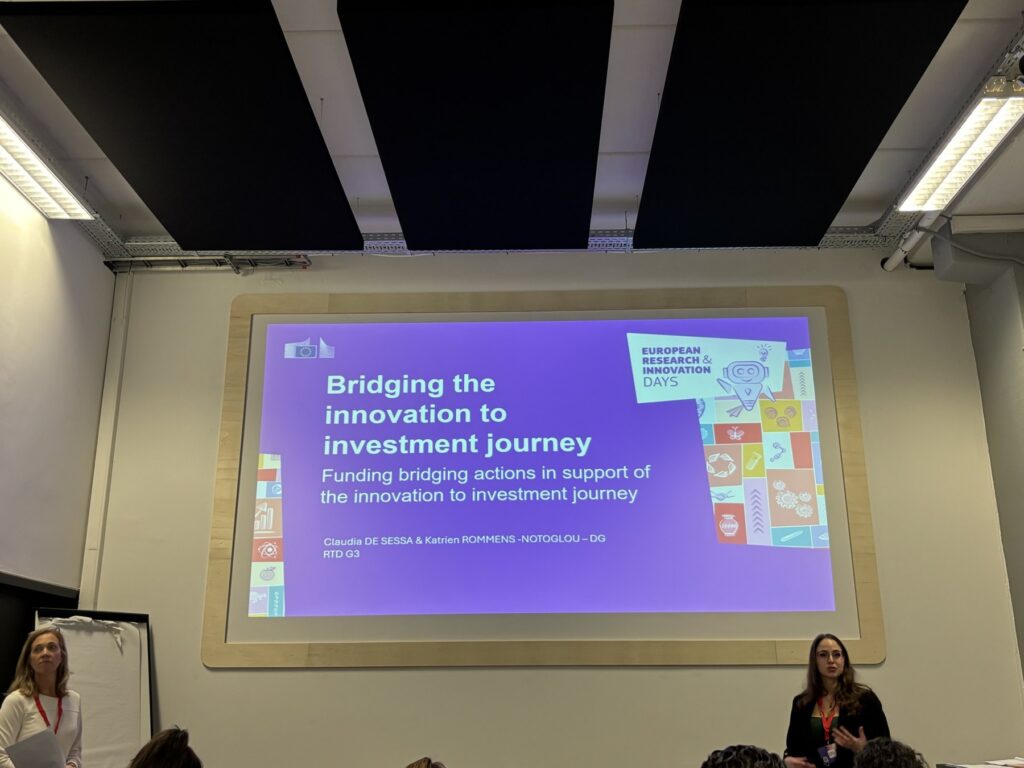
DG RTD session “Bridging the innovation to investment journey” at the European Research & Innovation Days 2026.
Why this matters now: what we heard at R&I Days
The Bridging calls arrive while the next framework programme is being negotiated. Two statements from the closing sessions of R&I Days set the context.
Speed. Commissioner Ekaterina Zaharieva said it currently takes about eight months to evaluate a proposal and sign the grant agreement, and eleven months for the EIC Accelerator, calling this “definitely not acceptable”. She added that in some parts of the programme success rates are as low as 4%, “not because we don’t have excellent proposals”.
Ambition. Christian Ehler, the European Parliament’s lead negotiator on the next framework programme, argued that research must be at the centre of the next EU budget:
“This time we need to be clear, it’s research, stupid.”
Christian Ehler, Member of the European Parliament, R&I Days 2026
Zaharieva also announced that the Commission plans to propose the European Research Area Act at the beginning of December 2026. On 10 November, the Parliament’s industry committee backed its position on the European Competitiveness Fund and a mandate for talks with the Council, as reported by Agence Europe.
For applicants, the message is consistent: the EU wants research results to move faster towards use and investment. The Bridging calls are the first funding instrument built around that logic.
The key topic: HORIZON-BRIDGING-2027-02-05
For most consortia, the most relevant topic is “Advancing promising results from Pillar II collaborative research through the innovation journey”. It funds work that takes an existing Horizon Europe result beyond the research environment.
| Key fact | HORIZON-BRIDGING-2027-02-05 |
| Type of action | Innovation Action, lump sum |
| EU contribution | Up to EUR 2.5 million per project |
| Topic budget | EUR 32.5 million, around 13 projects |
| Call opened | 20 October 2026 |
| Deadline | 28 January 2027 |
| Duration | Maximum 3 years |
| Consortium | Up to 6 independent eligible entities; end users must be beneficiaries |
| Evaluation | Fast Track to Research and Innovation: results within 4 months, grant within 6 months; thresholds of 4 per criterion, 12 overall |
| Extra | Eligible proposals above all thresholds receive a STEP Seal |
A proposal must start beyond the lab or research environment and cover more than one of five areas: validation and testing, commercialisation, scaling and operations, stakeholder and user readiness, and deployment and investment bridging. It needs key performance indicators, a business plan or exploitation strategy, and a first deployment in the EU or an Associated Country.
For Ukrainian organisations, this matters: Ukraine is associated to Horizon Europe, so Ukrainian partners can take part and the first deployment can take place in Ukraine, provided all other conditions are met.
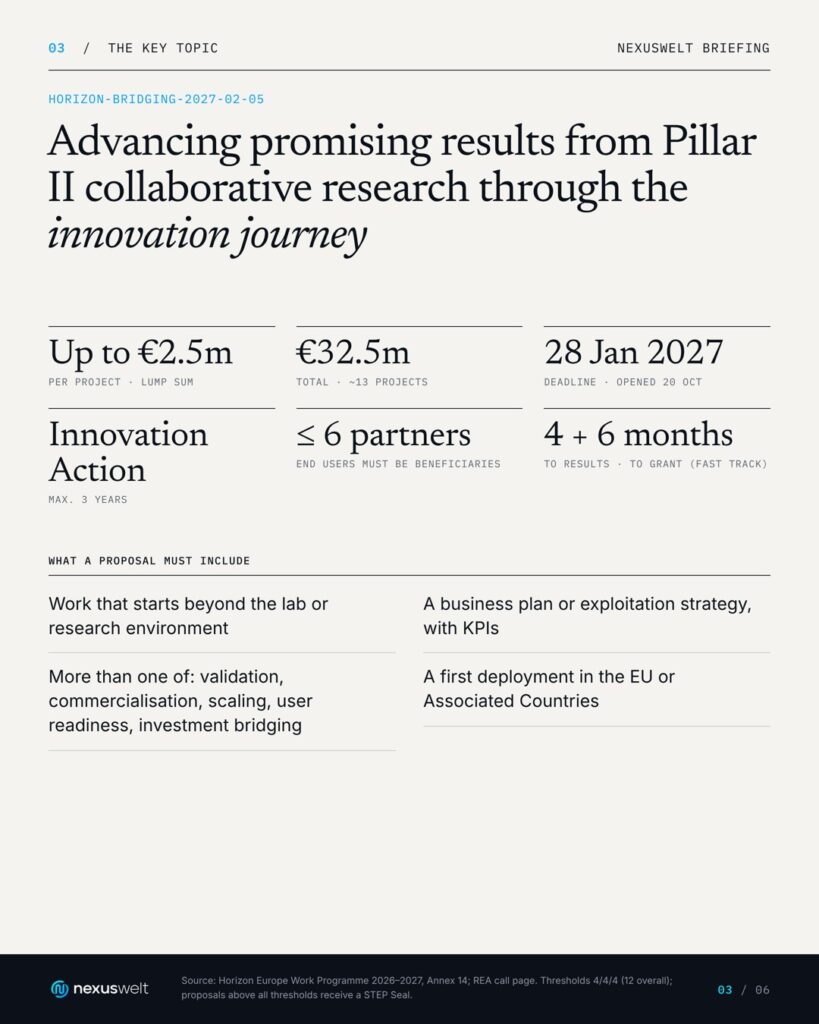
Key facts of topic HORIZON-BRIDGING-2027-02-05.
Does your project qualify?
Eligibility is narrower than many coordinators expect. The work programme sets clear conditions on where the results must come from.
Eligible results
- Results from a completed, multi-beneficiary project funded directly under Clusters 1 to 6 of Pillar II
- The source project was a Research and Innovation Action, Innovation Action or Pre-Commercial Procurement
- The project must be completed before the submission deadline
- Results from several projects can be combined, with one named primary project
- Applicants must prove ownership of, or access to, the results
Not eligible
- Ongoing projects
- Results generated through financial support to third parties (cascade funding)
- Projects funded under a co-funded European Partnership or a joint undertaking
- Entities controlled from China
Readiness: proposals based on results from Clusters 3 to 6 start at TRL 6. Results from Clusters 1 and 2 must start beyond the lab environment.
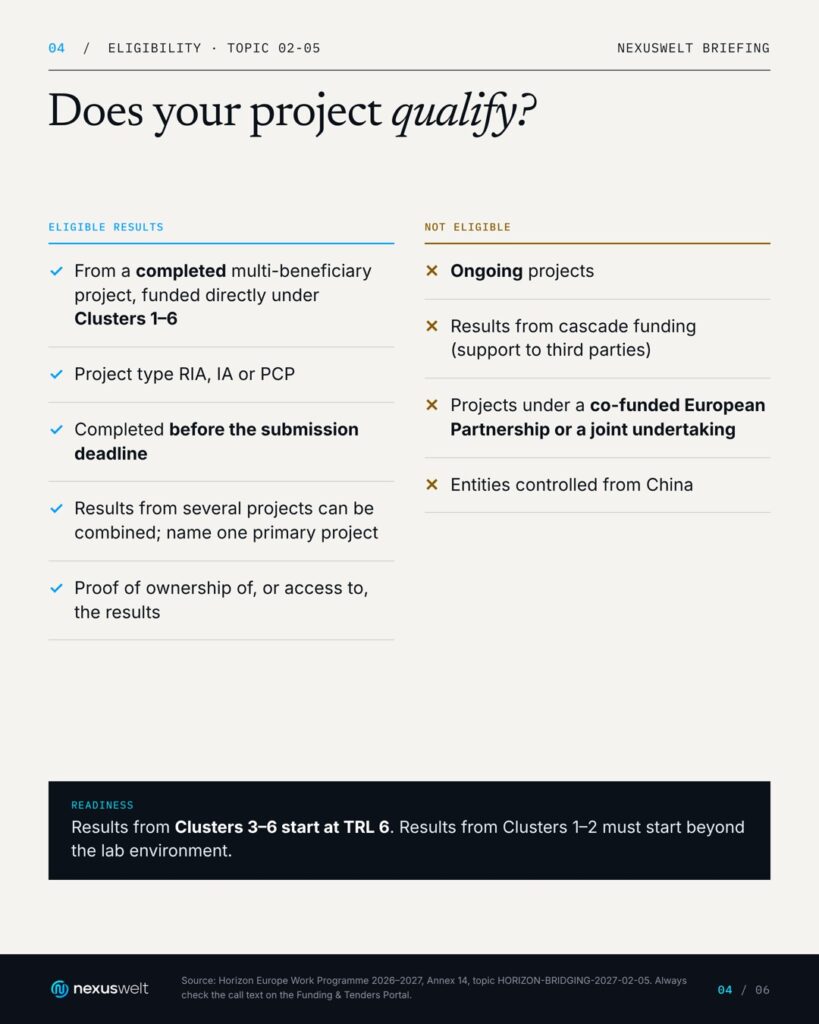
Eligibility conditions for HORIZON-BRIDGING-2027-02-05.
Five more Bridging topics to know
The Bridging call includes further topics with different formats and audiences. Dates and budgets below are taken from the work programme and are indicative.
| Topic | Type | Budget | Deadline |
| 2027-06-02 Valorising Horizon results via innovation ecosystems | RIA | EUR 2.5–4m per project, 5 projects | 16 Feb 2027 |
| 2027-05-01 Skills for innovative SMEs | CSA | EUR 30m topic | 3 Mar 2027 (opens 1 Dec 2026) |
| 2027-04-03 Climate preparedness and resilience solutions closer to the market | CSA | EUR 20m topic | 16 Feb 2027 |
| 2027-03-06 Research infrastructure services for industry needs | RIA | Around EUR 5m per project, 3 projects | 15 Jun 2027 (opens 9 Mar 2027) |
| 2027-01 Apply AI topics (media platform, autonomous driving cities, energy platforms, frontier AI) | IA / RIA | EUR 10–15m per project | 16 Feb 2027 |
Topic 06-02 works differently from 02-05: knowledge intermediaries such as technology transfer offices, incubators and clusters run open calls for owners of Horizon results, with up to EUR 150,000 per supported third party and at least 60% of the EU contribution passed on in this way.
Five checks before you apply
Based on the call conditions and our work with consortia on exploitation planning, these are the questions to answer before writing a single page:
- Is the source project finished in time? It must be completed before 28 January 2027 and funded directly under Clusters 1 to 6.
- Who owns the result? Secure ownership confirmation or an access commitment letter now, not in January.
- Which end user joins as a beneficiary? The topic requires end users inside the consortium, testing the solution in a real setting.
- Where is the first deployment? Define the site and the KPIs that will prove the solution works.
- What comes after the grant? Name the investor, customer or next public funding step that takes the result further.
What Bridging tells us about FP10
The Bridging actions are small in budget compared with the rest of Horizon Europe. Their design is the more important signal: lump sums, fast evaluation, end users as partners, mandatory business plans and a link to the future European Competitiveness Fund. Coordinators who learn to build proposals around the innovation to investment journey now will be better prepared for the next framework programme, whatever its final structure.
Our focus at Nexuswelt: from visibility to value
For many years, EU projects were judged largely by how widely they communicated their results. Communication still matters, but it is only the first step. The direction from Brussels is now clear: Europe invests in research to see it used, in products, services, public solutions and follow-on investment.
This is why Nexuswelt has shifted its focus from communication and visibility towards commercialisation and impact. In practice, that means three things:
- Exploitation strategy: business plans, IP and ownership arrangements agreed from the start of a project, not in its final months.
- Funding pathways: Bridging actions, follow-on calls and national or regional routes that carry results beyond the end of the grant.
- Uptake partners: end users, industry and investors brought into the consortium early, so validation happens in real settings.
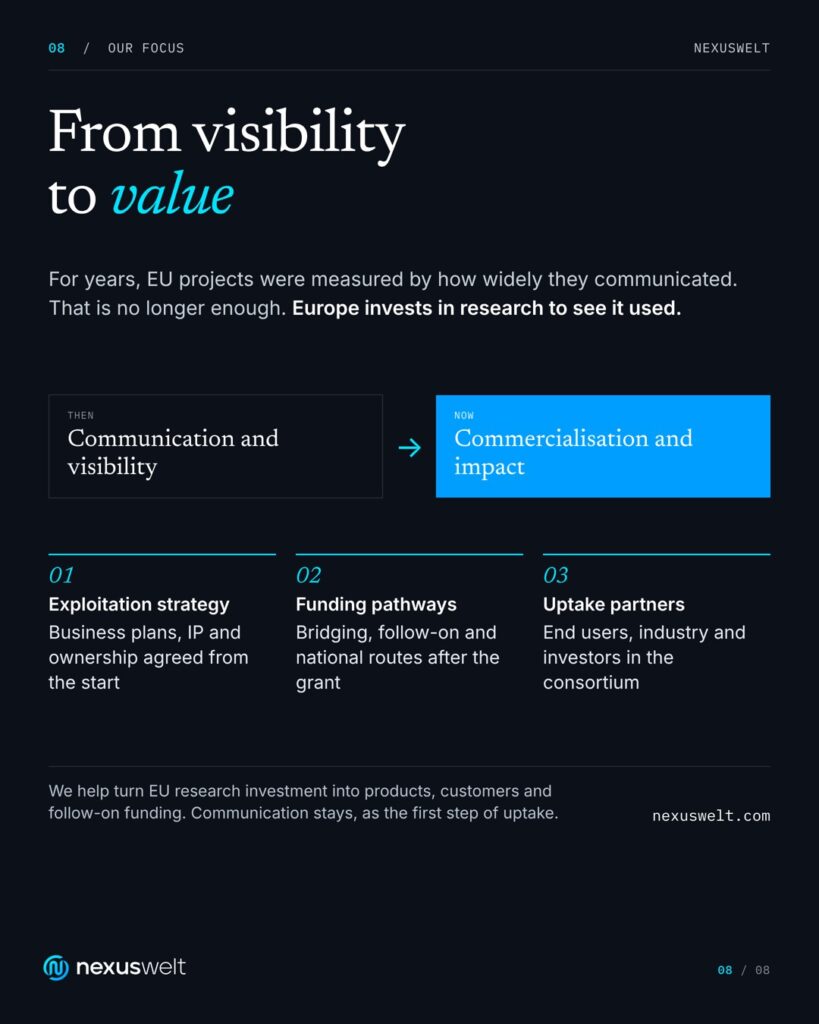
Nexuswelt focus: from communication and visibility to commercialisation and impact.
If you have a completed Horizon Europe project with results worth taking further, Nexuswelt can help you assess eligibility and shape the exploitation and deployment logic of a Bridging proposal. Contact Anna Lackner at anna.lackner@nexuswelt.com.