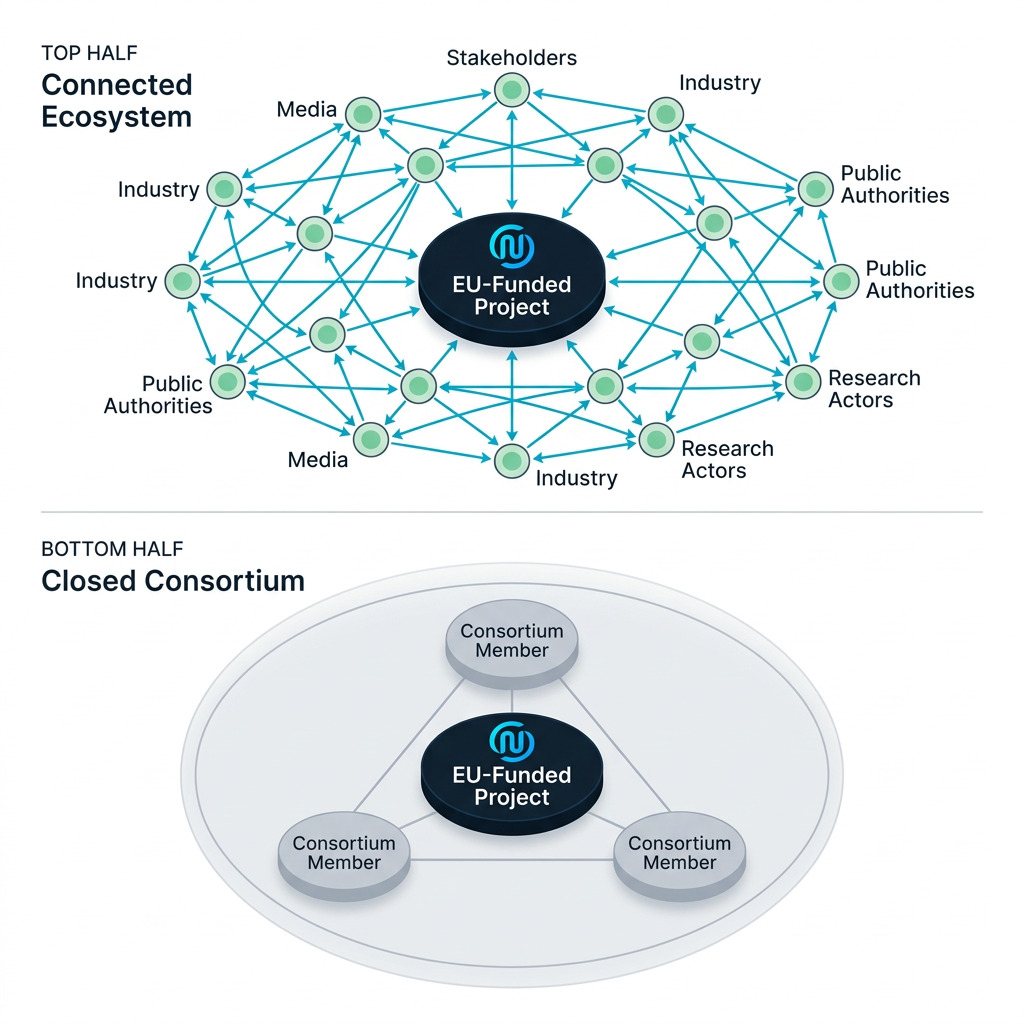
 In EU funding, visibility is not a “nice-to-have”; it is an obligation and an impact lever. Under Horizon Europe grant conditions, beneficiaries must proactively promote actions and results to multiple audiences “in a strategic, coherent and effective manner” and apply visibility requirements (EU emblem, funding statement, disclaimer), with potential consequences for non-compliance. In a programme where ~70% of proposals can be rated “excellent” yet only ~16.5% are funded, attention is scarce even after you win. The difference between a “visible” and an “invisible” project is rarely the innovation itself; it’s the execution of narrative, stakeholder journeys, channels, and measurable communication-and-exploitation systems.
EU programmes treat communication, dissemination, and exploitation as distinct (but connected) pathways to impact. European Research Executive Agency frames dissemination as sharing results with the audiences who can use them (science, industry, civil society, policymakers) and exploitation as using results to create products/services/processes or shape policy impacts.
This matters because visibility is not explained by “novelty” alone; it is shaped by (a) legal and programme expectations, (b) fierce competition for attention, and (c) the maturity of a project’s communication system.
Legally, beneficiaries must promote the action and its results through targeted information to multiple audiences and follow visibility rules (EU emblem, funding statement, disclaimer), with a grant-reduction risk for breach.
Strategically, the ecosystem is crowded: a single set of European Commission calls managed by REA attracted 3,422 proposals in 2025, with some calls seeing very steep year-on-year growth.
Operationally, the Commission and executive agencies publish toolkits precisely because many projects struggle to translate results into public and stakeholder uptake. For example, European Climate, Infrastructure and Environment Executive Agency launched a Communication Toolkit that explicitly covers planning, messaging, monitoring, and “golden rules” for EU visibility.
Competitor positioning on LinkedIn aligns with this. Zabala Innovation Europe explicitly markets “Impact section” strength as decisive and highlights the need to link dissemination, exploitation and uptake to competitiveness. Innovation Dis.Co publicly frames “campaigns, visibility, storytelling, stakeholder engagement” as the mechanism to prevent innovation from “staying inside reports,” and connects visibility work to exploitation tooling.
Why innovation quality alone doesn’t guarantee visibility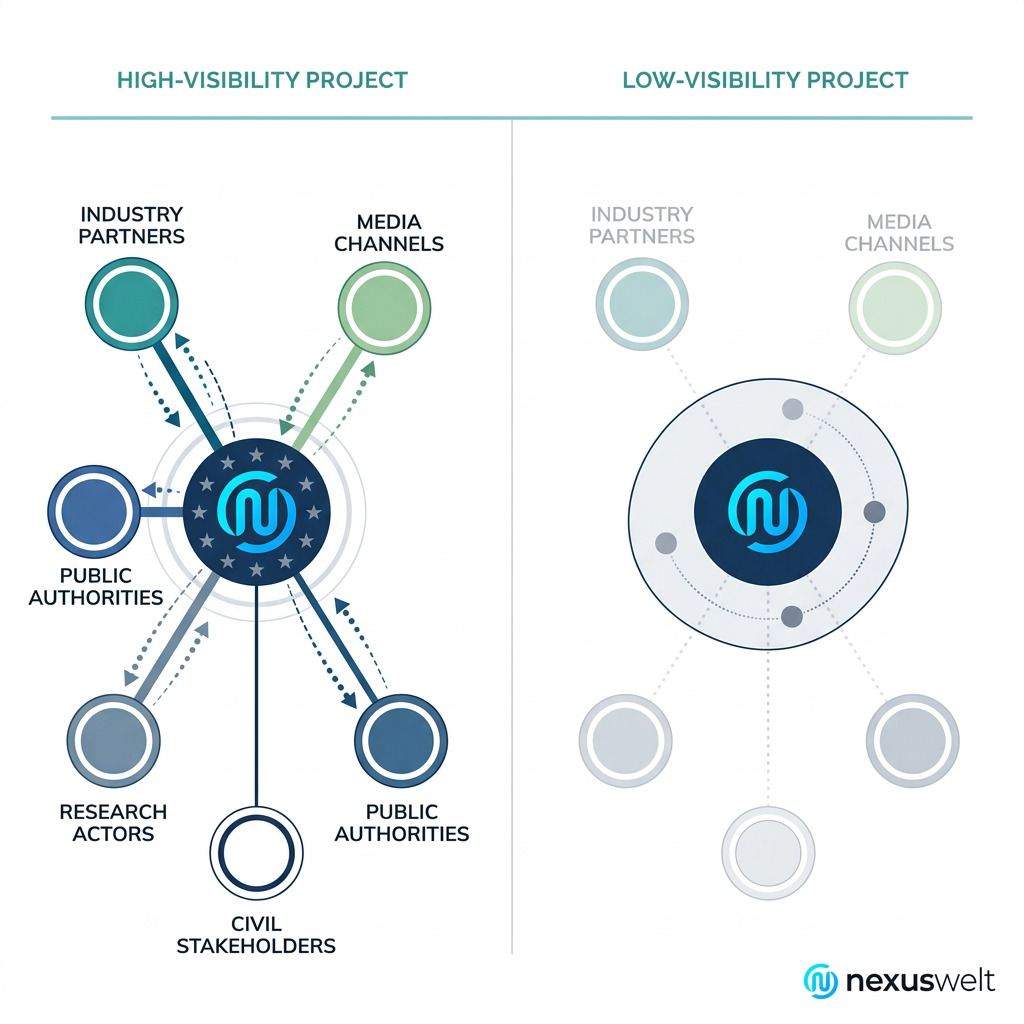
EU programmes are designed to fund excellence, but excellence is not the same as visibility. Three structural forces explain why “good innovation” frequently stays “invisible” unless a project builds a deliberate communication-and-uptake engine.
First, oversubscription compresses attention. In the Commission’s own interim evaluation material, the first three years of Horizon Europe funded over 15,000 projects (over €43bn), and only a minority of applications succeed (the document cites a ~16% success rate, with many high-quality proposals unfunded due to budget limits). In parallel reporting, the ecosystem notes that demand exceeds available funding: a large share of proposals can be “excellent,” yet only a fraction are funded. In practice, that means post-award competition is also intense: your project competes not only with non-funded projects, but with thousands of funded initiatives publishing results, running events, and seeking the same policymakers, adopters, investors, media narratives, and consortium opportunities.
Second, EU projects are contractually accountable for communication quality and visibility mechanics. Article 17 in the Horizon Europe unit model grant agreement requires beneficiaries to promote the action and its results via targeted information to multiple audiences (including media and the public) in a strategic, coherent and effective manner, and to comply with EU visibility rules (emblem, funding statement, disclaimer). This shifts visibility from “marketing optional” to “delivery risk”: a technically strong project can still underperform on impact if the consortium cannot evidence credible dissemination and exploitation pathways.
Third, stakeholder uptake is a design and governance problem, not a communications afterthought. Evidence from an open-access scoping review on stakeholder engagement in EU climate and energy research finds that engagement terminology is often undefined or used inconsistently, and argues for more standardised engagement practices to improve impact; it also shows workshop-based co-design can surface policy-relevant priorities. In other words, visibility flows from participation architecture (who is engaged, when, and how) and from how results are translated into stakeholder-useful formats. The same logic appears in EU monitoring and evaluation frameworks that treat citizen/end-user engagement and oversubscription as indicators, reflecting the Commission’s system-level view that uptake is not automatic.
The practical implication: two projects can be equally innovative, but the visible one behaves like a publisher, coalition-builder, and product manager for knowledge—measuring reach, engagement, and uptake, and iterating its narrative and channels accordingly.
Mini-case studies of visibility outcomes
Mini-case study one: “Visibility at scale” through cultural and public hooks (LIFE communication example)
In the CINEA communication toolkit, LIFE communication examples emphasise building mass visibility through recognisable public hooks and external amplification (e.g., ambassadors, public-facing campaigns) rather than relying on technical reporting alone. The toolkit is explicitly designed to help beneficiaries plan, implement and evaluate communication, and illustrates “success stories” to inspire replication.
Tactics extracted: use a “story-first” frame, recruit credible third-party voices, and translate outcomes into public narratives aligned with EU priorities.
Outcome pattern: the project is discussed beyond the consortium ecosystem—media, citizens, and policy stakeholders become part of dissemination, creating a multiplier effect.
(Note: the official toolkit PDF is referenced on CINEA’s site; some public copies exist, but use the official landing page as the authoritative reference.)
Mini-case study two: “Trust transfer” via testimonials and ambassadors (CINEA toolkit example)
The CINEA toolkit contains an explicit lesson: testimonials and recognised ambassadors can materially strengthen dissemination campaigns, because they lend legitimacy and memorability for audiences outside the technical community.
Tactics extracted: plan testimonials as distribution assets (quotes, short videos, event appearances), recruit ambassadors who match the audience (e.g., sport/public figures for citizen-facing mobility), and bake those assets into an editorial calendar rather than treating them as one-off PR.
Outcome pattern: higher “shareability” and partner amplification (stakeholders distribute because it’s reputationally safe and emotionally resonant), which is crucial in crowded EU innovation landscapes.
Mini-case study three: “Solid reporting, modest visibility”—when communications stays mostly inside project channels (H2020 example)
A Horizon 2020 deliverable from the MIND STEP project reports substantial web activity—6,414 sessions (month 23–40), 12,495 page views, and average session duration ~1:11. Yet its LinkedIn presence remained relatively small: 120 followers as of December 2022, with 48 new followers over a year; top posts reached around 1,274 impressions each.
Tactics observed: consistent channel set-up (website, social profiles, repositories), periodic newsletters, and reporting of analytics.
Visibility constraint: the reported metrics suggest a communications system that reaches engaged niche professionals but may struggle to break into wider stakeholder ecosystems without additional amplification tactics (media partnerships, ambassador assets, stronger “policy-to-practice” packaging, or paid distribution). That is a common pattern in technical projects when dissemination is treated primarily as “outputs published” rather than “audiences mobilised.”
Tactical recommendations and KPI system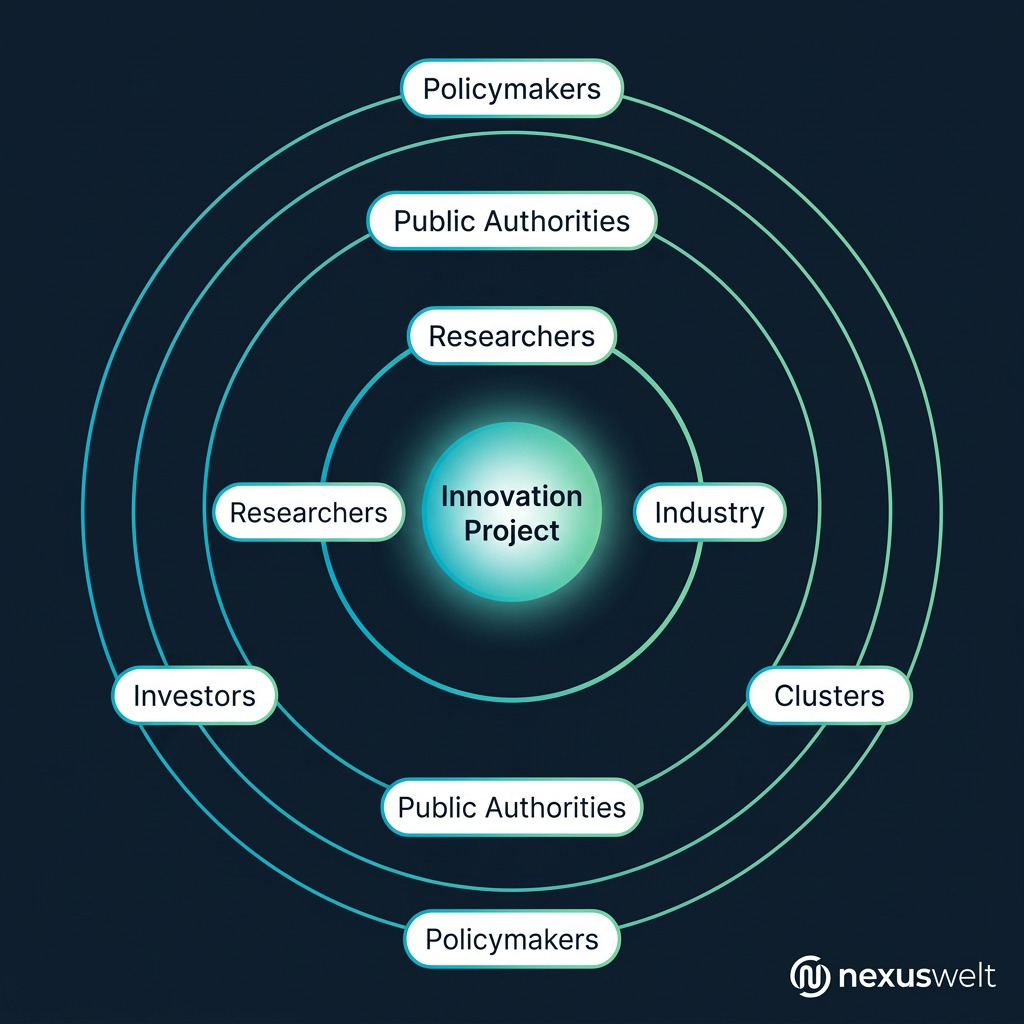
Below are 10 tactical recommendations designed for EU project coordinators, research managers, and innovation managers. They are written to be immediately usable for a Communication, Dissemination and Exploitation Plan (CDEP) and to align with Horizon Europe expectations on proactive, multi-audience promotion and visibility.
Start communications on day zero, not month six
Because promotion is an obligation and major-visibility activities may require notifying the granting authority, your communication system should be ready before the kick-off: website skeleton, stakeholder map, and baseline KPIs.
Build a stakeholder journey map, not just a stakeholder list
Move from “who exists” to “what decision/action do we need from them, and what evidence format will enable that?” This is consistent with EU framing of dissemination audiences (industry, policymakers, civil society) and with research emphasising the need for more robust, standardised stakeholder engagement practices.
Use a narrative spine that links policy priorities -> problem -> intervention -> measurable change
Competitor messaging emphasises policy alignment and linking dissemination/exploitation to real-world uptake; this is also aligned with EU expectations that projects support political priorities and create societal/economic value.
Treat the project website as an “impact product” (with conversion paths)
Many projects have websites; fewer have conversion paths (newsletter sign-up, stakeholder onboarding, event registration, “adopter pack” downloads). Your website should support stakeholder actions, not only publish deliverables. Analytics in projects like MIND STEP show what can be measured (sessions, pageviews, duration); use that to diagnose whether the site actually moves stakeholders forward.
Design assets for re-use: three “packaged results” per major work package
For each major result, produce: (a) a one-page “stakeholder brief,” (b) a slide deck / short native document for LinkedIn, and (c) an implementation or adoption note (for pilot users / policymakers). The CINEA toolkit explicitly pushes beneficiaries to craft impactful messages and choose channels with intent.
Use ambassadors and third-party validators when you need reach beyond the consortium bubble
CINEA’s toolkit highlights the role of testimonials/ambassadors in dissemination success stories; competitors also frame storytelling and stakeholder engagement as what keeps innovation from remaining trapped in reports.
Choose KPIs that capture uptake, not vanity
Minimum KPI set (quarterly):
– Reach/impressions by channel; engagement rate by impressions; follower growth; website sessions and key page conversion rates; stakeholder sign-ups; event registrations and attendee composition; media mentions; “exploitation pipeline” indicators (inquiries, pilots initiated, MoUs, standardisation steps). This aligns with agency toolkits that stress monitoring and evaluation, and with Horizon Europe’s broader monitoring logic around uptake and engagement.
Budget allocation: ring-fence funds for distribution, not only production
If you produce assets but lack budget/time to distribute (partner activation, PR, paid boosts, translations), visibility will lag. Paid reach is auction-based and varies by targeting, but benchmarks indicate material costs per thousand impressions; plan realistically.
Exploit “EU channels” and “EU credibility” as multipliers
The EU offers infrastructure like Horizon results repositories and dissemination/exploitation services; these are designed to bridge stakeholders and results. Use them as credibility multipliers rather than relying solely on your own website.
Governance: create a comms-and-uptake operating system
Assign a single editorial owner, a monthly content council (WP leaders + exploitation lead), and a quarterly “impact review” where you prune channels, double down on best formats, and adapt to stakeholder signals. This is consistent with toolkits that recommend planning and evaluation cycles rather than one-off communications.
What is project visibility in Horizon Europe?
Project visibility in Horizon Europe refers to how effectively a funded project communicates its objectives, activities, and results to target audiences, while meeting EU visibility obligations.
Why is communication important in EU-funded projects?
Communication is important because Horizon Europe requires beneficiaries to promote the action and its results strategically, coherently, and effectively to multiple audiences.
What is the difference between dissemination and exploitation?
Dissemination focuses on sharing project results with audiences that can use them, while exploitation means applying those results in products, services, processes, or policy impact.
Why do innovative projects still struggle with visibility?
Because visibility depends not only on innovation quality, but also on narrative, stakeholder engagement, communication systems, distribution, and measurable uptake.
Need stronger visibility, dissemination and exploitation support for your EU project? Nexuswelt helps consortia turn research results into strategic communication, stakeholder engagement and measurable impact.
Official external links to add in the blog
#HorizonEurope
#EUProjects
#EUFunding
#ProjectVisibility
#Dissemination
#Exploitation
#StakeholderEngagement
#ResearchImpact
#InnovationManagement
#CommunicationStrategy
#Cluster2
#Cluster6
#EUInnovation
#ResearchCommunication
#ImpactStrategy
#EuropeanProjects
#KnowledgeTransfer
#ProjectManagement
#ScienceCommunication
#EUPolic