A Comprehensive Guide to Communication, Dissemination and Exploitation in Horizon Europe Across All Clusters
Context and relevance
In Horizon Europe, communication, dissemination and exploitation (CDE) are no longer treated as supportive or horizontal activities. Across all clusters and action types, they are assessed as impact-enabling mechanisms that demonstrate whether project results can realistically create value beyond the consortium.
For the 2025–2027 Work Programme period, including 2026 calls, evaluators and REA services consistently emphasise that CDE must be designed around results and outcomes, demonstrate clear pathways to uptake and use, extend beyond the project lifetime, and remain coherent with EU policy priorities and societal needs.
Projects with strong scientific or technical content but weak CDE logic are increasingly penalised, not because of missing activities, but because of missing credibility.
Communication: explaining why the project matters
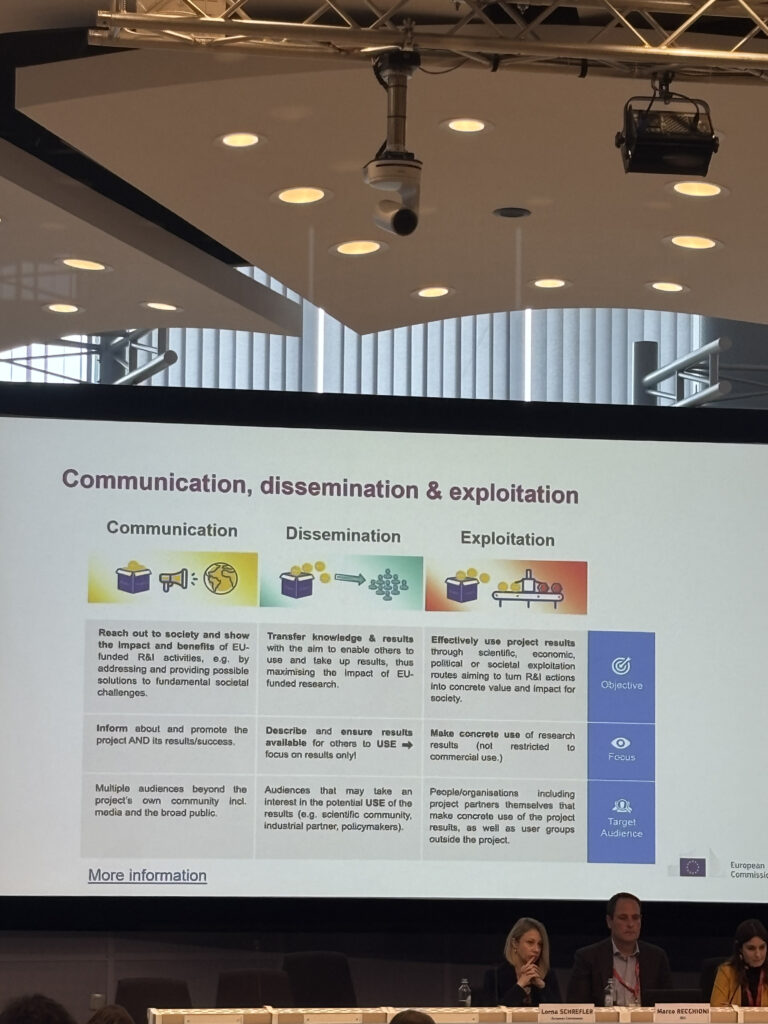
Communication addresses society at large. Its purpose is to explain why the project exists, which societal or policy challenge it addresses, and why EU funding is justified.
Communication is not about technical depth. It is about clarity, accessibility and relevance for non-specialist audiences.
Typical communication outputs include project websites and public-facing content, social media and press engagement, and policy-oriented narratives linked to EU strategies. Evaluators assess communication based on purpose and coherence, not volume.
Dissemination: enabling others to use results
Dissemination targets audiences capable of using project results, such as scientific communities, industry and value-chain actors, and policymakers or standardisation bodies.
Dissemination is result-driven, not activity-driven. Evaluators expect clearly identified results, specific and justified target audiences, appropriate channels, and timing aligned with result maturity.
A list of conferences or journals without explaining what is disseminated and why is a recurring weakness.
Exploitation: turning results into concrete use
Exploitation concerns the actual use of project results, including industrial or commercial uptake, integration into public services or policy instruments, contribution to standards or regulatory frameworks, and societal or environmental applications.
Commercialisation is not mandatory. Use is.
Evaluators look for realistic exploitation pathways, clear partner roles, continuity beyond the project end, and alignment with the nature of the action.
CDE as an impact credibility test
Horizon Europe requires a draft dissemination, exploitation and communication plan at proposal stage as an admissibility condition, unless explicitly stated otherwise. This signals that CDE is a precondition for impact credibility.
Evaluators expect CDE measures to be proportionate, feasible within consortium capacities, and coherent across the full project lifecycle.
Target groups and pathways, not tools
A strong CDE strategy starts with identifying who should use the results, why they would do so, and what changes as a result. Only then should tools and channels be selected.
Projects that start with tools instead of use pathways are systematically weakened under the Impact criterion.
Open science, gender and SSH as CDE enablers
CDE is closely linked to open science practices, the gender dimension in research and innovation content, and the integration of social sciences and humanities where required by the topic.
When addressed convincingly, these elements strengthen dissemination and exploitation potential and are evaluated positively.
Common weaknesses seen by evaluators
Confusion between communication, dissemination and exploitation; activities not linked to results or users; overloading proposals with channels; vague exploitation statements; ignoring post-project impact; weak policy relevance; reuse of generic CDE text.
Practical action checklist for applicants
Define results first; separate communication, dissemination and exploitation objectives; identify and justify target groups; describe use, not only sharing; align timing with maturity; integrate cross-cutting requirements; plan beyond project end; validate against evaluator descriptors.
How Nexuswelt supports CDE across all clusters
Nexuswelt supports Horizon Europe applicants and consortia in designing evaluator-oriented, implementation-ready CDE strategies applicable across all clusters and action types.
The approach focuses on translating results into credible impact pathways, structuring communication, dissemination and exploitation in line with evaluator logic, ensuring policy relevance, and supporting implementation beyond the project lifecycle.