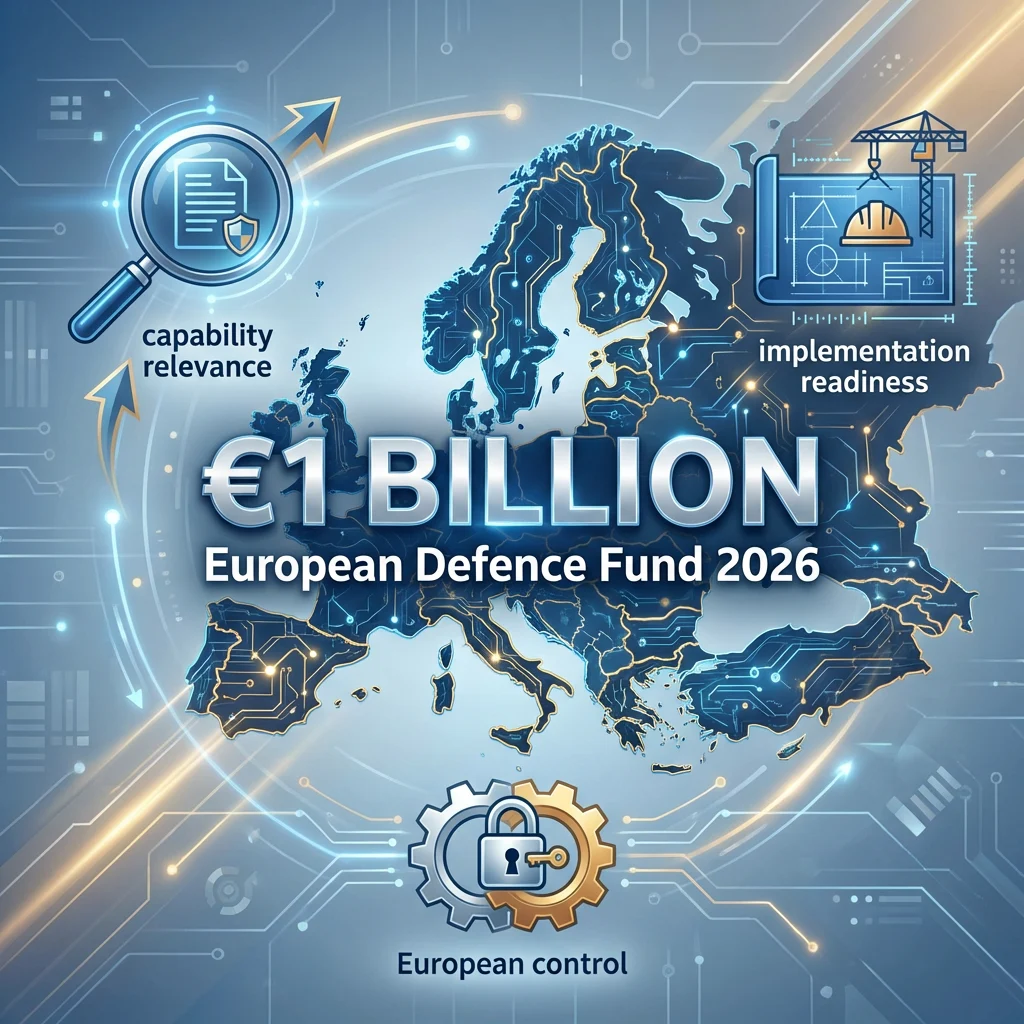
The European Defence Fund (EDF) 2026 Work Programme mobilises around €1 billion to support collaborative defence research and development in Europe. With 10 calls and 31 topics and a single submission deadline on 29 September 2026, EDF requires applicants to demonstrate capability relevance, European control, and implementation readiness under strict eligibility and security constraints.
In this context, the European Commission’s official EDF Info Days 2026 (10–11 March 2026, Brussels and online) are the key public milestone for applicants to interpret call priorities, confirm eligibility assumptions, and build consortia through matchmaking and pitch sessions. Nexuswelt will participate online to support coordinators and partners with evaluator-oriented proposal readiness and consortium-building discussions.
Context and relevance
EDF is not a general innovation programme. It is an EU instrument to strengthen the European Defence Technological and Industrial Base (EDTIB), reduce critical dependencies, and accelerate capability-relevant R&D. This shapes evaluator expectations: proposals must be technically credible, capability-driven, and demonstrably ‘European-controlled’ in governance and exploitation. Security of supply, ownership/control, and handling of sensitive information are treated as core design constraints, not administrative annexes.
EDF 2026 headline figures:
- Total budget: approximately €1 billion.
- Calls for proposals: 10.
- Funding topics: 31.
- Call opening: 11 February 2026.
- Single submission deadline: 29 September 2026 (17:00 Brussels time).
- EDF Info Days 2026 (hybrid): 10–11 March 2026 (Brussels and online).
Core explanation
EDF 2026 priorities and thematic focus
EDF 2026 addresses strategic capability areas and critical technologies, including air and missile defence, ground and naval combat, digital transformation, space, advanced sensors, defence medical support and CBRN, cybersecurity, and disruptive technologies. Dedicated SME and innovation actions are supported through the EU Defence Innovation Scheme (EUDIS).
Budget logic and funding rates
Funding depends on action type and activity mix. Research activities can be funded up to 100% of eligible costs. Development actions are co-financed at varying rates, with potential bonuses depending on topic conditions, including SME participation and, in some cases, PESCO-related conditions. For lump-sum actions, the budget is assessed ex ante, and implementation discipline (deliverables, acceptance criteria, and milestones) becomes a decisive credibility factor.
Eligibility and consortium requirements
Participation is governed by strict criteria designed to protect EU strategic interests. Typical requirements include:
- Transnational consortium: commonly at least three independent entities established in at least three different EU Member States and/or EDF-associated countries (e.g., Norway). Some disruptive technology topics may allow fewer participants.
- Establishment and control: participating entities must be established in the EU or Norway, have executive management in the EU, and not be controlled by a non-associated third country unless exceptional conditions and guarantees apply.
- Security and IP: robust procedures for handling sensitive information; foreground IP and exploitation pathways must remain under European control, free from third-country restrictions.
Evaluation logic mapped to excellence, impact, implementation
EDF proposals are assessed using a structured award-criteria framework and a 0–5 scoring scale (half points possible). Competitiveness is driven by the overall pattern of strengths and weaknesses. In practical terms, proposals must ensure traceability: topic requirements translate into objectives, which translate into work packages, deliverables, milestones, KPIs and exploitation pathways.
Evaluator-oriented interpretation:
- Excellence: capability relevance, technical credibility, measurable performance targets, and (for disruptive topics) step-change potential.
- Impact: contribution to EDTIB autonomy, security of supply, interoperability, and credible exploitation/uptake under European control.
- Implementation: coherent work plan, governance and decision-making, risk management, realistic resourcing, and test/validation credibility.

Concrete examples evaluators recognise
Use concrete elements that demonstrate implementation readiness and evidence-based progress:
Work package architecture example (adapt to topic):
- WP1 Project management, ethics and security governance (including sensitive information handling model).
- WP2 Requirements, CONOPS/use cases, and system architecture.
- WP3 Core technology development (subsystems; AI/quantum/sensors as relevant).
- WP4 Integration and prototyping (mapped to eligible activity types).
- WP5 Verification, validation and testing (acceptance criteria, test environments, TRL progression).
- WP6 Exploitation, industrialisation and security of supply (European-controlled uptake pathway).
- WP7 Dissemination and communication (defence-appropriate, approval-controlled, and aligned with restrictions).
Examples of proposal KPIs and evidence (select the relevant set for your topic):
- Probability of detection and false alarm rate under representative operational conditions.
- Latency, throughput, and availability in contested or degraded environments.
- Accuracy and robustness against spoofing, jamming or adversarial interference (where applicable).
- Interoperability compliance: interface standards, data models, integration constraints.
- Reliability metrics such as mean time between failures and maintenance burden assumptions.
- Security-of-supply indicators: number of European suppliers for critical components, dual sourcing, lead time and substitution plans.
EDF Info Days 2026: why the event matters for applicants
The EDF Info Days 2026 event is structured to support both interpretation and consortium formation. Day 1 provides call presentations and application guidance. Day 2 focuses on matchmaking and pitch sessions aimed at forming competitive consortia. Nexuswelt will participate online and is available for structured proposal readiness exchanges during and immediately after the event.
Practical way to use the event (online participation):
- Arrive with a short topic shortlist and a one-page capability storyline, not only a technology description.
- Prepare a partner gap list (integration, test/validation, supply chain, end-user link where permissible).
- Use 10–15 minute conversations to validate consortium fit and agree concrete next steps (roles, technical ownership, drafting responsibilities).
- Capture evaluation-critical inputs: required KPIs, test environment assumptions, TRL targets, and exploitation constraints.
Common mistakes and pitfalls evaluators frequently criticise
- Topic mismatch disguised as broad narrative: interesting technology without direct alignment to expected outcomes.
- Vague performance claims: no quantified KPIs, baselines, test conditions or success thresholds.
- European control treated as administrative: weak ownership/control, IP governance, export restriction and security narrative.
- Exploitation described as dissemination: no credible uptake pathway into European-controlled industrial or capability routes.
- Work plan not aligned with development reality: missing integration logic, shallow verification/validation, unclear demonstration conditions.
- Consortium assembled for eligibility rather than delivery: unclear technical ownership, duplicated roles, token SME participation.
- Risk management presented as a template: no probability/impact logic, mitigation owners, decision gates and contingencies.

Practical action plan and checklist
A proposal-ready sequence that fits EDF timelines and evaluator expectations:
- Translate the topic text into a requirements sheet (expected outcomes, constraints, mandatory activities, TRL assumptions).2.
- Draft a one-page capability story (use cases/CONOPS, users, mission constraints, interoperability needs, success conditions)
- Define an evidence-first KPI framework (8–12 KPIs with baselines, targets, methods, and demonstration context)
- Design the work plan to prove progress (WPs, milestones, deliverables with clear acceptance criteria).
- Build the consortium around delivery logic (integrator capability, SMEs with technical ownership, RTOs for validation, supply chain competence).
- Engineer European control into governance and exploitation (IP model, access control, restrictions, security-of-supply approach).
- Make implementation readiness visible (decision gates, integration cycles, V&V campaigns, resourcing realism).
- Use EDF Info Days 2026 for targeted matchmaking (validate partner fit and close gaps quickly).
- Run a mock evaluation against award criteria and fix the weakest-scoring sections first.
- Perform a final traceability check (topic → objectives → tasks → deliverables → KPIs → exploitation).
How Nexuswelt supports
Nexuswelt supports EDF applicants with an evaluator-oriented approach focused on policy alignment, technical credibility and implementation readiness:
- KPI systems connecting objectives, deliverables, milestones and demonstrations (evidence-based progress).
- Impact and exploitation planning under European control (EDTIB autonomy, security of supply, uptake pathways).
- Defence-appropriate dissemination and communication planning (approval-controlled, restriction-aware).

References and sources used
- EDF Info Days 2026 official event platform page (10–11 March 2026, Brussels and online)
- #EDF2026 #EDFInfoDays #EUDIS #DefenceInnovation #EDTIB #EUFunding #DefenceTech #ConsortiumBuilding #ProposalStrategy #SecurityOfSupply #DGDEFIS