Munich, 7 September 2026 · Nexuswelt Group
Yes — a startup can apply for Horizon Europe without a consortium, but only through a small number of specific routes.
This is the question that decides whether a founder spends the next three months writing a proposal or building a network, so it is worth answering precisely rather than reassuringly. Below: which doors are genuinely open to a single applicant, why most of Horizon Europe is not, and the three confusions that produce the question in the first place.
Can you apply for Horizon Europe without a consortium?
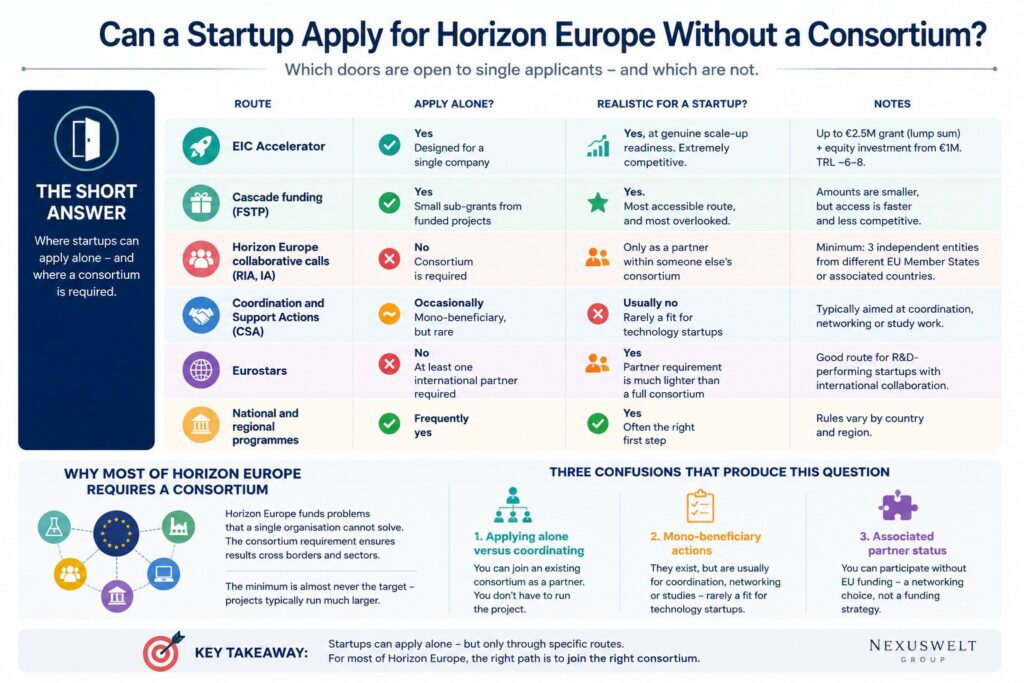
Why most of Horizon Europe requires a consortium
For most collaborative actions the eligibility minimum is three independent legal entities, each established in a different EU Member State or associated country, with at least one established in a Member State. Independent means genuinely independent – subsidiaries of the same parent do not count as separate partners.
This is not administrative friction. The programme funds problems that a single organisation cannot solve, and expects results to travel across borders and sectors. A consortium requirement is the mechanism for that. Reading it as an obstacle to be circumvented usually leads to the wrong instrument.
In practice the minimum is almost never the target. Collaborative projects typically run considerably larger, because the work programme expects coverage of the whole pathway from research through to uptake.
Three confusions that produce this question
1. „Applying alone“ versus „coordinating“
Many founders asking whether they can apply alone are actually asking whether they have to run the project. They do not. Joining an existing consortium as a partner means contributing a defined piece of work – you are not assembling the team, writing the whole proposal or carrying the administrative load. For almost every startup, this is the correct route, and it is considerably lighter than it appears from outside.
2. Mono-beneficiary actions
Some action types can be single-beneficiary – certain Coordination and Support Actions, for example. These exist, but they are usually aimed at organisations doing coordination, networking or study work rather than at a startup developing a technology. Finding one that fits a company’s actual work is rare enough that it is not a strategy.
3. Associated partner status
An organisation can participate in a project as an associated partner without receiving EU funding. This is sometimes suggested as a way in. It is a legitimate arrangement, but it means doing the work without being paid for it from the grant, so it is a networking decision rather than a funding one – occasionally worth it for a first project, rarely otherwise.
EIC Accelerator: the main single-applicant door
The EIC Accelerator is the flagship instrument for a single company: a lump-sum grant of up to €2.5 million for innovation activities at roughly TRL 6 to 8, with equity investment available through the EIC Fund from €1 million upward, in grant-only, blended-finance or equity-only form. The short proposal can be submitted at any time, and the 2026 work programme moved to six full-proposal cut-off dates across the year.
Where founders misjudge it:
- It is not an early-stage instrument. It funds companies ready to scale a validated innovation, not companies hoping funding will get them there.
- Competition is severe, and the evaluation includes a jury interview – a different exercise from written assessment, and one that exposes gaps between the proposal and the company.
- The grant can generally be received only once in the current programme period, so it is not a repeatable funding line.
- For a company outside the EU or associated countries, it is not available without relocating to Europe.
Applying to the EIC Accelerator because you do not want to find partners is the wrong reason, and it produces the applications that fail earliest.
Cascade funding: the route almost nobody uses
Cascade funding – formally, financial support to third parties – is where an already-funded EU project redistributes small grants through its own open calls. The project runs the selection, the application processes are comparatively light, and competition is far lower than for headline instruments.
For a startup with no EU track record, this is usually the fastest legitimate way in. The amounts are modest, and that is not the point: it produces a completed EU-funded engagement, a reference, and contact with a consortium that is already inside the system and will form again for the next call.
The 2026–2027 work programme uses cascade funding more widely than its predecessor, which makes this route better than it has been. Open calls are published by the individual projects rather than centrally, so they are found by watching projects in your field on CORDIS rather than by browsing the portal.
What joining a consortium actually requires
Founders overestimate this consistently. To be a partner you need:
- An eligible registered legal entity and a Participant Identification Code.
- A defined role – specific work you would deliver in a specific work package, with the facilities and methods that back it.
- A one-page profile in English stating what you do, what you have delivered and the role you are seeking.
- Capacity to deliver that work and to meet reporting obligations.
- A relationship with a coordinator, built before the call opens.
You do not need prior EU project experience, a large team, or the ability to write a full proposal. The consortium as a whole is what must demonstrate capability, and pairing a newcomer with an experienced coordinator is a normal, accepted structure.
The binding constraint is the last item on the list, and it is a networking problem rather than a capability problem.
Which route fits you
| Your situation | The realistic route |
| Validated innovation, ready to scale, can withstand a jury interview | EIC Accelerator |
| No EU track record, want to start somewhere | Cascade funding open calls from funded projects in your field |
| Strong technology, no European network | Join a consortium as a partner – start the network work now, target the cycle after next |
| Want collaborative R&D but a full consortium is too much | Eurostars, which needs at least one international partner rather than a full consortium |
| Need money this quarter | National or regional programmes, or non-grant finance. European funding operates on a twelve-month horizon |
| Not sure the technology is ready | Establish your TRL honestly first. It determines everything downstream |
How Nexuswelt works with startups on this
The decision between applying alone and joining a consortium is usually made too late and on the wrong grounds. Nexuswelt works with startups and SMEs on instrument selection, role definition, partner profiles and consortium positioning, and contributes to funded projects as a partner for communication, dissemination and exploitation. The broader introduction is our guide to EU funding for startups, and more on the firm is on the Nexuswelt about page.