Munich, 9 September 2026 · Nexuswelt Group
A Horizon Europe partner profile is the one document that does most of the work when a consortium is forming. It gets forwarded, pasted into partner-search platforms, attached to introductions, and circulated inside organisations you will never speak to directly.
Most organisations do not have one. They have a company brochure, a list of publications, and a website – none of which answers the question a coordinator is asking. This article covers what the profile has to contain, how to write the part that decides everything, and how to use it.
What a partner profile is, and what it is not
| It is not | It is |
| A company brochure describing your excellence | A proposal for a specific role in someone else’s project |
| A list of publications or past projects | Evidence that you can deliver a defined piece of work |
| A capability statement | A role statement, with the capability as support |
| A document about you | A document about what the coordinator gets |
The distinction matters because a coordinator reading twenty profiles before a deadline is not evaluating organisations. They are filling gaps in a work plan. A profile that describes capability leaves them to work out where you fit; a profile that proposes a role has already done that work for them.
The one-page structure
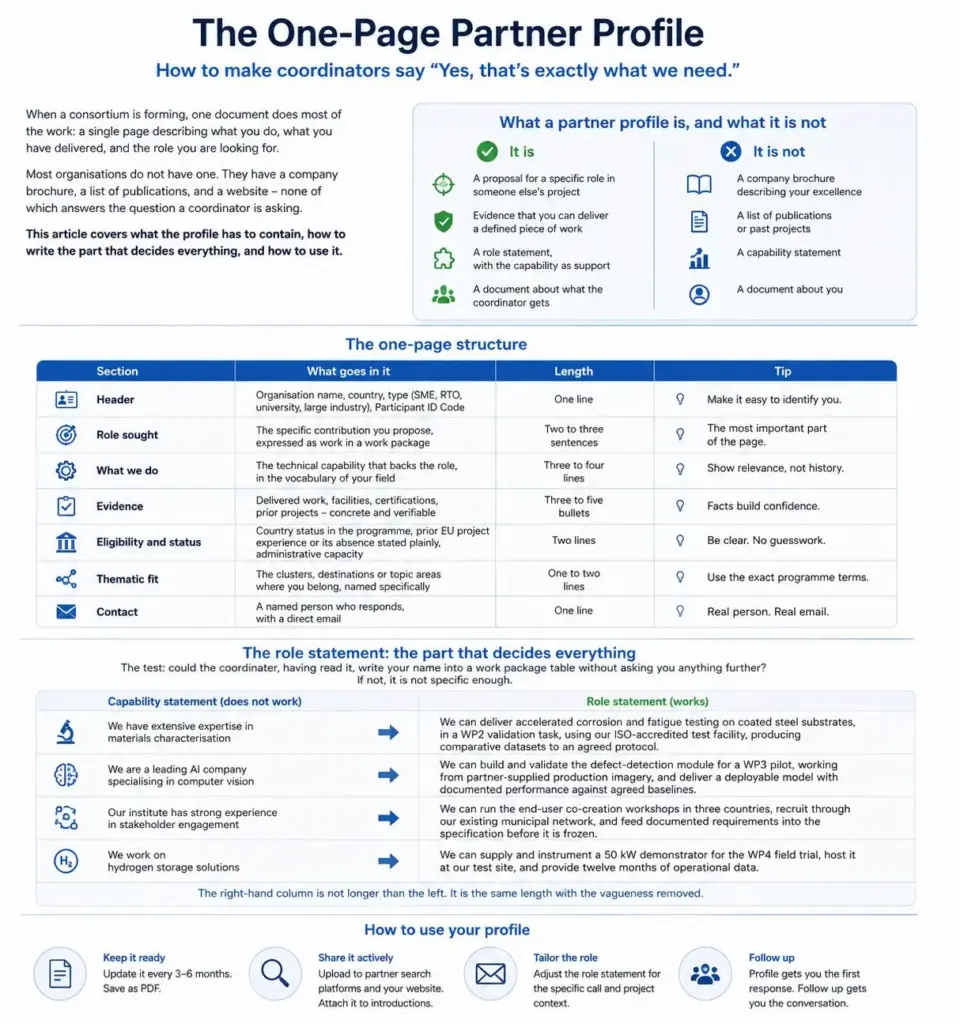
The role statement: the part that decides everything
Everything else on the page is support. This is the section a coordinator reads first and often the only one they read.
The test: could the coordinator, having read it, write your name into a work package table without asking you anything further? If not, it is not specific enough.
| Capability statement (does not work) | Role statement (works) |
| We have extensive expertise in materials characterisation | We can deliver accelerated corrosion and fatigue testing on coated steel substrates, in a WP2 validation task, using our ISO-accredited test facility, producing comparative datasets to an agreed protocol |
| We are a leading AI company specialising in computer vision | We can build and validate the defect-detection module for a WP3 pilot, working from partner-supplied production imagery, and deliver a deployable model with documented performance against agreed baselines |
| Our institute has strong experience in stakeholder engagement | We can run the end-user co-creation workshops in three countries, recruit through our existing municipal network, and feed documented requirements into the specification before it is frozen |
| We work on hydrogen storage solutions | We can supply and instrument a 50 kW demonstrator for the WP4 field trial, host it at our test site, and provide twelve months of operational data |
The right-hand column is not longer than the left. It is the same length with the vagueness removed.
Stating what you do not have
Counterintuitively, naming your limitations strengthens the profile. A coordinator’s fear is not that you lack EU experience – it is that you lack it and do not know it.
- No prior EU project: say so, and say what administrative support arrangement you would put in place. This is a normal, accepted position.
- Small team: state the effort you can realistically commit rather than implying unlimited capacity.
- Non-EU or associated-country status: state it plainly with the eligibility position, so the coordinator does not have to check.
Overstating is the more damaging error. It is discovered during proposal preparation, at the point where replacing a partner is expensive, and it ends the relationship for future calls as well as this one.
The email that carries it
The profile is an attachment. The email is what gets it opened, and most outreach fails here rather than in the document.
A message that gets answered contains:
- The call topic identifier in the subject line, so the recipient knows immediately what this concerns.
- One sentence on why them specifically – a reference to their actual prior work, which signals research rather than a mass mailing.
- Two sentences proposing the role, drawn straight from the profile.
- The deadline and when you need a decision.
- The profile attached, as a PDF.
What sinks it: the same message sent to twenty organisations, approaching three weeks before a deadline, describing your organisation before proposing a role, and any request for payment in exchange for inclusion – which is a recognised warning sign rather than normal practice.
Where the profile circulates
Once written, the same page serves several channels. Publish it on the Funding & Tenders Portal partner search so you are findable against specific topics; give it to your National Contact Point, who can forward it with an endorsement that cold outreach cannot buy; upload it to brokerage event platforms before attending; send it to coordinators identified through CORDIS; and register it with the Enterprise Europe Network.
The National Contact Point route is the most under-used. An introduction carrying an NCP’s implicit endorsement changes how the first message is read.
Common mistakes
- Two pages. Coordinators skim; the second page is not read.
- Opening with organisational history rather than the role.
- Jargon from your own field with no bridge to the call’s language.
- A generic profile sent for every topic, when the role statement should be adjusted for each.
- A general enquiries email address, or a named contact who does not reply within days.
- No Participant Identification Code, which signals that the administrative groundwork has not been done.
- Listing every capability the organisation has, which reads as an inability to identify which one is relevant.
- Writing it during deadline week, when it should already exist and be circulating.
Keeping it current
A profile written once and left alone becomes wrong quickly. Review it whenever a project completes, whenever a facility or certification changes, and before each brokerage event. Maintain one base version and adjust the role statement per topic – the rest of the page rarely needs to change.
The practical point: this document should exist before you need it. Organisations that write it in response to a specific call are already too late for that call, because the consortium formed before the topic was published.
How Nexuswelt works on this
Nexuswelt works with companies and research organisations on the positioning layer: assessing fit against real topics, defining a defensible role, preparing partner-facing material, and building consortium relationships before calls open. The wider treatment of consortium formation is in our guide to building a Horizon Europe consortium, and more on the firm is on the Nexuswelt about page.
Frequently asked questions
What is a Horizon Europe partner profile?
A one-page document describing what your organisation does, what it has delivered, and the specific role it is seeking in a consortium. It is the document that circulates when consortia form – forwarded between coordinators, pasted into partner-search platforms and attached to introductions.
How long should a partner profile be?
One page. Coordinators reading several profiles before a deadline do not read a second page. If the content does not fit, the role is usually not defined tightly enough.
What is the difference between a capability statement and a role statement?
A capability statement describes what your organisation is good at and leaves the coordinator to work out where you fit. A role statement proposes specific work in a specific work package, with the facilities, methods and outputs that back it. The test is whether a coordinator could write your name into a work package table without asking anything further.
Should I mention that I have no EU project experience?
Yes. A coordinator’s concern is not that you lack experience but that you lack it without knowing it. State the position plainly and describe the administrative support arrangement you would put in place. Overstating familiarity is discovered during proposal preparation and ends the relationship for future calls as well.
Where should I publish my partner profile?
The Funding & Tenders Portal partner search, your National Contact Point, brokerage event platforms, the Enterprise Europe Network, and direct outreach to coordinators identified through CORDIS. The National Contact Point route is the most under-used, because an introduction carries an endorsement that cold outreach cannot.
What should the first email to a coordinator contain?
The call topic identifier in the subject line, one sentence on why that coordinator specifically with reference to their actual work, two sentences proposing your role, the deadline and decision timing, and the profile attached as a PDF. Sending an identical message to many organisations is the most common reason outreach fails.
Do I need a Participant Identification Code before making contact?
You should have one. It takes little effort, can be obtained independently of any specific call, and its absence signals to a coordinator that the administrative groundwork has not been done.
Should I adapt the profile for each call?
Adapt the role statement for each topic; the rest of the page rarely needs to change. A single generic profile sent for every topic reads as an inability to identify which of your capabilities is relevant.