Horizon Europe Cluster 6 — Food, Bioeconomy, Natural Resources, Agriculture and Environment — represents one of the most policy-driven and strategically complex clusters within the Horizon Europe Framework Programme. The Cluster is central to delivering the European Green Deal, the Farm to Fork Strategy, the EU Biodiversity Strategy, climate adaptation objectives, and sustainable bioeconomy transformation.
Based on the official European Commission Cluster 6 Info Days and dedicated sessions on lump sum funding, this article consolidates key implementation, budgeting, and evaluation principles that applicants must fully understand in order to remain competitive in 2025–2026 calls.
This guidance is particularly relevant for coordinators, work package leaders, SMEs, research organisations, and public authorities preparing lump sum proposals, which now represent the dominant funding model across Cluster 6.
1. Understanding Lump Sum Funding in Horizon Europe Cluster 6
Lump sum funding fundamentally changes how proposals are assessed, implemented, and monitored. Unlike actual-cost grants, lump sum grants are not reimbursed based on real expenditure, but on the successful completion of predefined work packages (WPs).
Key principles highlighted by the European Commission:
– Lump sum amounts are fixed in the Grant Agreement
– Payments are triggered by completion of work packages, not by financial reporting
– Financial audits focus on implementation, not invoices
– Poorly designed budgets can directly reduce evaluation scores
This means that technical design, work package structure, and budget logic are inseparable.
2. Evaluation of Lump Sum Proposals: What Experts Really Assess
According to the Commission’s guidance, cost estimations in lump sum proposals are evaluated under the Implementation criterion.
Experts assess whether:
– Cost estimations are reasonable and non-excessive
– Resources are adequate to complete the proposed activities
– The distribution of the lump sum across work packages reflects real effort and risk
– The proposal can be implemented without financial or operational bottlenecks
If evaluators identify overestimated or underestimated costs, they may:
– Issue concrete budget recommendations
– Adjust the final lump sum amount
– Lower the proposal’s Implementation score
In other words: a technically strong proposal with weak lump sum logic can still fail.
3. Designing Work Packages: Structure Matters More Than Ever
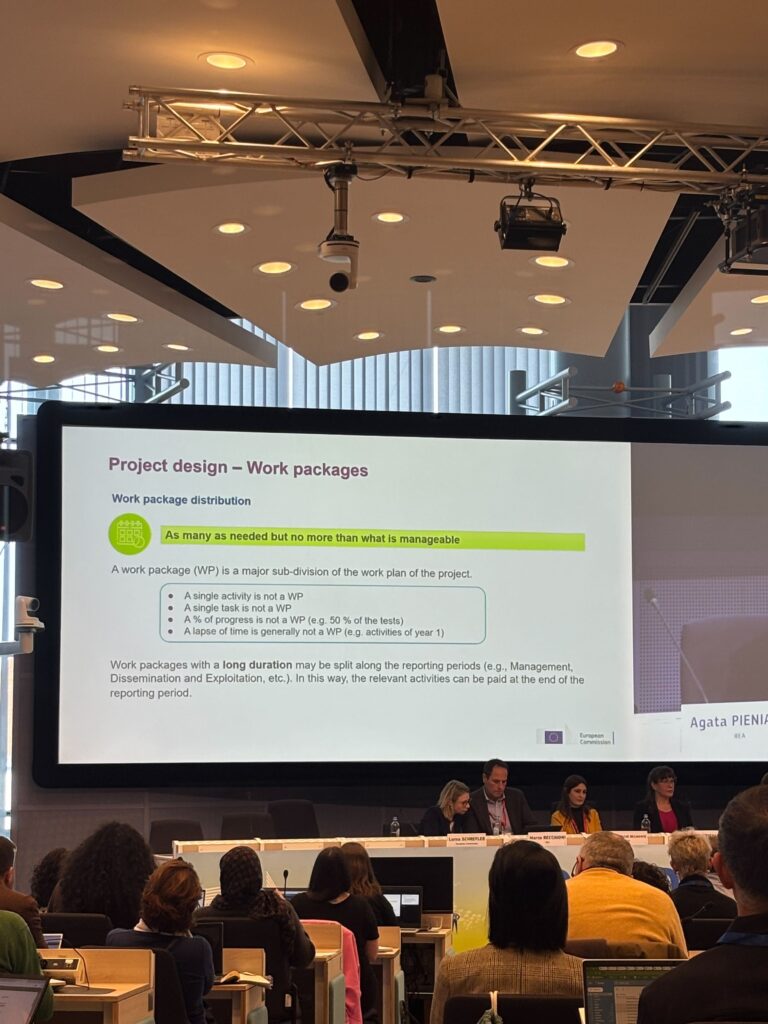
A recurring message from the Info Days is that work package design is the backbone of lump sum success.
The European Commission explicitly clarified that:
– A single activity is not a work package
– A single task is not a work package
– A percentage of progress is not a work package
– A time period is not a work package
A work package must represent a coherent, meaningful block of work that can be clearly assessed as “completed”.
Best practice guidance:
– Use as many work packages as needed, but no more than what is manageable
– Long work packages may be split along reporting periods
– Each work package must be verifiable, realistic, and outcome-oriented
4. Payments, Duration, and Risk Allocation
In lump sum grants:
– One lump sum share is fixed per work package
– Payments depend solely on completion of activities
– Outcomes may fail — but activities must be completed
This has major implications for risk management.
5. Detailed Budget Logic: What Applicants Must Provide
Although financial reporting is simplified after grant signature, applicants must still provide detailed cost estimations at proposal stage.
Cost estimations must:
– Be an approximation of actual costs
– Follow the same eligibility rules as actual-cost grants
– Be aligned with normal organisational practices
– Be necessary for the proposed activities
– Be reasonable and non-excessive
These estimations are used to generate:
– The distribution of lump sum shares per work package
– The allocation per beneficiary
6. Financial Support to Third Parties (FSTP): Use with Caution
Financial Support to Third Parties is not automatically allowed in Cluster 6.
The Commission explicitly warns:
– Do not include FSTP unless explicitly allowed by the topic
– FSTP rules must be detailed in a separate annex
– The annex must be uploaded independently
Including FSTP where it is not permitted can lead to ineligibility.
7. Key Resources for Applicants
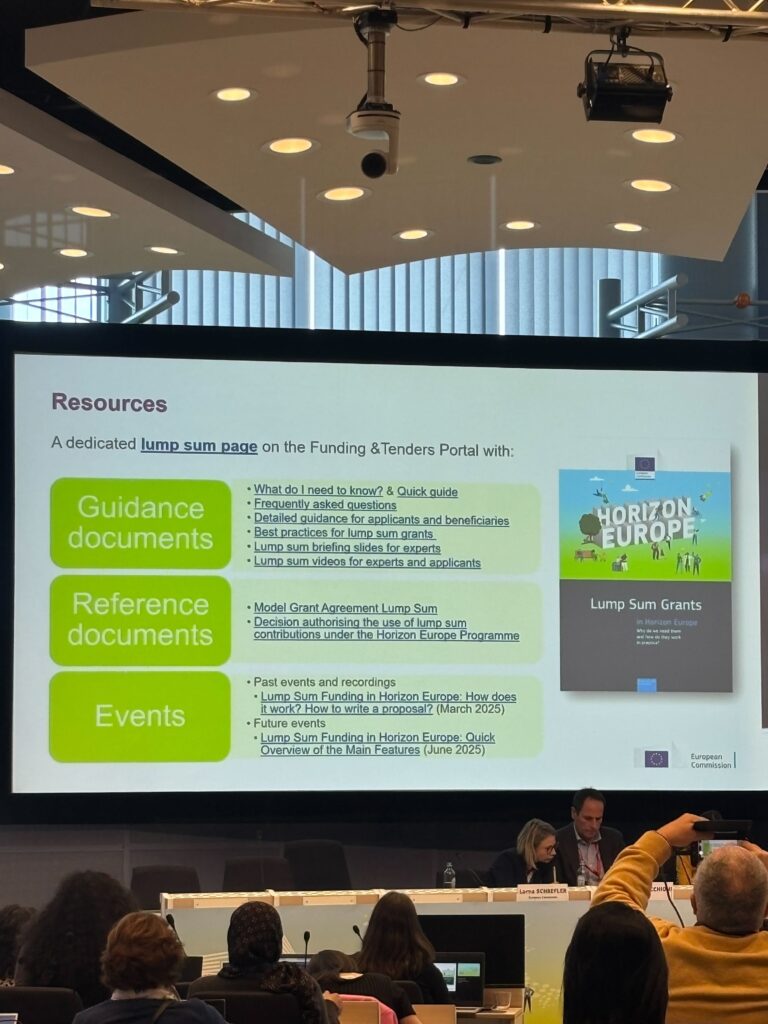
The European Commission provides a dedicated Lump Sum Funding section on the Funding & Tenders Portal, including:
– Guidance documents
– FAQs
– Model Grant Agreement
– Training materials
– Event recordings
8. Strategic Implications for Cluster 6 Applicants
Cluster 6 lump sum proposals require:
– Strong policy alignment
– Robust work package architecture
– Realistic cost logic
– Clear implementation pathways
– Professional consortium coordination
Template reuse rarely succeeds under this funding model.
How Nexuswelt Supports Cluster 6 Lump Sum Proposals
Nexuswelt supports organisations across the full proposal lifecycle, including:
– Cluster 6 call analysis
– Lump sum work package structuring
– Budget logic validation
– Dissemination, communication and exploitation strategy
– Consortium positioning
#HorizonEurope
#EUFunding
#LumpSum
#ProjectBudget
#GrantFunding
Horizon Europe
https://research-and-innovation.ec.europa.eu/funding/funding-opportunities/funding-programmes-and-open-calls/horizon-europe_en
EU Funding
https://research-and-innovation.ec.europa.eu/funding_en
Lump Sum Funding (Horizon Europe)
https://research-and-innovation.ec.europa.eu/strategy/strategy-2020-2024/european-research-area/lump-sum-funding_en
Project Budget and Eligible Costs
https://research-and-innovation.ec.europa.eu/funding/funding-opportunities/funding-programmes-and-open-calls/horizon-europe/guidance/eligible-costs_en
Horizon Europe Implementation Rules
https://research-and-innovation.ec.europa.eu/funding/funding-opportunities/funding-programmes-and-open-calls/horizon-europe/rules-implementation_en